
Jensen Huang: Biography, Age, Height, Career, Net Worth, Family & More

Jensen Huang (born Jen-Hsun Huang on February 17, 1963) is a Taiwanese-American electrical engineer and businessman who co-founded the chipmaker Nvidia in 1993 and led it as president and CEO for more than three decades. Under his leadership, a small company built around 3D graphics for PC games became the central supplier of the processors that power modern artificial intelligence. In October 2025, Nvidia became the first public company to reach a market value of $5 trillion.
His personal story is just as unusual as the company's. Huang was born in Taiwan, spent part of his early childhood in Thailand, and was sent to the United States at age nine, where an uncle enrolled him and his brother in a Kentucky boarding school that turned out to be a religious reform academy. He washed dishes and waited tables at Denny's as a teenager. Years later, he sketched out the idea for Nvidia in a booth at a Denny's diner in San Jose.
For a long time, the public image was one of a founder who stayed with his company for 30 years, wore a black leather jacket on stage, and collected honors from engineering bodies and governments alike. That picture changed sharply in November 2026. After reports of extramarital relationships, one involving a business executive whose alleged links to Chinese intelligence were denied by Beijing, Huang resigned as Nvidia's CEO and board member on November 12, 2026. Nvidia's board has since said it does not intend to reinstate him, and he has agreed to appear before the US Congress.
This article follows the whole arc: where he came from, how Nvidia was built, how his wealth is made up, what he has been honored for, and what is known, and not yet known, about the events of November 2026. Where reliable sources disagree, the disagreement is stated rather than hidden. Facts are current as of November 22, 2026.
Quick answer: Jensen Huang is the co-founder and former president and CEO of Nvidia. He is 63 years old, was born in Taiwan, holds degrees from Oregon State University and Stanford, and is estimated by Forbes to be worth about $142 billion as of November 2026. He resigned from Nvidia on November 12, 2026.
Quick Info: Jensen Huang Wiki Table
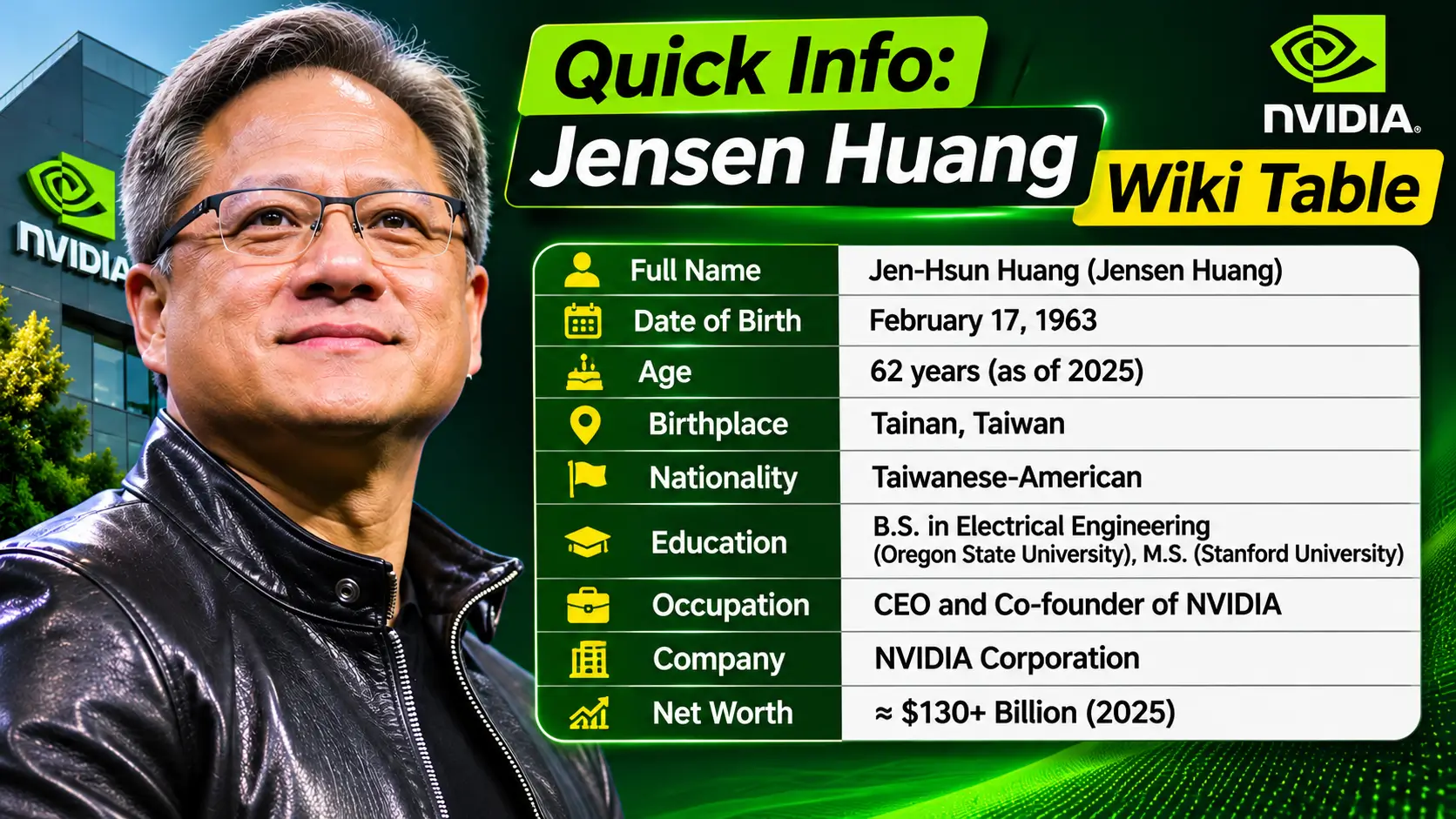
| Field | Information |
|---|---|
| Full Name | Jen-Hsun "Jensen" Huang (Chinese: 黃仁勳) |
| Nickname | Jensen |
| Profession | Electrical engineer, entrepreneur, technology executive |
| Famous For | Co-founding Nvidia and leading it from 1993 to 2026 |
| Date of Birth | February 17, 1963 |
| Age | 63 years (as of November 2026) |
| Birthplace | Taiwan. Sources differ: Britannica and older Wikipedia versions say Tainan; the current Wikipedia entry says Taipei |
| Nationality | Taiwanese-American (US citizen; Wikipedia lists Taiwan and the United States) |
| Religion | Not publicly disclosed |
| Zodiac Sign | Aquarius (by birth date) |
| Height | Not publicly disclosed |
| Weight | Not publicly disclosed |
| Eye Color | Dark brown (visible in photographs; not officially documented) |
| Hair Color | Black, now graying |
| Education | B.S. and M.S. in electrical engineering |
| School | Aloha High School, Oregon (graduated at 16) |
| College/University | Oregon State University (B.S., 1984); Stanford University (M.S., 1992) |
| Marital Status | Married |
| Boyfriend/Girlfriend/Partner | Not applicable |
| Spouse | Lori Mills Huang (married since the mid-1980s) |
| Children | Two: Madison Huang and Spencer Huang |
| Parents | Taiwanese immigrants; further details not publicly documented |
| Siblings | An older brother |
| Net Worth | Roughly $142 billion (Forbes, November 2026); estimates vary by source |
| Monthly Income | Not disclosed. Reported Nvidia pay for fiscal 2026 was around $36 million for the year, mostly equity |
| Hobbies | Family time (he has said little else fills his free time); played competitive tennis in his teens |
| Current Residence | California, USA (long-time homes in Los Altos Hills, plus San Francisco and Hawaii) |
| Languages Known | English; others not formally documented |
| Official Website | nvidia.com (corporate biography, now historical) |
| Social Media Profiles | No widely verified personal handles; public presence runs through Nvidia's corporate channels |
Early Life and Background
Birth and Family Roots
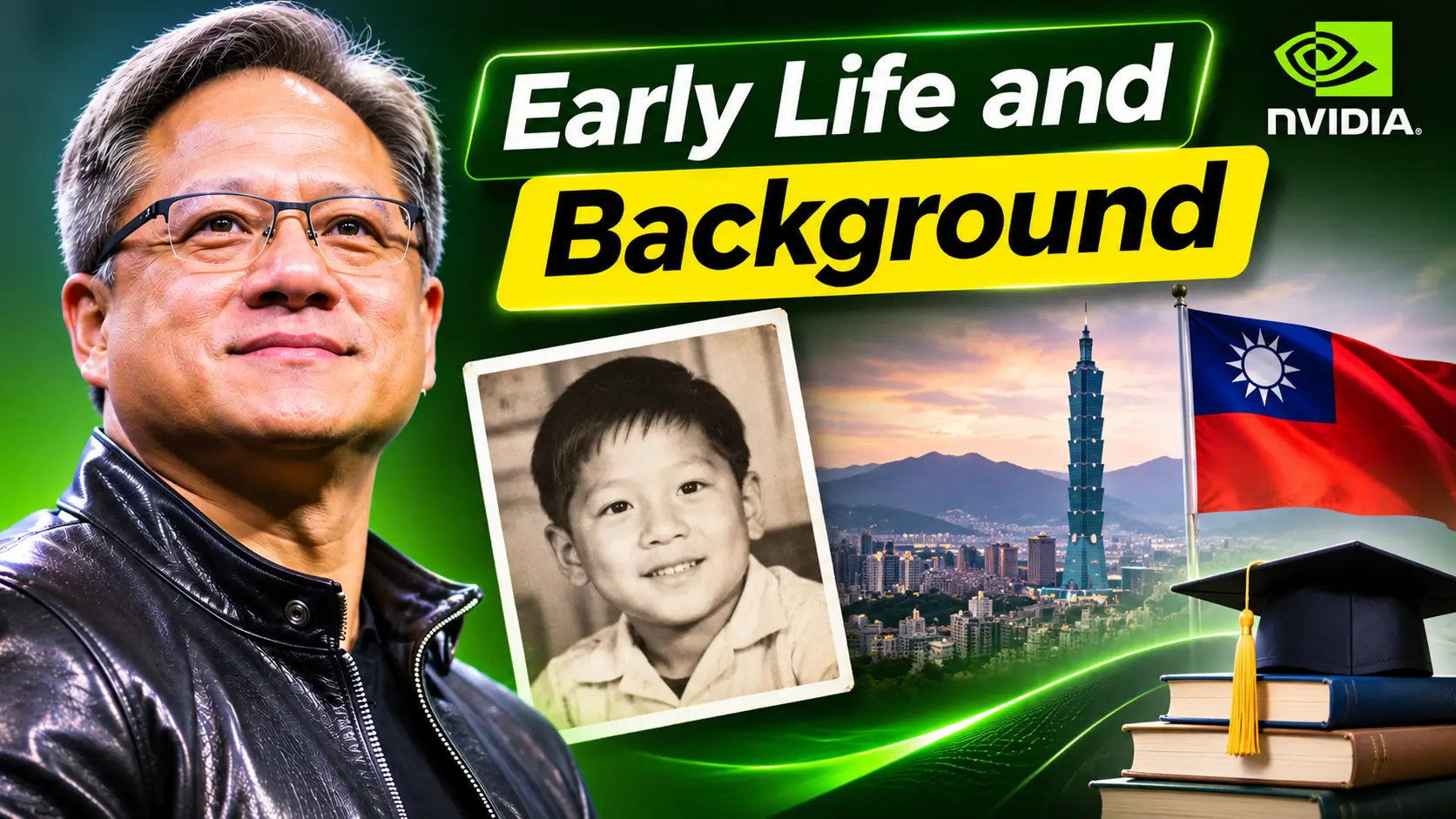
Jensen Huang was born on February 17, 1963, in Taiwan. The exact city is a small point of disagreement. Encyclopaedia Britannica and earlier versions of Wikipedia name Tainan; the current Wikipedia biography gives Taipei. Because no birth record is publicly available, this article treats the birthplace as "Taiwan" and notes both claims.
He grew up in what profiles describe as a middle-class Taiwanese family that moved often. His Taiwanese name is Huáng Rénxūn, and "Jen-Hsun" is the spelling used on legal and philanthropic documents, including the names of buildings that carry his family's name. His family is also connected, by blood, to another well-known figure in the chip industry. AMD chair and CEO Lisa Su is his relative: Huang's mother is the youngest sister of Su's maternal grandfather, which makes them first cousins once removed, according to Wikipedia.
Thailand and the Journey West
When he was five, the family moved to Thailand, where his father worked. Wikipedia notes that he attended Ruamrudee International School in Bangkok. Political unrest in the region and the belief that American schools offered better prospects led his parents to make a difficult decision. His father had seen the opportunities available in the US and believed it would be the best place for his sons to get an education.
At around age nine, Jensen and his older brother were sent ahead to live with an uncle in Tacoma, Washington. The sources give slightly different ages and years (some say nine, others ten, and one summary lists 1973 as the arrival year), which is common in biographies built on interviews rather than documents. A feature in Wikipedia mentions that, before he left, his mother taught her sons English by picking random dictionary words each day.
The Oneida Baptist Institute
The uncle in Tacoma enrolled the two boys in the Oneida Baptist Institute in rural Kentucky, believing it to be a prestigious boarding school. According to Britannica, the institute was actually a religious reform school for "difficult" children. His parents sold nearly all their possessions to pay the tuition, as Wikipedia reports.
Life there was harsh. Britannica says Huang was made to clean toilets every day while his older brother worked on a tobacco farm. Because the school was not yet a full school for children his age, he attended Oneida Elementary School separately, arriving as a small immigrant with long hair and strongly accented English. Fortune reported that the student body included boys who carried knives and smoked, and that he was the youngest on campus.
Huang has said he remembers Kentucky "more vividly than just about any other" part of his life, according to a 2002 interview cited on Wikipedia. He has repeatedly described the hardship as formative. The founder later credited "pain and suffering" as part of how he prepared himself and the company for difficulty. He also gave back: he and his wife donated $2 million to the Oneida Baptist Institute for a new girls' dormitory and classroom building, which opened in 2019 and bears the name Huang Hall.
Reunion in Oregon
About two years after he arrived in Kentucky, his parents joined the United States and settled in the Portland suburbs of Oregon (Beaverton, per Wikipedia). They discovered the nature of the Oneida school, and the brothers left to live with them. The family stabilized in Oregon, where Jensen attended Aloha High School in Aloha.
Childhood Personality
Biographers describe a young Huang as small for his age, a fast learner, and unusually driven. According to Fortune, he played competitive tennis in high school. The common thread in each profile is determination under unfamiliar circumstances. He has often tied his later habits, a high tolerance for stress and a belief that setbacks should be admitted early, to these years.
Education
Aloha High School
At Aloha High School, Huang excelled academically. He skipped two grades and graduated at the age of 16, according to Wikipedia and Fortune. He also worked from age 15, taking a graveyard shift at a local Denny's.
Oregon State University
He enrolled at Oregon State University (OSU) in Corvallis and earned a bachelor's degree in electrical engineering in 1984. His LinkedIn profile lists only two jobs: founder and CEO of Nvidia, and dishwasher, busboy and waiter at Denny's from 1978 to 1983, as the Associated Press noted.
OSU is also where he met his future wife. Lori Mills was his lab partner in an engineering class, and he has told the story on stage many times, including that he used homework as an excuse to spend time with her. The couple married five years after meeting.
Stanford University
After college, Huang started work in Silicon Valley and studied for a master's degree in electrical engineering at Stanford University while working full-time. He received the degree in 1992. At the time, he was also raising two young children. Stanford's engineering school later named a building after him: the Jen-Hsun Huang Engineering Center, supported by a $30 million gift from the Huang Foundation.
Honorary Degrees and Skills
He has received honorary doctorates from Taiwan's National Chiao Tung University and National Taiwan University, from Oregon State University, and from the Hong Kong University of Science and Technology, according to the Queen Elizabeth Prize biography, Wikipedia and public reports. In 2024, he was elected to the US National Academy of Engineering for high-powered graphics processing units that fueled the AI revolution.
Skills developed through these years include microprocessor design, chip architecture, and the management of complex hardware projects with limited resources. Perhaps just as important was something he did not study: how to pitch a technical bet to investors with limited proof.
Career Journey
Early Jobs: AMD and LSI Logic
After graduating, Huang worked as a microprocessor designer in Silicon Valley. He interviewed at Texas Instruments, AMD and LSI Logic, and chose AMD, partly because he was already familiar with it. He later moved to LSI Logic, where he became director of CoreWare, a division that built chips for hardware vendors. At LSI he worked with engineers from Sun Microsystems, which is how he met two people who would shape his life: Chris Malachowsky and Curtis Priem.
Founding Nvidia (1993)
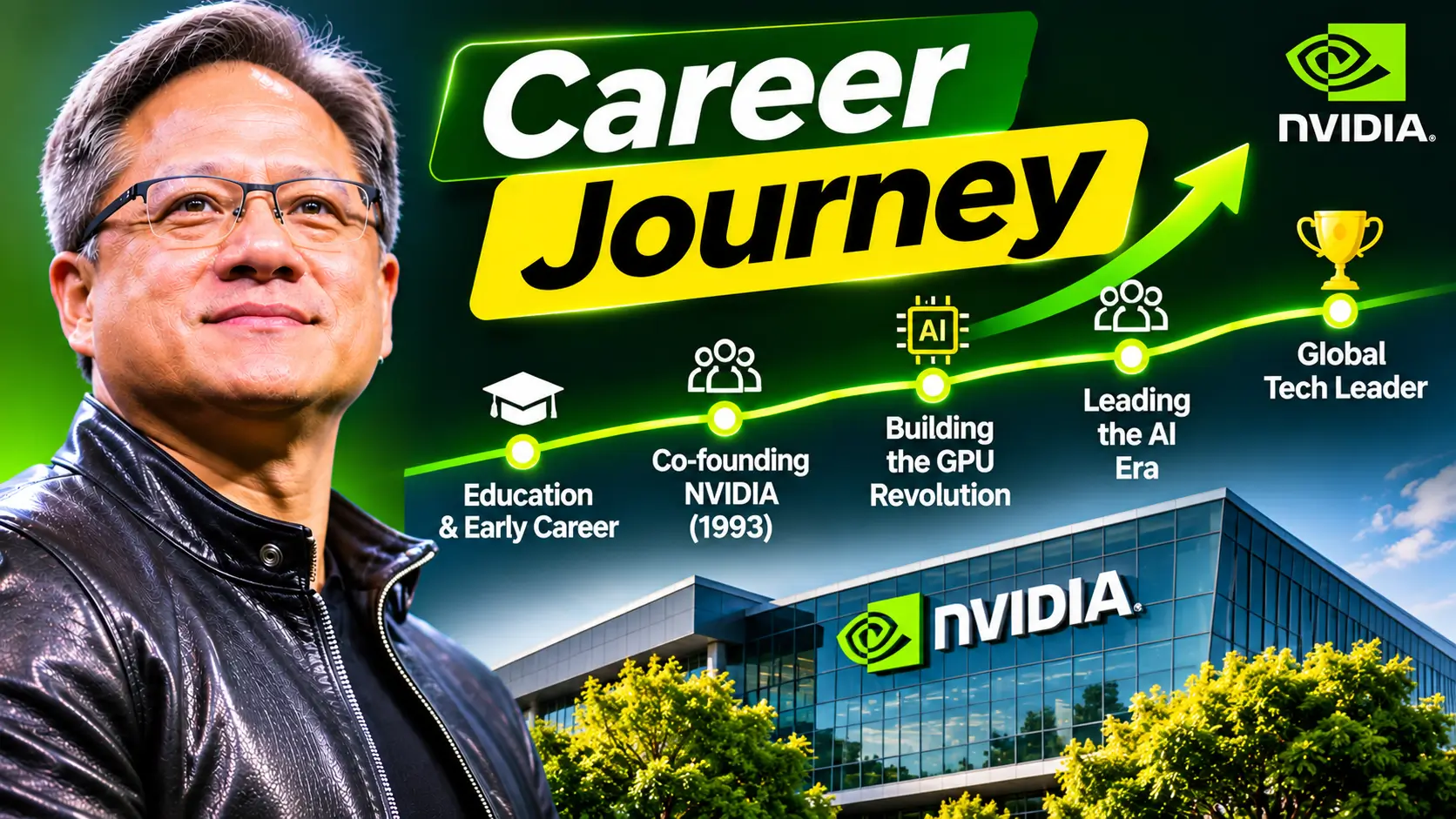
Nvidia was founded on April 5, 1993, by Huang, Malachowsky and Priem. The three had been meeting at a Denny's diner in East San Jose to hash out a bet: that personal computers would soon need dedicated chips for 3D graphics, and that video games would be the first mass market for them. Huang was 30 at the time. They pooled about $40,000 in seed money, according to German technology outlet PC Games, which describes the company as having started without a name.
The company name was chosen by Huang, according to Wikipedia: it comes from the Latin word invidia, meaning envy. Priem wanted competitors to turn "green with envy." LSI Logic's CEO, Wilfred Corrigan, introduced Huang to venture capitalist Don Valentine of Sequoia Capital, which helped fund the start-up, as Quartr and Wikipedia describe.
Struggles: The NV1 and Near-Failure
The early years were hard. Nvidia's first graphics chip, the NV1 (1995), got a lukewarm reception. A product failure at that point could have ended the company. Huang has described the period as one where the company had to become honest with itself. Automotive Hall of Fame commentary on his career notes the lesson he took from it: intellectual honesty had to be a pillar of the culture, mistakes had to be corrected early, and adversity helped develop a stronger corporate character.
Breakthrough: RIVA and the GeForce 256
The turning point was the RIVA 128, which sold one million units in its first four months in 1997. A year later came the RIVA TNT. In 1999, the year Nvidia went public, it released the GeForce 256, the product the company marketed as the world's first GPU, or graphics processing unit. That chip is also what put a new term into the computing vocabulary.
CUDA: The Bet That Changed Everything
The most consequential decision of Huang's career may be one that looked strange at the time. In November 2006, Nvidia released CUDA 1.0 alongside the GeForce 8800 GTX. CUDA let ordinary developers write general-purpose programs for the GPU in a language close to C. One account says Nvidia carved out chip area for scheduling and shared memory that graphics did not need, gave away the software development kit, and committed thousands of engineers to drivers and libraries. Another summary notes that between 2006 and 2017 Nvidia invested nearly $12 billion in research and development, with a large portion going to CUDA.
For years, investors questioned whether the investment would pay off. Then, in the early 2010s, researchers discovered that GPUs were ideal for training neural networks. The famous image-recognition model that helped launch the deep-learning boom was trained using hand-written CUDA code. Nvidia, which had built the platform years earlier, was already in position.
The AI Era
From 2012 onward, Nvidia positioned itself as a computing company rather than just a graphics company. Data-center products came to dominate the business. In the second quarter of fiscal 2026, Nvidia's data center business generated over $41 billion in revenue against $4.3 billion for gaming, as HotHardware reported. Key milestones in market value:
| Date | Milestone |
|---|---|
| June 2023 | Market value passes $1 trillion |
| February 2024 | Record one-day gain of about $277 billion after earnings, then passes $2 trillion |
| March 1, 2024 | Third US company to pass $2 trillion |
| June 2024 | Briefly the most valuable company in the S&P 500 |
| January 2025 | Single-day loss of about $589 billion, nearly 17%, the largest in market history |
| July 9, 2025 | First company worth $4 trillion |
| October 29, 2025 | First company worth $5 trillion |
| May 2026 | Market value tops $5.5 trillion |
At Nvidia's GTC conference in Washington in October 2025, Huang said the company had secured more than $500 billion in orders for its AI chips through the end of 2026. At GTC in March 2026, he said he expected $1 trillion in business for the Blackwell and Rubin chip families by the end of 2027.
Strategy and Management Style
Huang ran Nvidia for 33 years without a change at the top, one of the longest CEO tenures among large US companies. He is known for short emails, flat management, and long keynote presentations. Fortune noted his 2.5-hour keynote at GTC 2026 and the attention it held. His stated philosophy is to be "a market maker, market creator" rather than a market taker.
Policy and China
Huang was often a high-profile voice on US-China chip policy. In 2025, he criticized US export controls on the H20, a chip Nvidia designed for China, calling the policy "a failure." Nvidia took a $5.5 billion charge related to the H20 in the spring of 2025. He said Nvidia's share of the Chinese market fell from about 95% to 50% after the Biden administration's restrictions, and later said it had fallen to zero. Reporting in 2026 described him as a last-minute addition to the business delegation accompanying President Trump to Beijing in May for a summit with Xi Jinping.
He also stated that Nvidia would pay a potential $147 million bill for a proposed $100,000 fee for certain visas, saying "legal immigration remains essential," as reported by Fortune.
Business Ventures and Collaborations
Apart from running Nvidia, Huang's wealth and influence are tied to that single company. He is not known for a separate portfolio of private businesses, and no verified list of personal ventures exists. Nvidia itself worked with many partners, including TSMC (which manufactures Nvidia's most advanced chips), General Motors, Foxconn and the US government on supercomputers. In October 2025, the company said it was building seven new supercomputers for the US.
Leadership Transition (November 2026)
On November 12, 2026, Nvidia announced that Huang had resigned as president, CEO and member of the board, effective immediately. Chief Financial Officer Colette Kress was named interim CEO. The circumstances are covered in the Controversies section.
Social Media Presence
Unlike many celebrity CEOs, Jensen Huang does not have a widely verified personal social media footprint with documented follower counts. His public image has been built mainly through live keynotes (GTC, Computex, CES), interviews, podcasts and Nvidia's own channels, which publish his talks and often go viral.
Reported appearances include the How I Built This podcast with Guy Raz in May 2026 and a conversation with Joe Rogan reported by Fortune in December 2025. A jacket signed by Huang sold for $960,000 at a charity auction, according to Open magazine.
| Platform | Username | Followers |
|---|---|---|
| No verified personal account documented | Not applicable | |
| YouTube | Appears through Nvidia's official channel | Not applicable (corporate) |
| TikTok | No verified personal account documented | Not applicable |
| No verified personal page documented | Not applicable | |
| X (Twitter) | No verified personal account documented | Not applicable |
| Profile reported to list only Nvidia and Denny's | Not publicly confirmed |
Social Influence and Brand Collaborations
Huang has not been a traditional brand ambassador. His influence is institutional: when he speaks, markets and governments listen. Brand-style collaborations have been business partnerships, not endorsements, such as Nvidia's work with automakers and cloud companies. Chinese social media drew heavy engagement around him in 2026; CNN reported that his downfall dominated discussion on Chinese platforms for a week, with many users voicing sympathy for him.
Physical Appearance and Public Style
Height and Weight
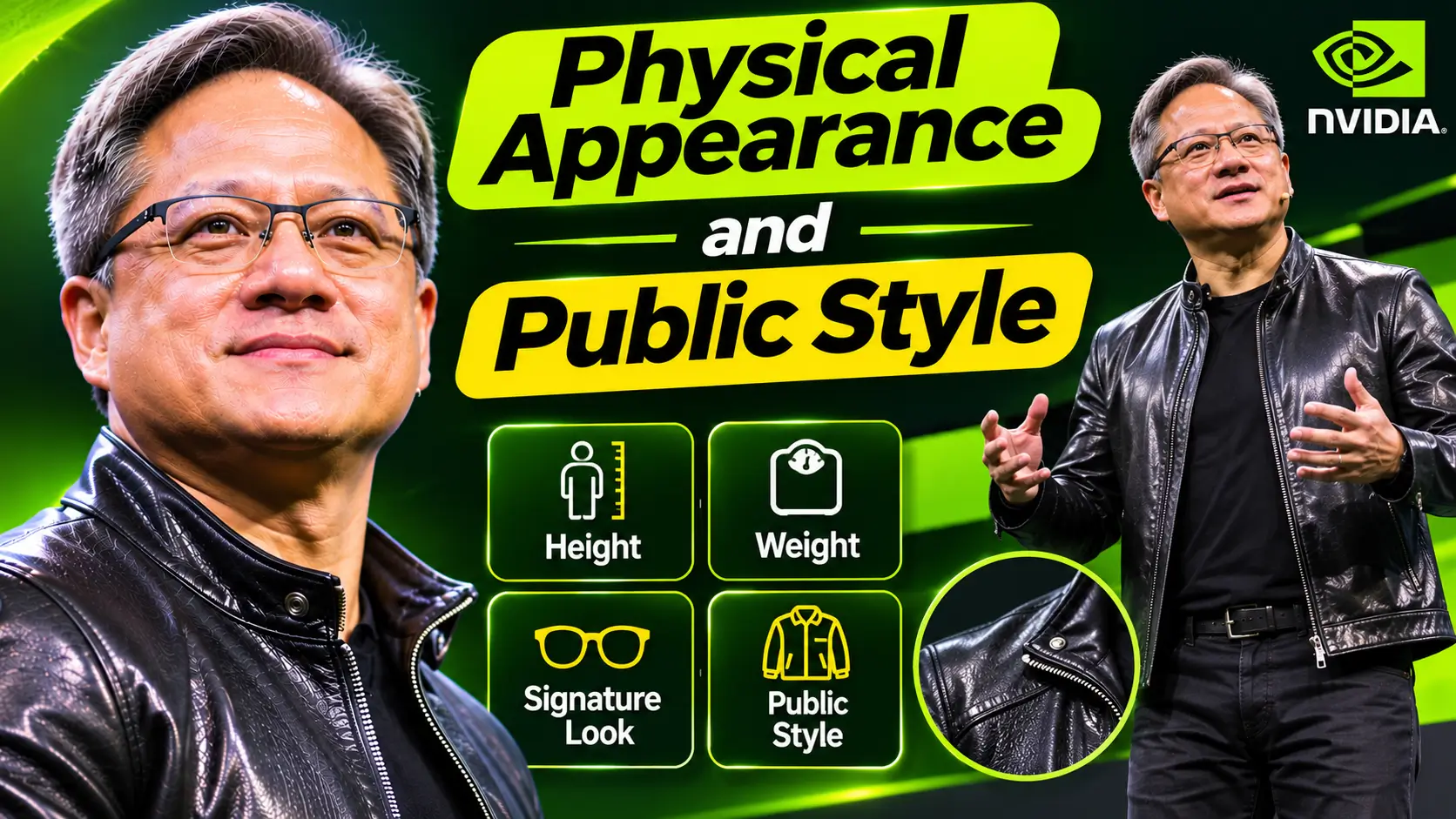
Neither Huang nor Nvidia has published his height or weight, and no reliable source gives verified figures. Several fan sites list estimates, but because they cannot be checked against a primary source, this article does not repeat them.
Fashion: The Leather Jacket
His signature look is a black leather jacket, worn at product launches and developer conferences. He has said that his family shapes the style. In an interview he joked that he was "happy" that his wife and daughter dress him, a line widely quoted. The jacket became a kind of corporate logo, and a signed one later sold at a charity auction.
Fitness and Personality Style
He has been described as energetic on stage and informal in conversation, known for long, detailed keynotes. Fortune noted that tattoos and leather jackets are welcome at Nvidia's offices. No verified information about personal tattoos is documented in the sources reviewed, so none is listed here.
Public Image
Before November 2026, the public image was of a hardworking, approachable founder, an immigrant success story, and the face of AI. After November 2026, press coverage added a scandal narrative. See Public Image and Legacy.
Net Worth
Estimated Net Worth
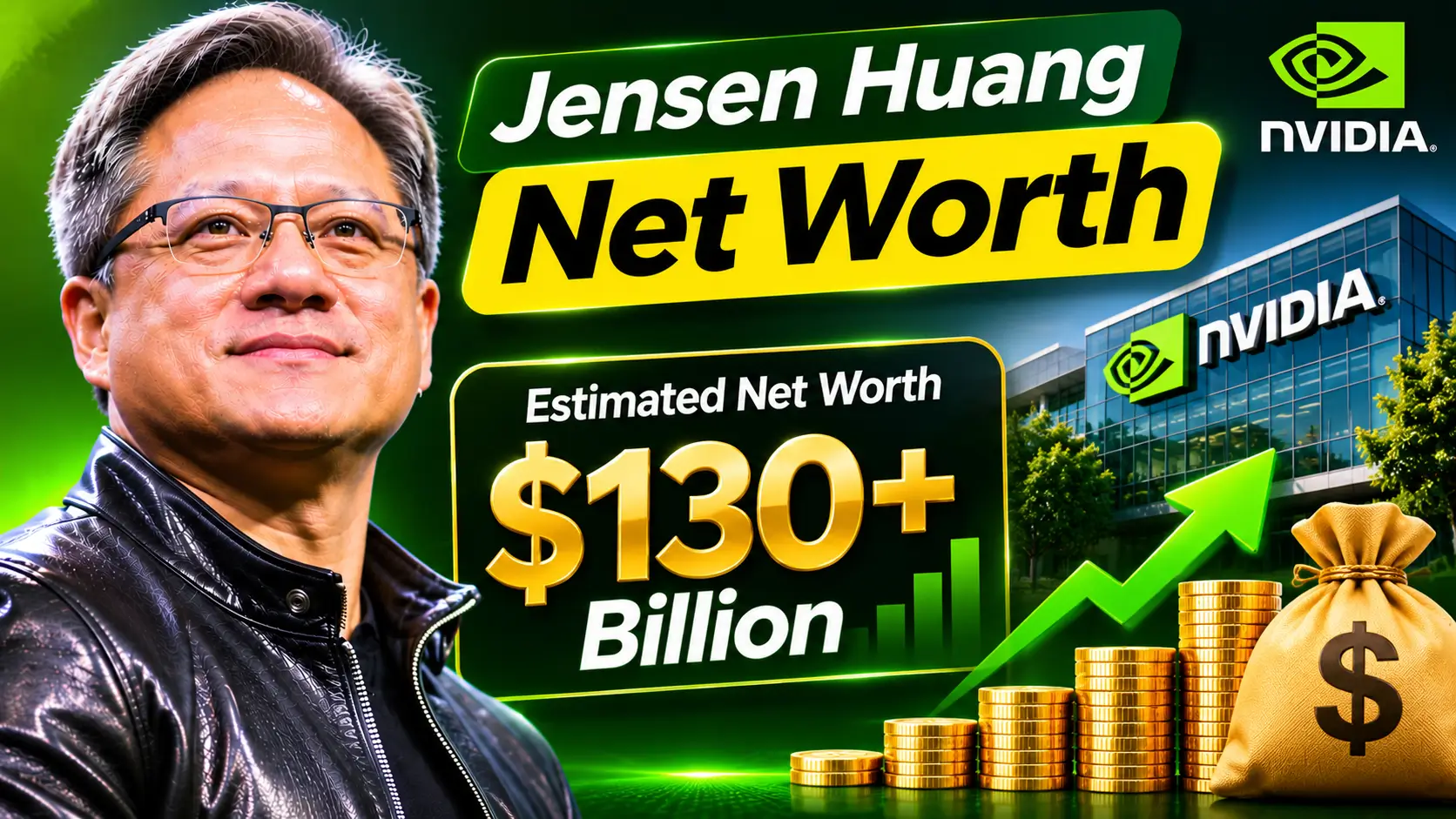
Huang's wealth is overwhelmingly one asset: Nvidia stock, held in part through family trusts. Estimates vary because publications count shares differently and because Nvidia's stock moves daily.
| Source | Date | Estimate |
|---|---|---|
| Forbes (per Wikipedia) | November 2026 | About $141.9 billion (13th richest) |
| Forbes Real-Time | October 21, 2026 close | About $192.3 billion (No. 7) |
| Bloomberg Billionaires Index | October 2026 | About $172 billion (No. 8) |
| Forbes | May 14, 2026 | First above $200 billion |
| Forbes list | 2026 | $154 billion |
| Forbes list | 2025 | $98.7 billion |
| Forbes list | 2024 | $77 billion |
| Forbes list | 2023 | $21.1 billion |
The jump between October and November 2026 reflects the fall in Nvidia's share price after the resignation. According to Inc., the stock was down 10.5% from the announcement of his resignation as of November 17. One tracker estimated each $10 move in Nvidia's stock changes his net worth by about $8.1 billion, based on about 811.5 million shares reported in a Form 4 filing on September 18, 2026. Differences between sources come mostly from how many shares are counted. Bloomberg uses about 3.3%; others use roughly 3.5%.
Because these numbers change with the market, treat any single figure as a snapshot.
Income Sources
- Nvidia equity: the dominant source, about 99% of his wealth by one tracker's estimate
- Salary and awards: his pay was reported around $36 million for fiscal 2026, weighted toward long-term equity
- Stock sales under pre-arranged plans: in 2025, he sold over $1 billion of Nvidia stock under a second plan
- Prize money: the 2026 IEEE Medal of Honor carries a $2 million prize
Endorsements and Businesses
There is no verified record of personal brand endorsements contributing meaningfully to his wealth. His business life is Nvidia.
Investments
His investments beyond Nvidia are not publicly detailed. The Huang family foundation holds a very large block of Nvidia shares (see below).
Real Estate
| Property | Details |
|---|---|
| Los Altos Hills, California | Newly built home of more than 7,000 sq ft, six bedrooms, bought for $6.9 million in 2003 and still owned |
| Wailea, Hawaii | About 8,000 sq ft, seven bedrooms, purchased in 2004 for $7.5 million |
| San Francisco | A home reported in the family's portfolio |
| Early homes in San Jose | A 1,500 sq ft starter home sold for $185,000 in 1988; a larger one bought the same year for $338,000 and sold in 2002 for $500,000 |
Reports estimate that he has spent around $55 million on real estate since the late 1980s.
Cars Collection
No verified car collection has been documented by reliable sources, and this article does not list one.
Luxury Lifestyle
By his own account, he lives modestly relative to his wealth, saying nothing gives him more joy than to spend time with family. The most public signs of his wealth are philanthropic.
Philanthropy
The Jen-Hsun and Lori Huang Foundation was seeded in 2007 with 370,000 Nvidia shares, then worth about $12.6 million. By 2025 it held about 68.5 million Nvidia shares, making it one of the larger private foundations in the US, according to Celebrity Net Worth. Notable gifts:
- $30 million to Stanford for the Jen-Hsun Huang Engineering Center
- $5 million for a cancer research lab at Oregon State
- $50 million to Oregon State toward the Jen-Hsun Huang and Lori Mills Huang Collaborative Innovation Complex, a $213 million research and education center, opened in 2026; Oregon State said after the resignation that no changes were planned for the building
- $2 million to Oneida Baptist Institute for a girls' dormitory and classroom
- $75 million to Vanderbilt University for a college of art, architecture and design, set to open in 2027, according to Hello magazine
Net Worth Breakdown Table
| Category | Estimated Share or Value | Notes |
|---|---|---|
| Nvidia stock (direct and via trusts) | Roughly 3.3% to 3.6% of the company | By far the largest asset |
| Cash and other holdings | Not disclosed | Includes proceeds from planned stock sales |
| Real estate | Tens of millions of dollars | Los Altos Hills, Hawaii, San Francisco |
| Foundation holdings | About 68.5 million Nvidia shares (2025) | Charitable, separate from personal net worth |
| Annual compensation | About $36 million (fiscal 2026) | Mostly equity |
Family and Relationships

Parents and Siblings
Huang's parents were Taiwanese immigrants who sold nearly everything to keep their sons in school in the US. His mother, as noted, taught English at home. His father worked abroad in Thailand. Public information about their names and later lives is limited. He has an older brother, who lived with him at the Oneida Baptist Institute.
Marriage to Lori Mills Huang
Jensen met Lori Mills at Oregon State University in the early 1980s, when both were electrical engineering students. They were lab partners. They married about five years after meeting and have been together for more than four decades. Lori serves as president of the family foundation and has stayed largely out of the spotlight. In his How I Built This conversation in May 2026, he said Lori never complained about the time he spent building Nvidia, calling it a gift.
Children
The couple has two adult children, Madison and Spencer Huang, who both work at Nvidia.
| Child | Role at Nvidia | Background |
|---|---|---|
| Madison Huang | Senior leadership role in marketing and strategy (described as director of marketing in earlier reports) | Joined in 2020 as an intern; earlier worked at LVMH; MBA from London Business School; began in food |
| Spencer Huang | Director of product management in robotics | Joined in 2022 as a product manager on the Isaac Sim Cloud team; MBA from NYU; closed his bar in 2021 |
Reported total compensation for fiscal 2026 (ended January 25, 2026) was around $1.23 million for Madison and $1.32 million for Spencer, according to OfficeChai. Both began as interns, not as inherited executives.
Relationship History and Rumors
Before November 2026, no public relationship rumors involving Huang were documented in reliable sources. The reports of that month are covered in Controversies.
Close Friends and Mentors
Mentors named in public profiles include TSMC founder Morris Chang and former Stanford president John Hennessy, both winners of the same industry award that Huang received. His long partnership with co-founders Chris Malachowsky and Curtis Priem is central to the company's story. Priem sold all his shares by 2006, while Malachowsky stayed at Nvidia.
Controversies
This section reports what major news organizations have published, uses careful language about allegations, and notes denials. Much of this is still developing and may change.
Export Controls and China Policy
Throughout 2025, Huang opposed US limits on AI chip sales to China, arguing that they had not slowed Chinese AI work and had cost American firms. Critics argued the opposite. In a letter, a group of Democratic senators wrote that controls on the H20 "appear to have been working until" his lobbying secured a reversal, according to Tom's Hardware. Supporters of Huang said that keeping the American technology stack as a global standard served US interests. This debate was ongoing before any personal scandal.
The November 2026 Reports and Resignation
The sequence below follows TechCrunch's timeline and other news reports.
| Date (2026) | Event |
|---|---|
| Nov 5 | Three Republican House committee chairmen asked Huang for a closed-door briefing |
| Nov 8 | Huang sent a message to employees admitting he had been unfaithful to his wife; Nvidia's board began an investigation |
| Nov 9 | He withdrew from speaking engagements |
| Nov 11 | The New York Times reported a second relationship, with an Nvidia executive who reported to him; Nvidia's stock fell as the board reportedly prepared to remove him |
| Nov 12 | Huang resigned as president, CEO and director; CFO Colette Kress became interim CEO; Reuters reported a further relationship |
| Nov 12 | Democrats launched an investigation; Huang agreed to testify to Congress |
| Nov 17 | Nvidia reported record quarterly revenue of $115.8 billion; the board said it does not intend to reinstate him |
| Nov 18 | Senate Banking Chair Tim Scott said Huang had agreed to appear |
| Nov 20 | Scott's office said the Senate appearance would be public; no date announced |
In his November 8 memo, Huang wrote that he owed his family and colleagues an apology, saying there was no excuse for what he did. He did not name any person. He linked the matter to national-security concerns raised in news reports.
The Alice Huang Question
The widely reported relationship was with Alice Huang, an executive at Megaspeed, a Singapore-based company that bought advanced Nvidia chips. She is not related to him. Megaspeed has been investigated over whether it helped Chinese companies access Nvidia chips. Her exact role and any relationship with Chinese intelligence were described by NBC as unclear. Al Jazeera reported that the matter triggered investigations by the FBI and Congress, and a shareholder class action was filed against Nvidia. Wikipedia's summary states that US officials initially suspected she might be a Chinese spy, but later reporting said there was no conclusive proof.
China's Foreign Ministry called the allegations "groundless speculation" and an attempt to smear China. President Trump said it was not clear whether she was a spy, and also said he had spoken to Huang before the resignation. Nvidia's board hired a law firm to investigate; the board chair told investors that the resignation had been accepted unanimously.
Public Reaction
Reaction split. Some commentators saw a serious security lapse for the head of a company central to US-China technology competition. Others, including Chinese state-linked media, described the investigation as political. Many users on Chinese social media expressed sympathy. Investors worried about leadership: an analyst told the Associated Press that "Jensen's not replaceable." Nvidia's stock fell about 10% on the announcement, and Nvidia's market value dropped below $4 trillion.
Resolutions So Far
None are final. As of November 22, 2026: Huang has resigned, the board has said it does not intend to reinstate him, he has publicly said he would be honored to return if asked, and congressional appearances are pending. Allegations about espionage have not been established.
Achievements and Awards
Honors Timeline
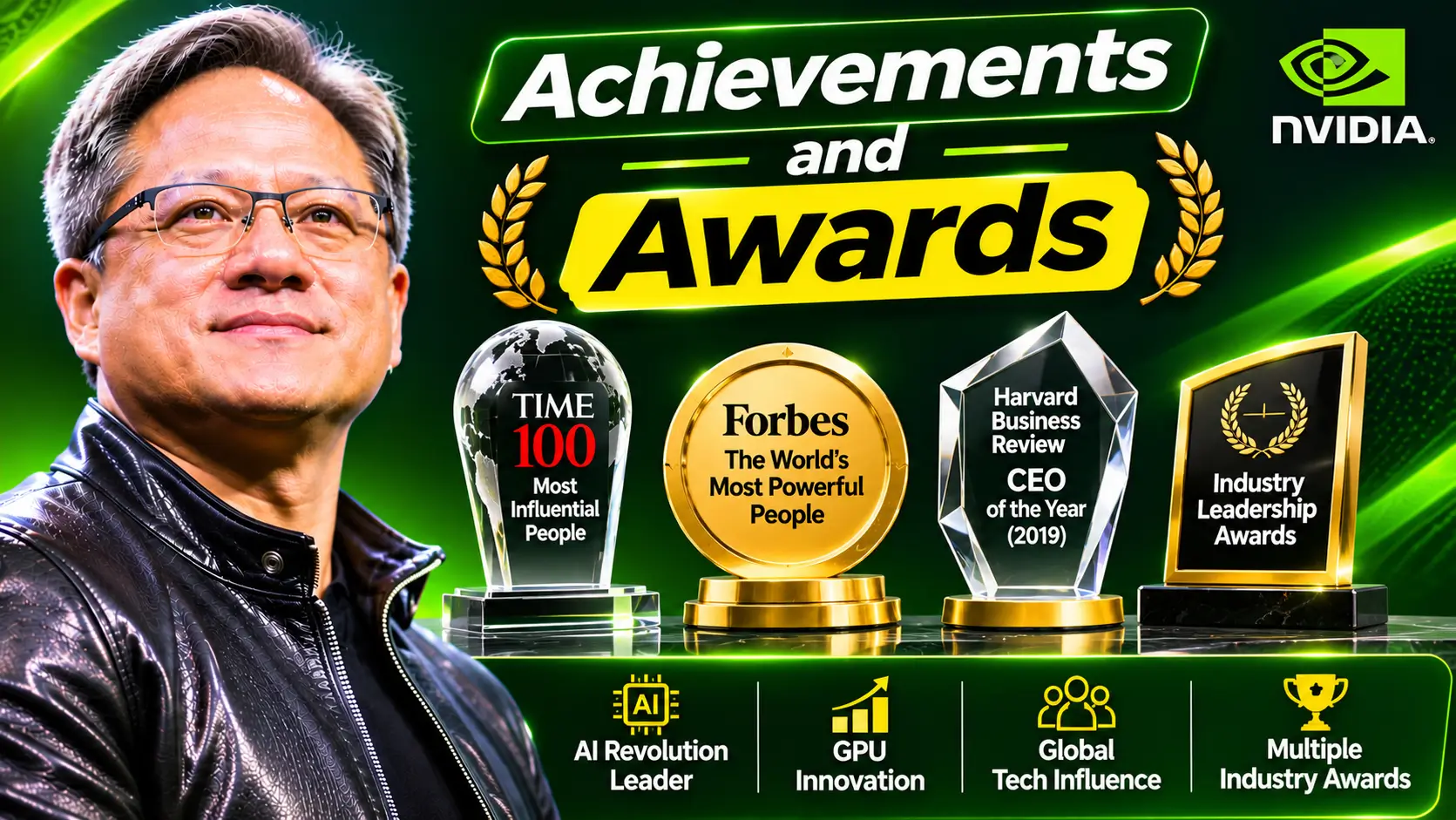
| Year | Award or Honor | Notes |
|---|---|---|
| 1999 | Ernst & Young Entrepreneur of the Year (High Technology) | Early recognition |
| 2005 | Oregon State University Alumni Fellow | |
| 2007 | Pioneer Business Leader Award, Silicon Valley Education Foundation | For corporate and philanthropic work |
| 2020 | IEEE Founders Medal | |
| 2020 | Honorary doctorate, National Taiwan University | Reported at school's anniversary |
| 2021 | Robert N. Noyce Award, Semiconductor Industry Association | Industry's highest honor; 31st recipient |
| 2021 | TIME 100 Most Influential People | Also listed in 2024 |
| 2024 | Elected to the US National Academy of Engineering | |
| 2024 | VinFuture Prize, Edison Award, Primetime Engineering Award | |
| 2025 | Queen Elizabeth Prize for Engineering | Shared with six others for modern machine learning |
| 2025 | Professor Stephen Hawking Fellowship | Cambridge Union Society |
| 2025 | Financial Times and TIME Person of the Year recognitions | As described by IEEE |
| 2026 | IEEE Medal of Honor | Includes $2 million prize |
| 2026 | National Medal of Science | Presented by President Trump on October 8, 2026 |
Also on the list: the Dr. Morris Chang Exemplary Leadership Award.
Records and Milestones
- First public company to reach $5 trillion in market value (Oct 29, 2025)
- Led Nvidia through the largest single-day gain and the largest single-day loss in stock market history
- Served as CEO for 33 years, from 1993 to 2026
The 2025 Queen Elizabeth Prize was shared by Bill Dally, Fei-Fei Li, Geoffrey Hinton, John Hopfield, Jensen Huang, Yann LeCun and Yoshua Bengio. The 2026 National Medal of Science was also awarded to Elon Musk, Sergey Brin and Lisa Su, per TweakTown.
Interesting Facts About Jensen Huang
- Denny's twice. He worked at Denny's as a dishwasher, busboy and waiter from 1978 to 1983, then returned to a Denny's booth to plan Nvidia. The chain later unveiled a plaque marking the founding.
- Nine years old, cleaning toilets. Fortune described him as the youngest student at his Kentucky school and said he was assigned to clean the toilets.
- Graduated at 16. He skipped two grades.
- He picked the name "Nvidia." It comes from the Latin word for envy.
- A family tie to AMD's chief. Lisa Su is his first cousin once removed.
- The jacket story. He credited his wife and daughter for his look.
- Three-founders story. Priem sold all of his shares by 2006; one estimate says those shares would be worth hundreds of billions today.
- Kids started as interns. Neither child was given an executive title at the start.
- He has said a $10 trillion valuation for Nvidia is "absolutely possible," according to a headline on AOL.
- Dinner on him. Fortune reported that he bought dinner for everyone when three billionaires showed up at a fried-chicken restaurant.
- Favorite diner order. A Denny's menu item based on buttermilk silver dollar pancakes was reportedly one of his favorites.
Timeline
| Year | Event |
|---|---|
| 1963 | Born in Taiwan on February 17 |
| 1968 | Family moves to Thailand |
| c. 1973 | Sent to the US with his brother; lives with an uncle in Tacoma, then attends Oneida Baptist Institute in Kentucky |
| c. 1975 | Parents arrive in the US; family settles near Portland, Oregon |
| 1978 to 1983 | Works at Denny's |
| 1979 | Graduates Aloha High School at age 16 |
| 1984 | B.S. in electrical engineering, Oregon State University |
| 1985 | Marries Lori Mills (mid-1980s per sources) |
| 1980s | Works at AMD, then LSI Logic |
| 1992 | M.S. in electrical engineering, Stanford |
| 1993 | Co-founds Nvidia on April 5 |
| 1995 | NV1 released |
| 1997 | RIVA 128 sells one million units in four months |
| 1999 | Nvidia goes public; GeForce 256 launches |
| 2006 | CUDA released |
| 2007 | Huang Foundation seeded with Nvidia shares |
| 2012 | GPUs power the deep-learning breakthrough |
| 2021 | Receives SIA Robert N. Noyce Award; TIME 100 |
| 2022 | $50 million gift to Oregon State |
| 2023 | Nvidia passes $1 trillion |
| 2024 | Nvidia passes $2 trillion; elected to the National Academy of Engineering |
| 2025 | Nvidia hits $4 trillion (July) and $5 trillion (October); Queen Elizabeth Prize |
| 2026 | IEEE Medal of Honor (January); Trump's Beijing trip (May); National Medal of Science (October) |
| Nov 12, 2026 | Resigns as Nvidia CEO and director |
| Nov 17, 2026 | Board says it does not intend to reinstate him |
Popular Quotes
Short, widely reported lines attributed to Huang:
- "We believed in ourselves." (on the early years of Nvidia, per the Carnegie Corporation)
- "I'm happy that my wife and my daughter dress me." (on the leather jacket)
- "The U.S. should maximise the speed of AI diffusion." (reported by Bloomberg, 2025)
- "There is no excuse for what I did." (from his November 8, 2026 message to employees)
He has also described the early "pain and suffering" of building Nvidia as essential to its later strength.
Major Projects and Nvidia Milestones
Because Huang is a business founder, his "works" are Nvidia's major platforms and products, which he led.
| Year | Product or Project | Why It Mattered |
|---|---|---|
| 1995 | NV1 | First graphics chip; weak sales |
| 1997 | RIVA 128 | First big hit |
| 1998 | RIVA TNT | Strengthened reputation |
| 1999 | GeForce 256 | Introduced the "GPU" term |
| 2006 | CUDA | Opened GPUs to general computing |
| 2010s | DGX systems and data-center GPUs | Became the AI training standard |
| 2022 | Hopper (H100) | Powered the generative AI boom |
| 2024 | Blackwell | Next-generation AI architecture |
| 2025 | Isaac GR00T N1 | Robotics initiative |
| 2026 | Rubin | Next family after Blackwell; first quarter of sales nearly $20 billion |
| Ongoing | Omniverse | Industrial simulation and "digital twin" platform |
GTC, Nvidia's developer conference, was Huang's yearly stage, with keynotes from San Jose to Washington to Paris.
Public Image and Legacy
Influence on Society
Huang's greatest impact was making accelerated computing practical. The deep-learning revolution, the large language models and the AI industry that followed all relied heavily on hardware and software that Nvidia built. Researchers such as Andrew Ng have credited his leadership with enabling a decade of AI progress, as noted in Nvidia's blog account of the Noyce Award.
Fan Following and Internet Popularity
He is one of the few executives to attract a following that looks like a fan base. Fortune wrote in March 2026 that everyone wanted to be his friend, and his keynotes were followed like events.
Media Perception
Coverage in 2024 and 2025 was celebratory: "dishwasher to $4.46 trillion" headlines and titles such as "Great Immigrant." Coverage in November 2026 focused on the scandal, with headlines like "the rise and fall." The ultimate verdict on his legacy remains open and depends on what investigations conclude.
Cultural and Economic Impact
Nvidia's market value rivaled the stock markets of entire countries; TechCrunch noted in 2025 that at $5 trillion it was worth more than the combined stock markets of every country but the US, China and Japan. Huang's life also became a story about immigration, with Carnegie Corporation naming him a Great Immigrant in 2024.
Legacy Questions
Two things can be true at once: his technical and business legacy is already established, and his reputation is under a cloud of the kind that earlier founders have also faced. The Nvidia he built is likely to operate for decades, led by successors. How he is remembered will be shaped by the Congress hearings and any further findings.
Latest News and Current Status
As of November 22, 2026:
- Status: Former president, CEO and director of Nvidia. The company says he has no formal role going forward. The board said on November 17 that it does not intend to reinstate him. Huang said he would be honored to return if asked.
- Nvidia leadership: CFO Colette Kress is interim CEO. Chair Harvey Jones has spoken for the board.
- Business: Nvidia reported record revenue of $115.8 billion for the quarter ended in October (fiscal Q3 2027), beating expectations by 5.6%. Its supplier purchase commitments rose to $390 billion, up from $279 billion three months earlier. Shares closed at about $155 on November 17, and the company's market value was reported at about $3.9 trillion.
- Congress: Three House committees asked him to attend a closed-door interview on December 1. Senate Banking Chair Tim Scott said Huang agreed to testify publicly; no date has been announced, and Scott hopes it happens before Christmas.
- Legal: Reports mention an FBI inquiry and a shareholder class action against Nvidia. Details are still emerging.
- Philanthropy: Oregon State University said no changes are planned for the Huang Collaborative Innovation Complex.
- Personal: His wife and children have not made detailed public statements in the sources reviewed.
Because this story is developing quickly, check primary sources for updates.
Frequently Asked Questions (FAQs)
1. Who is Jensen Huang?
Jensen Huang is the co-founder and former president and CEO of Nvidia, the chipmaker whose GPUs power much of the world's artificial intelligence.
2. How old is Jensen Huang?
He was born on February 17, 1963, so he is 63 as of November 2026.
3. What is Jensen Huang's net worth?
Forbes estimated it at roughly $142 billion in November 2026, down from more than $190 billion a month earlier. Figures differ by source and move with Nvidia's stock.
4. Is Jensen Huang married?
Yes. He has been married to Lori Mills Huang since the mid-1980s. They met as engineering students at Oregon State University.
5. What is Jensen Huang famous for?
For co-founding Nvidia in 1993 and leading it to become the first $5 trillion public company.
6. Where was Jensen Huang born?
In Taiwan. Britannica and older Wikipedia versions say Tainan; the current Wikipedia entry says Taipei.
7. What is Jensen Huang's height?
It is not publicly disclosed.
8. Did Jensen Huang resign from Nvidia?
Yes, on November 12, 2026, as president, CEO and board member, effective immediately.
9. Why did Jensen Huang resign?
He resigned after reports of extramarital relationships, including one with an executive at a firm that buys Nvidia chips whose alleged links to Chinese intelligence were questioned by US officials and denied by Beijing, and another with an Nvidia executive. He admitted being unfaithful in a message to employees.
10. Was Alice Huang a Chinese spy?
This has not been established. China denies it, President Trump said it was unclear, and some later reporting said there was no conclusive proof.
11. Who replaced Jensen Huang as Nvidia CEO?
CFO Colette Kress is the interim CEO.
12. Will Jensen Huang return to Nvidia?
The board said on November 17, 2026, that it does not intend to reinstate him.
13. What did Jensen Huang study?
Electrical engineering: a B.S. from Oregon State University (1984) and an M.S. from Stanford (1992).
14. Who are Jensen Huang's children?
Madison and Spencer Huang, both of whom work at Nvidia.
15. Is Jensen Huang related to Lisa Su?
Yes, as first cousins once removed, according to Wikipedia.
16. How did Jensen Huang start Nvidia?
With Chris Malachowsky and Curtis Priem, he founded it on April 5, 1993, after meetings at a San Jose Denny's, with about $40,000 in seed money and later venture funding.
17. Why is Jensen Huang associated with Denny's?
He worked there as a teenager and later co-founded Nvidia in a Denny's booth.
18. What awards has Jensen Huang won?
They include the Robert N. Noyce Award (2021), the Queen Elizabeth Prize for Engineering (2025), the IEEE Medal of Honor (2026) and the National Medal of Science (2026).
19. Will Jensen Huang testify before Congress?
He has agreed to a closed-door House interview set for December 1 and a public Senate Banking Committee appearance with no date announced.
20. Where did Jensen Huang grow up?
In Taiwan and Thailand as a young child, then in Kentucky and Oregon.
21. What is Nvidia's market value?
It passed $5 trillion in October 2025 and was reported at about $3.9 trillion after Huang's resignation in mid-November 2026.
22. How much did Jensen Huang donate to charity?
Notable gifts include $50 million to Oregon State, $30 million to Stanford, $2 million to Oneida Baptist Institute and $75 million to Vanderbilt, plus a family foundation with a large block of Nvidia shares.
23. Why does Jensen Huang wear a leather jacket?
It became his trademark at keynotes. He has said his wife and daughter help dress him.
24. What happened to Jensen Huang's wealth after he resigned?
Estimates fell with Nvidia's stock, which dropped about 10% on the news.
25. Where does Jensen Huang live?
He has long owned a home in Los Altos Hills, California, along with other properties in Hawaii and San Francisco.
Disclosure: Figures such as net worth, share counts and market values change frequently, and some details of the November 2026 events are still being reported. Allegations described here are reported allegations, not findings. Sources disagree on a few facts, including birthplace, and this article notes those differences where they exist.