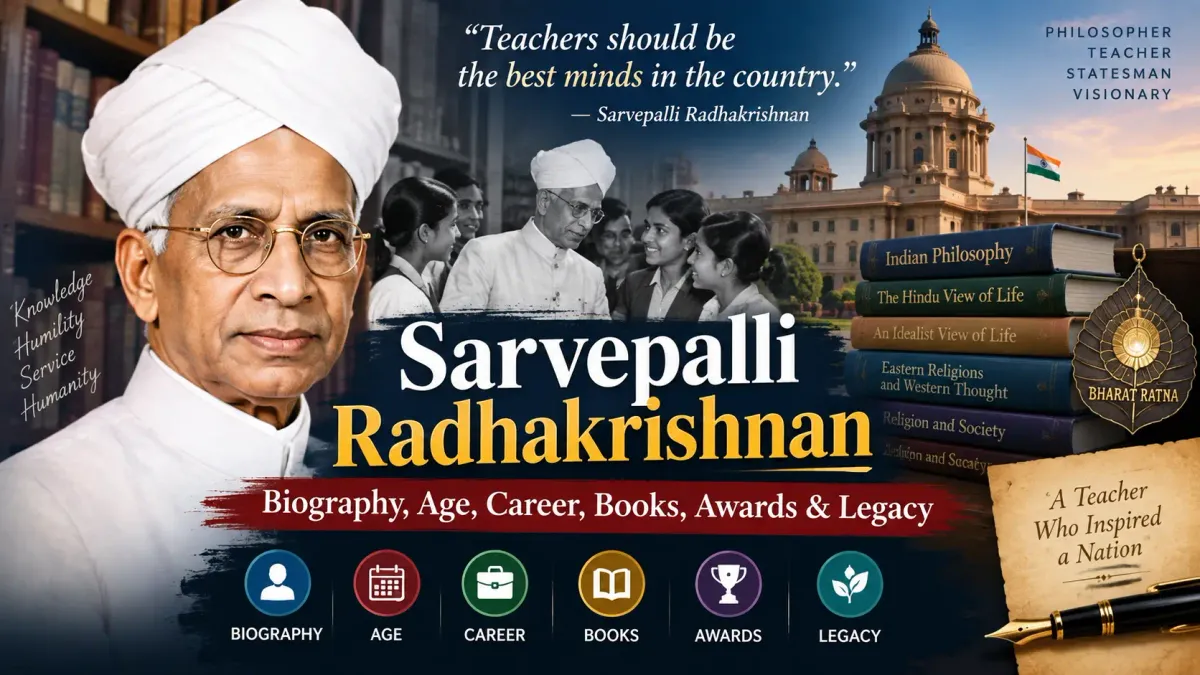
Sarvepalli Radhakrishnan: Biography, Age, Career, Books, Awards & Legacy

Long before he ever set foot in Rashtrapati Bhavan, Sarvepalli Radhakrishnan was known simply as a brilliant, soft-spoken teacher who could make ancient Indian philosophy feel urgent and alive in a lecture hall. That reputation followed him all the way to the highest offices in the country. Sarvepalli Radhakrishnan was an Indian academic, philosopher, and statesman who served as the Vice President of India from 1952 to 1962 and as President of India from 1962 to 1967. He remains the only person in Indian history to have built an internationally recognised academic career in philosophy before turning to full-time public life.
Dr. Radhakrishnan is remembered today for three distinct legacies that rarely overlap in one person: as a philosopher who is considered one of the most influential and distinguished 20th-century scholars of comparative religion and philosophy, as a statesman who steered India through some of its most turbulent early years as an independent republic, and as the reason India celebrates its teachers every year. Every September 5, when schools across the country pause to honour their teachers, they are marking his birthday — a tradition he himself set in motion. This biography traces his journey from a modest Telugu Brahmin household in a temple town to the world's lecture halls, embassies, and finally, the President's House.
Quick Facts: Sarvepalli Radhakrishnan Infobox
| Field | Information |
|---|---|
| Full Name | Sarvepalli Radhakrishnan (born Sarvepalli Radhakrishnayya) |
| Nickname | Dr. Radhakrishnan; "the Philosopher-President" |
| Profession | Philosopher, academic, diplomat, statesman |
| Famous For | First Vice President and second President of India; founder of India's Teachers' Day; scholar of comparative religion |
| Date of Birth | 5 September 1888 |
| Date of Death | 17 April 1975 (aged 86); some references, including Encyclopaedia Britannica, list 16 April 1975 — sources are not unanimous on this exact date |
| Birthplace | Tiruttani, North Arcot district, Madras Presidency, British India (present-day Tamil Nadu) |
| Nationality | Indian |
| Religion | Hinduism (Telugu-speaking Niyogi Brahmin family) |
| Zodiac Sign | Virgo |
| Height | Not publicly disclosed |
| Weight | Not publicly disclosed |
| Eye Color | Not publicly disclosed |
| Hair Color | Not publicly disclosed (commonly seen with grey/white hair in later photographs) |
| Education | BA and MA in Philosophy |
| School | Hermannsburg Evangelical Lutheran Mission School, Tirupati; Government High Secondary School, Walajapet; Voorhees College, Vellore |
| College/University | Madras Christian College (affiliated to the University of Madras) |
| Marital Status | Married; widowed in 1956 |
| Boyfriend/Girlfriend/Partner | Not applicable |
| Spouse | Sivakamu (m. 1903 – her death in 1956) |
| Children | 6 — five daughters (Padmavati, Rukmini, Sushila, Sundari, Shakuntala) and one son, historian Sarvepalli Gopal |
| Parents | Father: Sarvepalli Veeraswami (a subordinate revenue official); Mother: Sitamma |
| Siblings | Not publicly disclosed in available biographical records |
| Net Worth | No verified net worth figure exists; he lived on academic and government salaries and was widely described as personally austere |
| Monthly Income | Not publicly disclosed (drew a President of India's salary from 1962–1967) |
| Hobbies | Reading, writing, comparative study of religious texts |
| Current Residence | Not applicable (deceased) |
| Languages Known | Telugu (mother tongue), Tamil, English, Sanskrit |
| Official Website | Not applicable |
| Social Media Profiles | Not applicable — Radhakrishnan died in 1975, decades before social media existed |
Early Life and Background
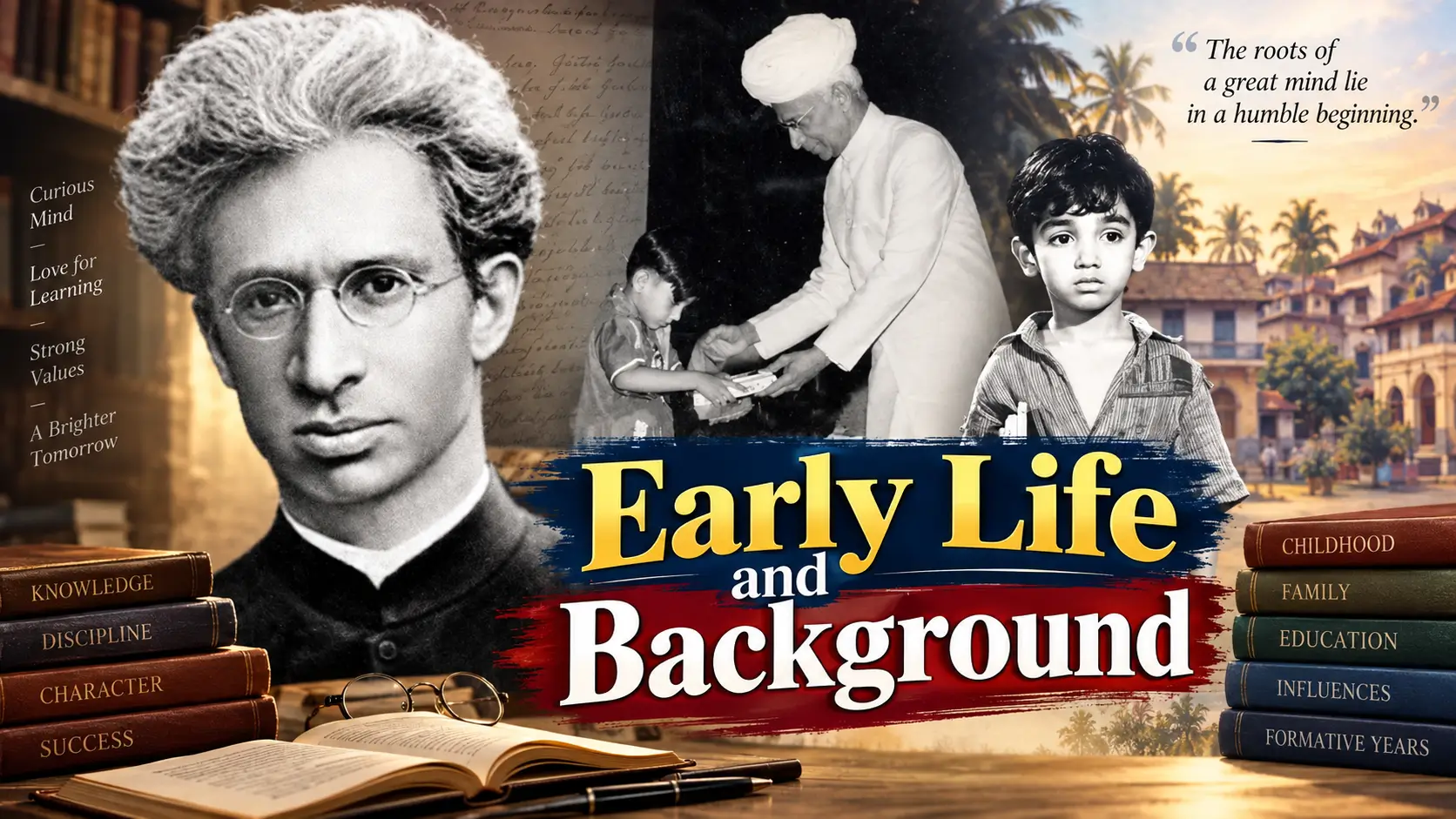
Sarvepalli Radhakrishnan was born as Sarvepalli Radhakrishnayya into a Telugu Niyogi Brahmin family, the son of Sarvepalli Veeraswami and Sithamma, in Tiruttani, in the North Arcot district of the old Madras Presidency — a town that today falls within Tamil Nadu's Tiruvallur district. The family's ancestral roots trace back to Sarvepalli village in the Nellore district of what is now Andhra Pradesh, which is where the family surname originates. His father worked as a subordinate revenue official in the service of a local zamindar, and the household income was modest by any measure.
Tiruttani was, and still is, a well-known pilgrimage town centred around its hilltop Murugan temple, and the Radhakrishnan family was deeply embedded in the town's devotional culture. Growing up in this environment gave the young Radhakrishnan an early, lived familiarity with Hindu ritual and philosophy — long before he would go on to study it formally or defend it intellectually to Western audiences. Comparatively little is documented about his very earliest childhood, since Radhakrishnan rarely spoke about his personal life in public, and most of what is known emerged only decades later through his own reflective writings.
Financial constraints shaped much of his early life. The family could not easily afford an elaborate education, and scholarships became essential to his schooling at almost every stage. Despite these constraints, he was recognised early as an unusually sharp student, and this combination of financial modesty and academic promise would recur as a theme throughout his early career — a young man moving between temporary jobs and prestigious appointments almost in the same breath.
Culturally, Radhakrishnan grew up straddling two worlds that would define his entire intellectual life: the orthodox Hindu, Sanskritic tradition of his upbringing, and the English-medium, Christian missionary education system that colonial India had built. That tension — between inherited faith and imported critique — became the single most defining force in his personality and his philosophy.
This was also an era of considerable intellectual ferment in South India, as figures like Swami Vivekananda were reshaping how educated Indians thought and spoke about their own religious traditions in response to colonial rule. Radhakrishnan later acknowledged that Vivekananda's example, and the sense of pride it instilled in a generation of young Hindus, had a direct bearing on how personally he took the missionary criticism of Hindu belief he would encounter throughout his schooling — a formative irritation that eventually pushed him toward a lifetime of scholarly defence of his own tradition.
Education
In 1896, the young Radhakrishnan moved to the Hermannsburg Evangelical Lutheran Mission School in Tirupati and later to the Government High Secondary School in Walajapet. He was awarded scholarships throughout his academic life, which allowed him to join Voorhees College in Vellore for his high school education.
After completing his First of Arts (F.A.) class, he joined Madras Christian College, affiliated with the University of Madras, at the age of sixteen. He completed both his Bachelor's and Master's degrees at the same institution. Sources differ slightly on the exact graduation year — some accounts state 1906, others 1907 — but all agree the degrees came from Madras Christian College in the mid-1900s.
One of the more charming footnotes of his academic life is how he ended up studying philosophy at all. Radhakrishnan had actually wanted to study mathematics, but as a financially constrained student, he inherited philosophy textbooks passed down from a cousin who had graduated from the same college — and that inheritance effectively decided his entire academic path.
That accidental beginning produced one of the most consequential academic careers in modern Indian history. His bachelor's degree thesis, titled "The Ethics of the Vedanta and its Metaphysical Presuppositions," was written directly in response to missionary criticism that Vedanta philosophy lacked any coherent ethical foundation. The thesis impressed his professors, Rev. William Meston and Dr. Alfred George Hogg, and was published when Radhakrishnan was only twenty years old.
It was at Madras Christian College that Radhakrishnan first encountered sustained religious polemic in an academic setting, and he later described how the challenge posed by Christian critics pushed him to seriously study Hinduism to determine, in his own words, what within it was living and what was dead. He also learned Sanskrit during this period, which became foundational to his later work translating and interpreting Indian religious texts. Upon completing his MA in 1908, Radhakrishnan found himself at both a financial and professional crossroads, since family obligations ruled out applying for a scholarship to study in Britain, and he initially struggled to find work in Madras.
Career Journey
Academic Beginnings
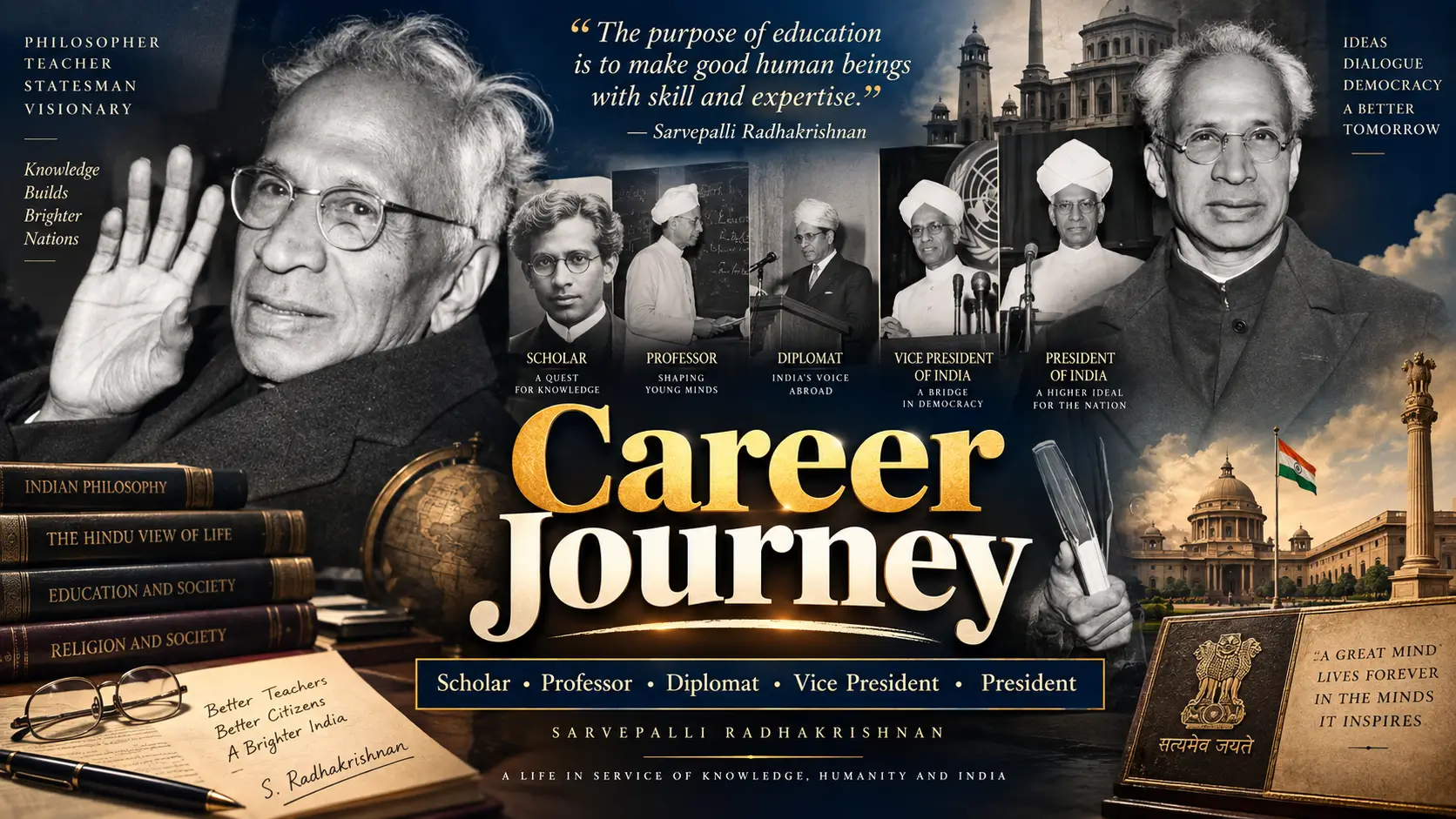
The following year, with assistance from William Skinner at Madras Christian College, Radhakrishnan secured what was intended to be a temporary teaching post in the Department of Philosophy at Presidency College, Madras, in April 1909. There he taught psychology, logic, epistemology, and ethical theory as a junior assistant professor — subjects far broader than his own formal training, which forced him into a rigorous process of self-education that arguably sharpened his later scholarship.
His publishing career began almost immediately. In 1918, alongside becoming Professor of Philosophy at the University of Mysore's Maharaja's College, he completed his first book, "The Philosophy of Rabindranath Tagore," which he described as a genuine expression of the Indian spirit. His second book, "The Reign of Religion in Contemporary Philosophy," followed in 1920.
In 1921, he was appointed professor of philosophy to the King George V Chair of Mental and Moral Science at the University of Calcutta, a position of considerable prestige that placed him at the centre of Indian academic philosophy. The relative isolation he experienced during his early years in Calcutta gave him the space to work on his two-volume "Indian Philosophy," the first volume published in 1923 and the second in 1927. He was also invited to Oxford to deliver the 1926 Upton Lectures, later published as "The Hindu View of Life" (1927), and in 1929 he delivered the Hibbert Lectures, published as "An Idealist View of Life" — widely regarded as his most mature and sustained philosophical work.
His growing international reputation earned him a knighthood in 1931, though he stopped using the title "Sir" after India gained independence. That same period saw him serve as Vice-Chancellor of Andhra University from 1931 to 1936. From 1936 to 1952, he held the Spalding Chair of Eastern Religion and Ethics at the University of Oxford, becoming one of the very few Indian scholars of his generation to hold a permanent chair at a major Western university while continuing to be deeply active in Indian public life. He simultaneously served as Vice-Chancellor of Banaras Hindu University from 1939 to 1948.
Philosophical Ideas and Contributions
At the core of Radhakrishnan's scholarship was a single, sustained project: reinterpreting Advaita Vedanta — the non-dualist school of Hindu philosophy — for a modern, comparative, and largely Western academic audience. His early exposure to smarta religious tradition in Tiruttani, a temple town where Advaita's implicit acceptance was a latent but important feature of everyday religious life, shaped his philosophical instincts long before he had the vocabulary to defend them academically.
Radhakrishnan consistently defended what he called the religion of the Spirit, using the terms Hinduism, Vedanta, and universal spiritual religion somewhat interchangeably across his writing, and he was particularly invested in demonstrating that Hindu thought could hold its own intellectually and ethically alongside Christian theology and Western secular philosophy. He argued that the deepest insights of religion came not from doctrine or dogma but from what he termed "integral experience" — an intuitive, unifying grasp of reality that he believed underpinned all major world religions in different cultural clothing. This idea allowed him to present religious pluralism as a philosophically coherent position rather than mere tolerance for its own sake, a stance that shaped decades of comparative religion scholarship after him.
His interpretation of the Indian caste system also drew both praise and criticism. He tended to present caste, in its idealised form, as a social framework that allowed individuals the freedom to pursue their own spiritual development without dogmatic restraint — an argument later critics found difficult to reconcile with the lived, often discriminatory reality of caste in Indian society. Scholars have continued to debate this aspect of his work, and it remains one of the more contested elements of his philosophical legacy, alongside the authorship dispute discussed later in this article.
Whatever the disagreements over specific arguments, Radhakrishnan's broader achievement is rarely disputed: he made Indian philosophical vocabulary — karma, dharma, moksha, Vedanta — legible and academically respectable within English-language philosophy departments at a time when very few Indian scholars were being read seriously in Oxford, Manchester, or Harvard lecture halls. His 1926 Congress of the Universities of the British Empire address and his 1926 International Congress of Philosophy appearance at Harvard were among the earliest instances of an Indian philosopher engaging Western academic philosophy as a peer rather than a subject of study.
From Academic to Diplomat
Radhakrishnan's transition into public administration and diplomacy came gradually. He led the Indian delegation to UNESCO from 1946 to 1952 and was elected chairman of UNESCO's executive board in 1948–49. From 1949 to 1952, he served as India's ambassador to the Soviet Union, a posting that placed him at the heart of early Cold War diplomacy. During his time in Moscow, he reportedly had a private audience with Joseph Stalin, after which he suggested that world leaders needed to meet directly and often if global tensions were to be resolved.
Vice President and President of India
On his return to India in 1952, he was elected the country's first Vice President, unopposed, and would be re-elected to a second term in 1957. Alongside his vice-presidential duties, he served as Chancellor of the University of Delhi from 1953 to 1962, refusing to fully separate himself from academic life even at the peak of his political career.
In the 1962 Indian presidential election held on 7 May 1962, Radhakrishnan won by a landslide, securing 553,067 electoral votes — 98.25 percent of the total — against token opposition candidates Chaudhary Hari Ram and Yamuna Prasad Trisulia. He was sworn in as India's second President on 13 May 1962, succeeding Rajendra Prasad.
His presidency coincided with some of independent India's most difficult years. His five-year term witnessed the Sino-Indian War of 1962, the Indo-Pakistani War of 1965, linguistic reorganisation of Indian states, and a tense Cold War diplomatic climate. In October 1962, as war with China broke out, Radhakrishnan's own earlier confidence — as Vice President, he had once publicly downplayed the significance of the disputed Himalayan territory relative to the value of India–China friendship — was tested by events, and he leaned instead on projecting calm, moral leadership at a moment of national anxiety.
In June 1963, President Radhakrishnan visited the United States and met President John F. Kennedy, only months after the Indo-China war had ended. The two countries issued a joint statement affirming India's determination to preserve its territorial integrity and their shared concern about countering Chinese aggression in the subcontinent. Interestingly, Kennedy's successor as President, Richard Nixon, was known to keep a framed photograph of Radhakrishnan in his New York law office years afterward — a small but telling sign of the personal respect Radhakrishnan commanded internationally.
Radhakrishnan's presidency also spanned a period of significant political transition at home: Prime Minister Jawaharlal Nehru's death in 1964, the brief tenure of Lal Bahadur Shastri, Shastri's own sudden death in January 1966, and the rise of Indira Gandhi as Prime Minister later that year. Through each transition, the President's office — and Radhakrishnan's steady, apolitical conduct within it — played a quiet stabilising role for the young republic. He chose not to seek a third term, and was succeeded as President by Zakir Husain in 1967, having served from 13 May 1962 to 13 May 1967. He then retired from active political life.
Physical Appearance and Public Image
Radhakrishnan is instantly recognisable in photographs of his era: a formally dressed, bespectacled figure, often wearing a traditional turban and simple Indian attire rather than Western dress, projecting the image of a scholar-statesman rather than a career politician. Contemporary photographs from his diplomatic postings — including his farewell meeting with Stalin in Moscow — consistently show him in this understated, dignified style, which became something of a visual signature over his decades in public life.
No verified figures for his height, weight, or other physical measurements exist in public biographical records, which is typical for a statesman of his era; there was no expectation, at the time, that such personal details would be documented or publicised. His public image instead rested almost entirely on his manner of speech, his writing, and his reputation for intellectual rigour combined with personal humility.
Honors, Salary and Financial Life
Because Radhakrishnan died in 1975, decades before financial disclosures or wealth estimates became a standard part of public biography, no verified net worth figure exists for him, and this article will not speculate on one. What is well documented is that he lived primarily on an academic professor's salary for the first four decades of his working life, followed by a diplomat's and then a constitutional office-holder's salary during his final quarter-century.
He was widely described by contemporaries as personally unpretentious despite holding some of the most powerful ceremonial offices in the country. Alongside industrialist Ghanshyam Das Birla and other social workers of the pre-independence era, he helped form the Krishnarpan Charity Trust, reflecting a consistent interest in philanthropic and social welfare causes across his life, separate from his academic and political roles. Royalties from his many published books would also have formed part of his income, though exact figures were never publicly disclosed and cannot be verified today.
Family and Relationships
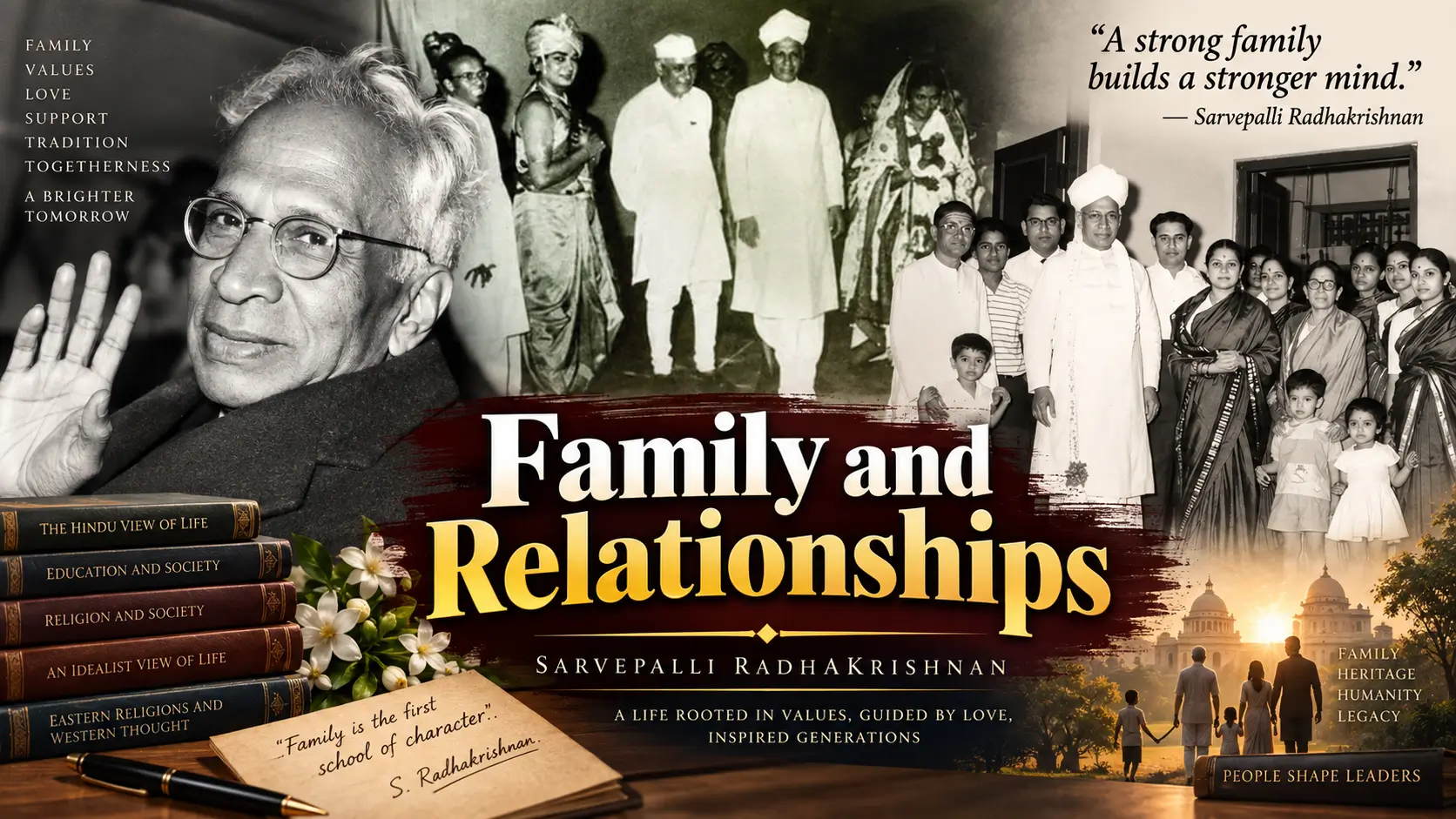
At the age of sixteen, Radhakrishnan married Sivakamu, a distant cousin, in 1903. Their marriage lasted for more than five decades and is consistently described in biographical accounts as a happy and supportive partnership. Sivakamu passed away on 26 November 1956. Radhakrishnan did not remarry and remained a widower for the final nineteen years of his life.
The couple had six children — five daughters, named Padmavati, Rukmini, Sushila, Sundari, and Shakuntala, and one son. Their son, Sarvepalli Gopal, was born in Madras on 23 April 1923 and went on to become a distinguished Indian historian in his own right, eventually receiving the Padma Vibhushan in 1999 for his contributions to Indian history, before his death in 2002. Gopal notably authored biographies of both Jawaharlal Nehru and his own father, titled simply "Radhakrishnan: A Biography."
Beyond his immediate family, Radhakrishnan maintained close working relationships with major figures of his era, including Jawaharlal Nehru, who appointed him ambassador to the Soviet Union, and industrialist G. D. Birla, with whom he co-founded a charitable trust. Public records do not document any dating history, romantic controversies, or estrangements within the family — consistent with the reserved, private nature Radhakrishnan maintained around his personal life throughout his career.
It is worth noting how unusual his family's own trajectory was: a father working as a modest revenue official saw his son rise to become the head of the Indian state, while that son's own child went on to become one of independent India's most respected historians in a completely different discipline. Across three generations, the family moved from provincial colonial administration, through academic philosophy and national politics, into professional historical scholarship — a trajectory that itself mirrors the wider story of social mobility through education in twentieth-century India that Radhakrishnan spent much of his public life advocating for.
Controversies
In keeping with a commitment to accuracy, it is worth noting that Radhakrishnan's otherwise celebrated legacy is not entirely free of controversy, and the most significant one concerns the originality of one of his major works.
In January 1929, Jadunath Sinha, then a young and relatively unknown lecturer of philosophy at Meerut College, publicly accused Radhakrishnan of extensively copying material from his own submitted thesis, "Indian Psychology of Perception," for use in the second volume of Radhakrishnan's "Indian Philosophy," published in 1927. Sinha's thesis had been reviewed by Radhakrishnan prior to the book's publication, and Sinha published side-by-side comparisons of the two texts in the journal Modern Review to support his claim.
Sinha subsequently filed a lawsuit at the Calcutta High Court seeking damages of Rs 20,000, and Radhakrishnan responded with a counter-suit for libel demanding Rs 1,00,000. Given the substantial personal costs both parties risked, and following the intervention of Syama Prasad Mookerjee, the case was ultimately settled out of court, with no official judgment ever delivered.
Because the matter was never formally adjudicated, opinions on it remain divided even today: some commentators treat the episode as a forgotten stain on the legacy of a man now celebrated annually on Teachers' Day, while others argue that an unresolved, out-of-court settlement should not be used to permanently label a towering academic figure a plagiarist. In fairness to both readings, this article presents the documented facts of the dispute without adjudicating a claim that Indian courts themselves never formally resolved.
Beyond this episode, Radhakrishnan also faced early institutional hostility at the University of Calcutta, where a section of the press criticised his English and Bengali language skills and his familiarity with Western referencing conventions shortly after he joined — criticism that, notably, predates and is separate from the later plagiarism dispute. No other major personal or professional controversies are documented in reliable biographical sources.
Achievements and Awards
Radhakrishnan's career produced a long list of national and international honours, reflecting his dual standing as both scholar and statesman.
| Award / Honor | Year | Notes |
|---|---|---|
| Knight Bachelor | 1931 | British knighthood; he stopped using the title "Sir" after India's independence |
| Bharat Ratna | 1954 | India's highest civilian award |
| Peace Prize of the German Book Trade (Friedenspreis des Deutschen Buchhandels) | 1961 | Awarded at the Frankfurt Book Fair for his contribution to East-West understanding through his writing |
| Honorary membership, Order of Merit (UK) | 1963 | A rare honour for a non-British statesman |
| Templeton Prize | 1975 | Recognised his writings for conveying a universal, accessible understanding of India's religious heritage |
| Multiple honorary doctorates | Various years | Conferred by universities in India and abroad over his academic career |
| Nobel Prize nominations | Multiple years | Nominated on several occasions for both the Nobel Prize in Literature and the Nobel Peace Prize, though he never won either |
Beyond formal awards, his most enduring "achievement" in the popular imagination is institutional rather than a trophy: the creation of Teachers' Day itself, observed annually across India on his birthday since 1962.
Interesting Facts About Sarvepalli Radhakrishnan
- His birth name was Radhakrishnayya; "Radhakrishnan" was an anglicised simplification used throughout his public life.
- He originally wanted to study mathematics and only moved into philosophy because he inherited a cousin's old textbooks.
- He was married at the very young age of sixteen, as was common in his community at the time.
- He proposed the idea of Teachers' Day himself — when students and colleagues wanted to celebrate his birthday after he became President, he suggested the day be dedicated to teachers instead.
- His son, Sarvepalli Gopal, became a celebrated historian and wrote his father's official biography.
- He is one of the few individuals in modern history to hold both a permanent Oxford professorship and a national head-of-state office.
- Despite reaching the country's highest constitutional post, he never abandoned academic writing, continuing to publish and lecture on philosophy well into his political career.
- Richard Nixon, who later became U.S. President, reportedly kept a framed photograph of Radhakrishnan in his personal law office in New York.
- He was involved in founding a charitable trust with industrialist G. D. Birla, showing an interest in philanthropy separate from his political and academic roles.
- His birthday, and Teachers' Day, falls under the zodiac sign Virgo — a detail modern astrology-themed content often highlights, though it has no bearing on his actual achievements.
Timeline of Sarvepalli Radhakrishnan's Life
| Year | Event |
|---|---|
| 1888 | Born on 5 September in Tiruttani, Madras Presidency |
| 1903 | Married Sivakamu at age sixteen |
| ~1906–07 | Completed BA and MA in Philosophy, Madras Christian College |
| 1909 | Appointed to the Department of Philosophy, Presidency College, Madras |
| 1918 | Became Professor of Philosophy, University of Mysore; published first book |
| 1921 | Appointed to the King George V Chair, University of Calcutta |
| 1923–27 | Published the two-volume "Indian Philosophy" |
| 1929 | Faced plagiarism accusations from Jadunath Sinha |
| 1931 | Knighted; became Vice-Chancellor of Andhra University |
| 1936 | Appointed Spalding Professor of Eastern Religion and Ethics, Oxford |
| 1939 | Became Vice-Chancellor of Banaras Hindu University |
| 1946–52 | Led Indian delegation to UNESCO |
| 1949 | Appointed Ambassador of India to the Soviet Union |
| 1952 | Elected first Vice President of India |
| 1954 | Awarded the Bharat Ratna |
| 1956 | Wife Sivakamu passed away |
| 1957 | Re-elected Vice President for a second term |
| 1961 | Received the Peace Prize of the German Book Trade |
| 1962 | Elected second President of India; first Teachers' Day observed |
| 1963 | Visited the United States and met President John F. Kennedy |
| 1967 | Retired from the presidency, succeeded by Zakir Husain |
| 1975 | Awarded the Templeton Prize; died on 17 April in Madras |
Popular Quotes
Radhakrishnan's public speeches and writings produced several lines that continue to be widely cited, particularly around Teachers' Day. A few of his most frequently quoted remarks include:
"True teachers are those who help us think for ourselves."
"Teachers should be the best minds in the country."
"Books are the means by which we build bridges between cultures."
He is also widely remembered — though usually paraphrased rather than quoted verbatim across sources — for suggesting that his birthday be observed as a day honouring teachers rather than himself, and for describing the goal of education as producing free, independent-minded individuals capable of meeting the challenges of their times.
Major Works and Books
Radhakrishnan was an extraordinarily prolific author across a career spanning nearly six decades. His major published works include:
- The Philosophy of Rabindranath Tagore (1918)
- The Reign of Religion in Contemporary Philosophy (1920)
- Indian Philosophy, Volumes I and II (1923, 1927)
- The Hindu View of Life (1927)
- The Vedanta According to Samkara and Ramanuja (1928)
- An Idealist View of Life (1932)
- East and West in Religion (1933)
- Eastern Religions and Western Thought (1939)
- India and China (1944)
- The Dhammapada (translation, 1950)
- East and West: Some Reflections (1955)
- A Source Book in Indian Philosophy (co-edited with Charles A. Moore)
- The Brahma Sutra: The Philosophy of Spiritual Life (1960)
- The Principal Upanishads (translation and commentary)
- Recovery of Faith
His scholarship consistently pursued one overarching project: presenting Hindu philosophy, and Advaita Vedanta in particular, in terms that Western academic audiences could engage with seriously, while defending it against what he considered uninformed missionary-era criticism.
Public Image and Legacy
Radhakrishnan occupies an unusual place in Indian public memory: he is one of the rare Indian leaders remembered less for grand political acts and more for a single institutional legacy — Teachers' Day — that touches nearly every Indian student and educator each year. This has arguably made him more visible in everyday public consciousness, decades after his death, than many of his political contemporaries.
Academically, his influence on how Hinduism and Indian philosophy are studied and presented globally remains significant. He is widely credited with helping build what many scholars describe as a genuine intellectual bridge between Indian and Western philosophical traditions, at a time when serious academic engagement with Hindu thought in Western universities was rare. His two-volume "Indian Philosophy" remains a standard reference work in the field decades after publication.
Politically, his presidency is remembered as a period of dignified, non-partisan constitutional leadership during a genuinely dangerous stretch of Cold War-era history for India — a war with China, a war with Pakistan, and two abrupt changes of Prime Minister in quick succession. Radhakrishnan is generally credited with helping the presidency retain its intended ceremonial and moral authority through all of it, rather than being pulled into partisan politics.
His legacy also carries a quieter, structural dimension that is often overlooked: as a former Vice-Chancellor of two major Indian universities and Chancellor of a third, he helped shape how Indian higher education institutions were governed in the decades immediately after independence, at a time when the country was rapidly expanding university access. His repeated insistence — echoed in his most quoted lines — that teachers ought to be among the best minds a country produces reflected a genuine, long-held conviction about the link between educational quality and national development, not simply a rhetorical flourish coined for one birthday speech.
Internationally, his tenure at UNESCO and his ambassadorship in Moscow are often treated as a template for how a scholar-diplomat could operate credibly in Cold War-era international relations — bringing academic credibility to forums that were otherwise dominated by career politicians and career diplomats. This dual credibility, as both a recognised Oxford-chaired philosopher and a serving head of state, is genuinely rare in twentieth-century political history and remains a distinctive part of why his biography continues to be taught in Indian civics and history curricula today.
Commemorations and Present-Day Recognition
Since Radhakrishnan died in 1975, this section covers his ongoing commemoration rather than "current activity" in the conventional sense used for living public figures.
India Post has issued multiple commemorative stamps in his honour, including one released on 5 September 1967 and another marking his birth centenary on 11 September 1989. A separate stamp was issued to mark his 75th birth anniversary. The Indian government has also released commemorative coins in his honour, including denominations released at public ceremonies in New Delhi. Several colleges and academic institutions across India, including government arts colleges, continue to be named after him.
Every year on 5 September, Teachers' Day observances across Indian schools, colleges, and media outlets renew public attention on his life and thought, typically accompanied by his most quoted lines on education and teaching. Academic interest in his philosophical writings, particularly his interpretation of Advaita Vedanta, also continues in university philosophy departments in India and abroad, more than a century after he first began publishing.
Frequently Asked Questions (FAQs)
1. Who was Sarvepalli Radhakrishnan?
He was an Indian philosopher, academic, and statesman who served as India's first Vice President (1952–1962) and second President (1962–1967).
2. When was Sarvepalli Radhakrishnan born?
He was born on 5 September 1888 in Tiruttani, Madras Presidency (present-day Tamil Nadu).
3. When did Sarvepalli Radhakrishnan die?
He died on 17 April 1975 in Madras (now Chennai); a small number of sources, including Encyclopaedia Britannica, list 16 April 1975.
4. Why is 5 September celebrated as Teachers' Day in India?
It marks Radhakrishnan's birthday. When students and colleagues wanted to celebrate his birthday after he became President, he suggested the day instead be observed to honour teachers across the country.
5. What is Sarvepalli Radhakrishnan famous for?
He is best known for his contributions to comparative religion and Indian philosophy, for serving as India's first Vice President and second President, and for inspiring the national observance of Teachers' Day.
6. Where did Sarvepalli Radhakrishnan study?
He studied at Voorhees College, Vellore, and completed his BA and MA in Philosophy at Madras Christian College.
7. What did Sarvepalli Radhakrishnan study at university?
Philosophy — a subject he took up somewhat by chance, after inheriting philosophy textbooks from a cousin, having originally wanted to study mathematics.
8. Was Sarvepalli Radhakrishnan married?
Yes. He married Sivakamu in 1903, at the age of sixteen. She passed away in 1956, and he did not remarry.
9. How many children did Sarvepalli Radhakrishnan have?
Six — five daughters (Padmavati, Rukmini, Sushila, Sundari, and Shakuntala) and one son, historian Sarvepalli Gopal.
10. Who was Sarvepalli Gopal?
He was Radhakrishnan's son, a noted Indian historian who wrote biographies of both Jawaharlal Nehru and his own father, and who received the Padma Vibhushan in 1999.
11. What is Sarvepalli Radhakrishnan's net worth?
No verified net worth figure exists for him. He lived on academic and government salaries throughout his life and was widely described as personally austere.
12. When did Sarvepalli Radhakrishnan receive the Bharat Ratna?
He was awarded the Bharat Ratna, India's highest civilian honour, in 1954.
13. Was Sarvepalli Radhakrishnan knighted?
Yes, he received a British knighthood (Knight Bachelor) in 1931, though he stopped using the title "Sir" after India's independence.
14. What books did Sarvepalli Radhakrishnan write?
His major works include the two-volume "Indian Philosophy," "The Hindu View of Life," "An Idealist View of Life," and "Eastern Religions and Western Thought," among many others.
15. What philosophy is Sarvepalli Radhakrishnan associated with?
He is most closely associated with Advaita Vedanta, which he reinterpreted extensively for a modern, comparative academic audience.
16. Did Sarvepalli Radhakrishnan win a Nobel Prize?
No. He was nominated on multiple occasions for both the Nobel Prize in Literature and the Nobel Peace Prize but never won either.
17. What was the Templeton Prize Radhakrishnan received?
He was awarded the Templeton Prize in 1975, recognising his accessible writing on religious heritage and a universal understanding of the divine.
18. Was Sarvepalli Radhakrishnan involved in any controversy?
Yes. In 1929, philosophy lecturer Jadunath Sinha accused him of plagiarising portions of his thesis for use in "Indian Philosophy, Volume II." The resulting lawsuit was settled out of court in the early 1930s without a formal judgment.
19. What positions did Sarvepalli Radhakrishnan hold before becoming Vice President?
He served as a professor at Mysore and Calcutta universities, Vice-Chancellor of Andhra University and Banaras Hindu University, Spalding Professor at Oxford, and Indian Ambassador to the Soviet Union.
20. How long was Sarvepalli Radhakrishnan President of India?
He served one term as President, from 13 May 1962 to 13 May 1967, and chose not to seek re-election.
21. Who succeeded Sarvepalli Radhakrishnan as President?
Zakir Husain succeeded him as President of India in 1967.
22. What role did Radhakrishnan play during the 1962 Sino-Indian War?
As President during the war, he was known for projecting calm, dignified national leadership during a period of considerable public anxiety, rather than for any direct military or policy role, which fell to the Prime Minister and Cabinet.
23. Did Sarvepalli Radhakrishnan meet any U.S. Presidents?
Yes. He met President John F. Kennedy during an official visit to the United States in June 1963.
24. Are there institutions named after Sarvepalli Radhakrishnan?
Yes, several colleges and academic institutions across India carry his name, alongside commemorative stamps and coins issued in his honour.
25. What is Sarvepalli Radhakrishnan's zodiac sign?
Virgo, based on his 5 September birth date.
Sourcing note: This biography draws on Encyclopaedia Britannica, Wikipedia, the official website of the President of India, the Internet Encyclopedia of Philosophy, and several journalistic and academic secondary sources. Two minor factual discrepancies across sources are flagged directly in the text: his exact date of death (17 vs. 16 April 1975) and his exact BA/MA graduation year (1906 vs. 1907). No net worth figure, physical measurements, or social media details have been fabricated; where such data is not publicly available for a historical figure who died in 1975, this has been stated explicitly rather than invented.