Akhil Gogoi: Biography, Age, Height, Career, Net Worth, Family & More


Few political figures in Assam have travelled a road quite like Akhil Gogoi's — from a small village in Jorhat district to the front pages of national newspapers, from grassroots peasant organising to a jail cell, and from behind bars straight into the Assam Legislative Assembly. Akhil Gogoi is an Indian peasant leader, Right to Information (RTI) activist, and politician who currently serves as the Member of the Legislative Assembly (MLA) from the Sibsagar (Sivasagar) constituency in Assam, and as the founder-president of the regional party Raijor Dal.
Gogoi built his public identity over nearly two decades of anti-corruption and land-rights activism through the Krishak Mukti Sangram Samiti (KMSS), an organisation he founded in 2005. He became a household name in Assam for exposing government scams, opposing large hydroelectric dam projects, and, most prominently, for leading the 2019 protests against the Citizenship (Amendment) Act (CAA) in the state. That leadership led to his arrest under the Unlawful Activities (Prevention) Act (UAPA) and a 567-day incarceration — during which, remarkably, he contested and won an assembly seat without campaigning outside prison walls. In the 2026 Assam Assembly election, Gogoi retained his Sibsagar seat with an increased margin, being widely described in the press as one of the few prominent opposition leaders in the state to hold onto his constituency.
This article brings together everything publicly known and verifiable about Akhil Gogoi — his early life, education, activism, political career, family, legal battles, net worth, and his current standing in Assam's politics — while being transparent about the handful of details that remain unconfirmed or disputed across sources.
Quick Info / Infobox
| Field | Information |
|---|---|
| Full Name | Akhil Gogoi |
| Nickname | Not officially documented; widely referred to in the press as Assam's "peasant leader" and the face of the state's anti-CAA movement |
| Profession | Politician, social activist, peasant/farmers' rights leader, RTI activist |
| Famous For | Founding the Krishak Mukti Sangram Samiti (KMSS), leading Assam's 2019 anti-CAA protests, winning the 2021 Assam Assembly election from jail, founding Raijor Dal |
| Date of Birth | Not conclusively confirmed — see the note in "Early Life" below |
| Age | 51 years (as recorded in his 2026 election affidavit) |
| Birthplace | Selenghat village, Jorhat district, Assam, India |
| Nationality | Indian |
| Religion | Not publicly disclosed |
| Zodiac Sign | Cannot be reliably determined due to the unconfirmed date of birth |
| Height | Not publicly known |
| Weight | Not publicly known |
| Eye Color | Not publicly known |
| Hair Color | Black (as seen in public appearances) |
| Education | B.A. (English literature), Cotton College, Guwahati |
| School | Not publicly known |
| College/University | Cotton College, Guwahati (1993–1996) |
| Marital Status | Married |
| Boyfriend/Girlfriend/Partner | Not applicable |
| Spouse | Geetashree Tamuly (Associate Professor, Department of Assamese, B. Barooah College, Guwahati) |
| Children | One son, Nachiketa Gogoi |
| Parents | Father — Late Boluram Gogoi; Mother — Priyada Gogoi |
| Siblings | Not publicly known |
| Net Worth | Approx. ₹1.07 crore (combined declared assets of self and spouse, minus liabilities, per 2026 election affidavit) |
| Monthly Income | Salaried MLA; self-declared annual taxable income of roughly ₹12–13 lakh in recent years |
| Hobbies | Writing and political journalism (he formerly edited an Assamese Marxist journal); grassroots organising |
| Current Residence | Guwahati, Assam, with ancestral roots in Selenghat village, Jorhat district |
| Languages Known | Assamese, English, Hindi |
| Official Website | raijordal.org (party website) |
| Social Media Profiles | X (Twitter): @AkhilGogoiAG · Facebook: Official Akhil Gogoi / Raijor Dal page |
Early Life and Background
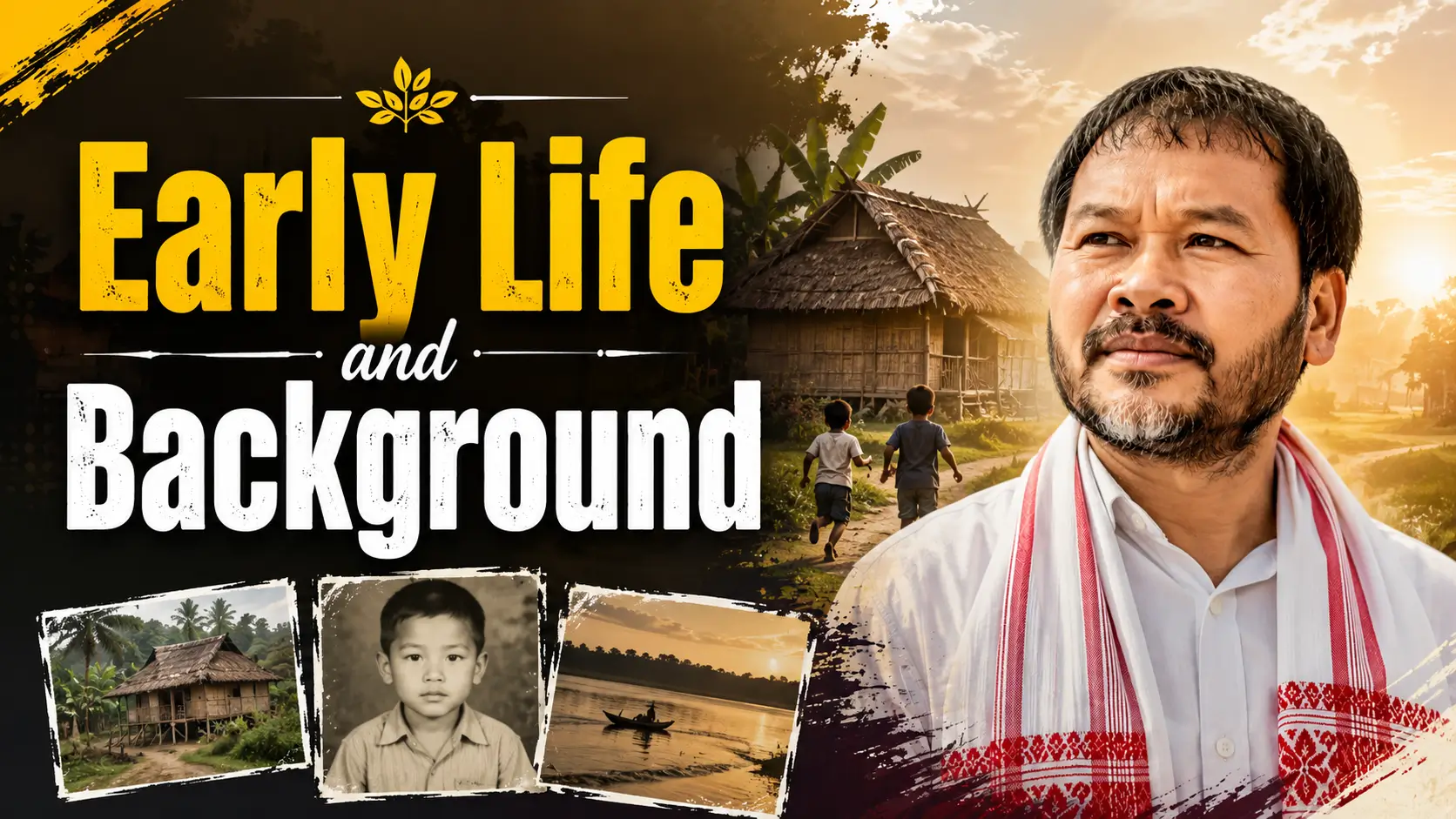
Akhil Gogoi was born to Boluram Gogoi and Priyada Gogoi in Selenghat village, in Assam's Jorhat district. His family background was modest and rooted in rural Assam, a setting that would later shape the direction of his life's work among farmers and forest-dwelling communities. His father, Boluram Gogoi, has since passed away, and reports from his early political campaigns describe his mother, Priyada, as having actively campaigned on his behalf during the periods when he was in judicial custody.
A note on his date of birth: Akhil Gogoi's exact birth date is not officially confirmed on any authoritative government or biographical record that is publicly accessible, and the available sources disagree with one another. A handful of unofficial profile sites list dates such as December 1 or March 1, alternately citing birth years of 1976. However, his own self-sworn election affidavits offer a more reliable trail — media reports described him as 46 years old at the time of the 2021 Assam Assembly election (held in April–May 2021), and his 2026 election affidavit records his age as 51. Both data points point consistently to a birth year of approximately 1974–1975, which is roughly two years earlier than the year cited by some unofficial astrology and profile websites. In keeping with a commitment to accuracy, this article treats the affidavit-based age (51 as of the 2026 election) as the more reliable figure and flags the exact date of birth as unconfirmed rather than presenting a fabricated precise date.
Growing up in rural Jorhat exposed Gogoi early to the everyday struggles of Assam's peasantry — land disputes, corruption in local governance, and the slow pace of rural development. This upbringing is frequently cited by profile writers and by Gogoi himself as the foundation for his lifelong focus on farmers' rights, land reform, and anti-corruption activism. As a young man he gravitated toward student politics and left-leaning political thought, setting the stage for the ideological path he would pursue through his college years and into his adult activist career.
Those who have followed his early years describe a personality marked by defiance toward authority he considered unjust, a preference for direct, ground-level engagement over armchair theorising, and an enduring commitment to organising ordinary people — traits that remained constant through his transition from student leader to peasant organiser to elected legislator.
Education

Akhil Gogoi pursued his higher education at the prestigious Cotton College in Guwahati, one of Assam's oldest and most respected institutions of higher learning, between 1993 and 1996. He studied English literature and earned his Bachelor of Arts (B.A.) degree from the college. His MyNeta election affidavit records his educational qualification simply as "Graduate," confirming the B.A. from Cotton College in 1996.
College life proved to be a formative political laboratory for Gogoi. He was actively involved in student politics at Cotton College, serving as the general secretary and the magazine secretary of the college students' union. It was during this period that he first engaged seriously with left-wing political organising, joining the United Revolutionary Movement Council of Assam (URMCA) — a mass organisation affiliated with the CPI-ML-PCC faction of the communist movement, then led by veteran communist leader Santosh Rana.
By the close of the 1990s, Gogoi had parted ways with Rana's faction. Rather than stepping back from public life, he channelled his energy into journalism, taking up the role of editor of Natun Padatik, an independent Marxist journal published in the Assamese language, working alongside the well-known intellectual and academic Hiren Gohain. This stint as a journal editor sharpened his skills in writing, argument, and public communication — skills that would prove valuable once he began organising farmers and confronting the state administration directly.
There is no publicly documented record of Gogoi pursuing any postgraduate degree, professional certification, or specialised training beyond his B.A. His subsequent "education," in a practical sense, came through nearly three decades of grassroots organising, legal battles, and direct engagement with Assam's bureaucratic and political institutions.
Career Journey

From Student Activism to Peasant Organising
After his years with URMCA and his stint editing Natun Padatik, Akhil Gogoi moved decisively toward grassroots organising work in rural Assam. In the early 2000s, he became involved in a peasant movement demanding land rights for forest dwellers in the Doiang-Tengani area of Golaghat district, a struggle that saw sustained agitation and a landmark dharna in Golaghat in June 2004, during which protesters faced a police crackdown. That struggle led to a formal proposal in April 2005 to grant land patta (title) rights to landless peasants in the Doiang area — an early sign that organised, sustained pressure could move the state administration.
Building on that momentum, Gogoi founded the Krishak Mukti Sangram Samiti (KMSS) in 2005. Conceived as a non-partisan peasant organisation, KMSS set out to tackle a wide sweep of rural governance failures: thefts and leakages in the Public Distribution System (PDS), poor implementation of the National Rural Employment Guarantee Act (NREGA), land rights for forest-dwelling and displaced communities, corporate and governmental corruption, and the use of the Right to Information Act to expose administrative wrongdoing. Under Gogoi's leadership as general secretary, KMSS grew rapidly into one of the most consequential civil-society organisations in Assam, frequently described in the press as functioning almost like a "principal opposition" to the state government on rural and land issues, even though it had no formal seats in any legislature.
The RTI and Anti-Corruption Years
A defining moment in Gogoi's rise to prominence came in 2005, when he exposed a Public Distribution System (PDS) rice scam in his home district of Golaghat. He followed this up with an investigation, using the Right to Information Act, that uncovered a scam worth roughly ₹1.25 crore in the Sampoorna Gram Rozgar Yojana in the same district — work that earned him the national Right to Information Award from the Public Cause Research Foundation in 2010. Two years earlier, in 2008, his broader anti-corruption efforts had already been recognised with the Shanmugam Manjunath Integrity Award, propelling him to national attention as a serious and effective anti-graft campaigner.
Gogoi's anti-corruption profile connected him, for a period, with the nationwide India Against Corruption (IAC) movement led by Gandhian activist Anna Hazare. He broke away from IAC, however, once some of its members decided to convert the movement into a formal political party (which eventually became the Aam Aadmi Party). Gogoi's stated reasoning was that the public support IAC had mobilised was meant to sustain a broad-based mass movement against corruption, not to be redirected into building an election-centred political outfit — a position that reflected his longstanding preference, at that stage of his career, for grassroots mobilisation over conventional party politics.
The Anti-Dam Movement
From the middle of 2009 onward, Gogoi and KMSS led a sustained, statewide movement opposing the construction of large hydroelectric dams in the seismically fragile regions of Assam and neighbouring Arunachal Pradesh. The central target of this campaign was the Lower Subansiri Hydroelectric Power Project, an NHPC-run mega-dam with a proposed capacity of 2,000 MW. In December 2011, a large body of anti-dam protesters organised by Gogoi physically blockaded trucks attempting to transport turbine parts to the project site at Gerukamukh in Lakhimpur district. The blockade was a major setback for the dam's construction timeline, and — remarkably for a protest movement of its kind — the project remained incomplete for many years afterward, a testament to the sustained disruptive power of the campaign Gogoi led.
Confronting "Land Mafia" and Building Farmer-to-Market Retail
In 2013, KMSS under Gogoi's direction set up a number of provisional retail outlets across Guwahati, designed to connect rural peasants directly with urban consumers and cut out exploitative middlemen and syndicate-run trading networks. The initiative, which Gogoi and KMSS framed as a grassroots alternative to both foreign direct investment (FDI) in retail and mafia-controlled trade, reportedly sold more than a hundred quintals of vegetables within hours of its first outlets opening, with plans to expand into a permanent retail presence.
The following year, in 2014, Gogoi launched a campaign against what he described as a "land mafia" that had allegedly appropriated thousands of acres of agricultural land from poor farmers in the rural areas of Kamrup district adjoining Guwahati city — a campaign that drew government scrutiny of large-scale land encroachment in the state.
The First "Maoist" Allegation (2010)
Gogoi's aggressive activism repeatedly put him at odds with the state administration. In April 2010, a leaked, secret Assam government report alleged that he had close links to the banned CPI (Maoist) organisation. Gogoi publicly challenged the state to substantiate the claim, and prominent civil-society figures — including Magsaysay Award winner Sandeep Pandey and noted activist Medha Patkar — condemned what they described as an attempt to unfairly implicate the activist. In a televised interview, Gogoi described himself as a Marxist who believed in social transformation through mass organising, but explicitly rejected the "Maoist" label, arguing that the allegation reflected the government's frustration at being unable to contain KMSS's growing influence. The controversy embarrassed the state government at the time, and the matter was ultimately dropped without any formal charges being pursued.
The 2017 National Security Act Detention
Gogoi's confrontations with the administration escalated further in September 2017, when the Assam government invoked the National Security Act (NSA), 1980 — a law permitting administrative detention for up to twelve months on loosely defined national-security grounds — to hold him without conventional trial. In December 2017, the Gauhati High Court ruled that his detention violated his constitutional rights and ordered his release, a judicial rebuke that underscored the recurring pattern of legal confrontation between Gogoi and the state.
Political Formation: Gana Mukti Sangram Asom and Raijor Dal
Gogoi's first formal foray into electoral politics came on March 20, 2015, when — during KMSS's fourth biennial conference in Moranhat, and following a speech by Anna Hazare — he announced the formation of a new political party, Gana Mukti Sangram Asom, describing its aim as changing what he characterised as India's capitalist economic system. In 2017, at KMSS's fifth biennial conference, Gogoi announced that this party would contest the next Assam Assembly elections, formally signalling his transition from a strictly non-partisan activist to an electoral political actor.
Leading the 2019 Anti-CAA Protests and Arrest
Gogoi's activism reached its highest-profile and most consequential chapter in late 2019, when the central government's Citizenship (Amendment) Act (CAA) triggered massive protests across Assam over fears that it would alter the state's demographic and cultural balance. Gogoi emerged as one of the most visible faces of the anti-CAA agitation in the state, mobilising large-scale protests across multiple districts. On December 12, 2019, Assam Police arrested him in Jorhat as the protests turned violent in parts of Guwahati and elsewhere. He was subsequently booked on charges including sedition, criminal conspiracy, and promoting enmity between groups, and the case was handed over to the National Investigation Agency (NIA), which registered two cases against him under the stringent Unlawful Activities (Prevention) Act (UAPA). The NIA alleged that the CAA protest movement in Assam had a "Maoist conspiracy" dimension and suggested Gogoi may have received training from CPI (Maoist) elements — an allegation his supporters and party rejected outright, echoing the pattern of the 2010 controversy.
Gogoi remained in judicial custody for 567 days. During this extended incarceration, on October 2, 2020, he launched his own political party from prison — Raijor Dal ("People's Party") — with Assamese filmmaker Jahnu Baruah formally announcing the party's launch, joined in extending public support by film actress Zerifa Wahid and lawyer Arup Borbora.
On July 1, 2021, a special NIA court finally cleared Gogoi of all charges, quashing both UAPA cases against him. By that point, however, an even more remarkable political outcome had already unfolded: in the 2021 Assam Legislative Assembly election, held while he was still in custody, Gogoi contested the Sivasagar constituency as a Raijor Dal candidate — without conducting any campaign of his own outside prison — and won, securing 57,219 votes out of a total of 124,219 cast, defeating his nearest rival, the BJP's Surabhi Rajkonwari, by a margin of 11,875 votes. He is widely credited as the first person in Assam's electoral history to win an assembly seat from jail without personally campaigning, with family members and party workers, including his mother, campaigning on his behalf.
Life as an Elected MLA and Party President
Since his release and subsequent formal assumption of his Sivasagar Assembly seat on May 21, 2021, Gogoi has functioned simultaneously as a sitting MLA and as the founder-president of Raijor Dal, positioning the party as a vocal, CAA-critical, and largely opposition-aligned regional force. In the years that followed, he became a leading voice in efforts to consolidate Assam's fragmented anti-BJP opposition, including talks in 2024 involving Raijor Dal, the Asom Jatiya Parishad (AJP), and the Asom Jatiya Dal to coordinate with the Indian National Congress ahead of the 2026 Assembly election. He also, at different points, engaged with national opposition figures — including publicly turning down an invitation from West Bengal Chief Minister Mamata Banerjee to join the Trinamool Congress and lead its Assam unit, while expressing openness to Raijor Dal partnering with TMC and other regional forces within a broader anti-BJP front.
The 2026 Assam Assembly Election
Gogoi's most recent and arguably most significant electoral test came in the 2026 Assam Legislative Assembly election, held on April 9, 2026, under delimited constituency boundaries that reshaped Sibsagar's electorate to over 209,000 voters. Contesting again from Sibsagar against the BJP's Kushal Dowari (a two-time former MLA), the Asom Gana Parishad's Prodip Hazarika, and several other candidates, Gogoi secured a decisive victory, polling 86,521 votes — 49.38% of the total — against Dowari's 69,249 votes, a winning margin of 17,272 votes, which represented an improved vote share compared to his 2021 win. Political commentary around the results noted that Gogoi was the lone prominent opposition leader in Assam to retain his seat in an election that otherwise saw the BJP-led alliance return to power in the state under Chief Minister Himanta Biswa Sarma. Raijor Dal's presence in the 126-member Assam Legislative Assembly currently stands at two seats.
Social Media Presence
Unlike entertainment or influencer figures, Akhil Gogoi's social media footprint is oriented almost entirely around political communication rather than personal branding, lifestyle content, or brand endorsements. He maintains an official presence on X (Twitter) under the handle @AkhilGogoiAG, identified as the official account of the "Member of Legislative Assembly, 108-LAC Sibsagar, Assam and President of Raijor Dal." Through this account, Gogoi regularly comments on state and national political developments — from criticising central government actions against opposition leaders to raising local infrastructure and welfare issues specific to Sibsagar and Charaideo districts, often posting in Assamese as well as English.
He also has an official Facebook presence, listed under the "Politician" category and linked to the Raijor Dal party website (raijordal.org), which is used for longer-form updates, video statements, and party announcements. There is no public evidence of Gogoi maintaining a YouTube channel, TikTok/Instagram Reels-style content, or engaging in brand collaborations or sponsored content of any kind — consistent with his public identity as a grassroots politician rather than a media personality or influencer. His social media influence should be understood in terms of political mobilisation and constituency communication rather than follower-count-driven popularity metrics.
| Platform | Username/Handle | Followers |
|---|---|---|
| X (Twitter) | @AkhilGogoiAG | Not independently verifiable at time of writing |
| Official Akhil Gogoi / Raijor Dal page | Not independently verifiable at time of writing | |
| Not confirmed | Not applicable | |
| YouTube | No official channel identified | Not applicable |
Physical Appearance
Because Akhil Gogoi is a grassroots political and activist figure rather than an entertainment personality, detailed physical statistics such as his exact height, weight, or eye colour are not part of any public record and are not tracked by the press in the way they might be for film or sports celebrities. What can be said, based on his public appearances at rallies, press briefings, and in the Assam Assembly, is that he generally presents in simple, understated attire — often plain shirts or kurta-style clothing — reflecting the unpretentious, grassroots public image he has cultivated over two decades of peasant organising. He does not appear to have any publicly documented tattoos, and his public persona is defined far more by his combative, plain-spoken rhetorical style than by fashion or physical presentation.
Net Worth
Akhil Gogoi's financial profile is unusual for a sitting state legislator and stands in sharp contrast to the extravagant net-worth narratives typically associated with celebrities or business-linked politicians. According to his self-sworn 2026 election affidavit filed with the Election Commission of India, his combined declared assets (self and spouse) stood at approximately ₹1,12,74,654 (around ₹1.13 crore), against declared liabilities of ₹5,54,896 (around ₹5.5 lakh) — putting his net worth in the region of ₹1.07 crore.
Income sources: Gogoi's primary income is his salary as a sitting MLA, supplemented in the past by whatever modest income his activism-linked work generated. His self-declared income tax returns show a taxable income of roughly ₹7.5 lakh to ₹13.75 lakh annually across the 2020–2025 assessment years, with ₹12,27,500 declared for 2024–25. His wife, Geetashree Tamuly, an Associate Professor of Assamese at B. Barooah College, Guwahati, has a separately declared income that has risen steadily, reaching approximately ₹35.7 lakh for 2024–25 as a government college employee — meaning her salaried income is, notably, higher than his in recent years.
Assets: Per the affidavit, Gogoi's personally declared movable assets amount to roughly ₹1.76 lakh, including cash in hand of ₹1.3 lakh and small bank deposits. He holds no motor vehicles, no jewellery, and no personally-owned immovable property. His spouse's declared movable and immovable assets are considerably larger and include bank deposits, postal savings instruments (NSC), a small agricultural landholding in Golaghat, a non-agricultural plot in Golaghat, and an Assam-type residential house in Nizarapar, Guwahati, together valued at approximately ₹82 lakh.
Liabilities: The couple's declared liabilities consist mainly of a housing loan of roughly ₹4.5 lakh from the State Bank of India, along with small personal loans of ₹50,000 each between spouses.
Businesses, endorsements, and lifestyle: There is no public record of Gogoi owning any business, holding company shares beyond a modest ₹10,000 stake in a cooperative orchid-park society (Kaziranga Jatiyo Orchid Aru Joiba Bolchitra Udyan Samabai Samiti Ltd.), or receiving brand endorsements — unsurprising given his profile as a peasant-rights activist and legislator rather than a public entertainer. He owns no cars and reports no luxury assets of any kind in his affidavit.
Net Worth Breakdown Table
| Category | Approximate Value |
|---|---|
| Total Declared Assets (Self + Spouse) | ₹1,12,74,654 |
| Total Declared Liabilities | ₹5,54,896 |
| Approximate Net Worth | ₹1.07 crore |
| Self — Movable Assets | ₹1,75,987 |
| Self — Immovable Assets | Nil |
| Spouse — Movable Assets | ₹28,98,487 |
| Spouse — Immovable Assets | ₹82,00,000 |
| Motor Vehicles Owned | None declared |
| Annual Declared Income (Self, 2024–25) | ₹12,27,500 |
Family and Relationships
Parents: Akhil Gogoi is the son of Late Boluram Gogoi and Priyada Gogoi, both from Selenghat village in Jorhat district. His mother, Priyada, became a visible public figure in her own right during his 2021 campaign, personally leading rallies and appealing to voters on her son's behalf while he remained in judicial custody.
Siblings: No information about any siblings is publicly available or verifiable at this time.
Marriage: Gogoi is married to Geetashree Tamuly, who works as an Associate Professor in the Department of Assamese at B. Barooah College, a government-run institution in Guwahati. She has largely maintained a lower public profile compared to her husband, continuing her academic teaching career even through the periods of his imprisonment, though she has periodically spoken to the press — including addressing reporters after an NIA raid on the couple's Guwahati residence, during which a personal diary Gogoi kept while in jail was reportedly seized.
Children: The couple has one son, Nachiketa Gogoi. Nachiketa was a young teenager during his father's 2019–2021 incarceration and became a quietly poignant figure in press coverage of that period — notably, he drew a portrait of his imprisoned father during the COVID-19 lockdown as a way of processing his absence, an image his mother later shared publicly with his permission.
Dating history and rumours: As a long-married public figure whose personal life has largely stayed out of tabloid coverage, there are no publicly documented dating rumours or relationship controversies associated with Akhil Gogoi beyond his marriage to Geetashree Tamuly.
Close associates: Over his activist career, Gogoi worked closely with intellectual and cultural figures including writer-academic Hiren Gohain (his co-editor at Natun Padatik) and received public solidarity from civil-society figures such as Sandeep Pandey and Medha Patkar during the 2010 "Maoist" controversy. His political party's 2020 launch was publicly backed by filmmaker Jahnu Baruah, actress Zerifa Wahid, and lawyer Arup Borbora.
Controversies
Akhil Gogoi's public life has been shaped by a series of legal and political controversies, nearly all of them arising from his confrontations with the state administration over corruption, land rights, and, later, the CAA protests. In the interest of neutrality, they are presented here factually, without editorialising about their merits.
The 2010 "Maoist" allegation: A leaked Assam government report alleged links between Gogoi and the banned CPI (Maoist) organisation. Gogoi denied the allegation, describing himself as a Marxist committed to mass organising rather than an adherent of Maoist armed struggle. The matter drew condemnation from national civil-society figures and was ultimately not pursued into formal charges.
The 2017 National Security Act detention: The state government detained Gogoi under the NSA in September 2017. The Gauhati High Court found the detention unconstitutional and ordered his release in December 2017.
The 2019–2021 UAPA case: Gogoi's arrest during the anti-CAA protests, and the subsequent NIA investigation alleging a Maoist-linked conspiracy behind the protest movement, represents the most significant legal battle of his career. After 567 days in custody, a special NIA court cleared him of all charges in July 2021, finding insufficient evidence to sustain the allegations.
Multiple pending criminal cases: As of his 2026 election affidavit, Gogoi has declared 21 pending criminal cases — the highest number among all candidates analysed in Assam's 2026 election cycle, according to an Association for Democratic Reforms (ADR) report. These cases span a wide range of charges accumulated over nearly two decades of protest activity, including allegations of criminal conspiracy, unlawful assembly, rioting, assault on public servants in the discharge of duty, defamation, and, in one case, sedition and offences under anti-terror provisions connected to the CAA protests. It is important to note that, per the same public record, Gogoi has zero convictions to date — all 21 cases remain pending at various stages, and several relate directly to his role organising and leading protest movements rather than to personal criminal conduct in the conventional sense.
Political criticism: As an opposition leader, Gogoi has been a frequent and vocal critic of the BJP-led Assam government, accusing it of favouritism in disaster relief distribution (notably during the August 2026 Assam floods) and of using central agencies to target opposition figures nationally. These are political positions rather than legal controversies, and are presented here as part of the ongoing back-and-forth of Assam's competitive party politics rather than as adjudicated wrongdoing on anyone's part.
Where his critics and supporters diverge sharply is in how these cases are interpreted: supporters frame the volume of cases as evidence of state harassment of a persistent grassroots organiser, while opponents point to the sheer number of pending cases as a matter of public concern. Both framings appear regularly in Assam's political discourse, and this article presents the underlying facts — case counts, outcomes, and dates — rather than adjudicating between them.
Achievements & Awards
| Award/Recognition | Year | Details |
|---|---|---|
| Shanmugam Manjunath Integrity Award | 2008 | Awarded for sustained anti-corruption activism in Assam |
| National Right to Information Award | 2010 | Awarded by the Public Cause Research Foundation for exposing a Rs. 1.25 crore scam in the Sampoorna Gram Rozgar Yojana, Golaghat |
| Founder, Krishak Mukti Sangram Samiti (KMSS) | 2005 | Built one of Assam's most influential peasant-rights organisations from the ground up |
| Election victory from judicial custody | 2021 | First person in Assam's electoral history to win an Assembly seat from jail without personal campaigning |
| Re-election as Sibsagar MLA | 2026 | Retained his seat with an increased vote share and margin, one of the few prominent opposition figures in Assam to do so |
| Judicial vindication in UAPA case | 2021 | Fully acquitted of all charges by a special NIA court after 567 days in custody |
| Judicial vindication in NSA detention | 2017 | Detention under the National Security Act ruled unconstitutional by the Gauhati High Court |
Beyond formal awards, Gogoi's most significant "achievement," as widely described in Assamese public life, is the sustained institutional legacy of KMSS itself — an organisation that, under his leadership, is credited with delaying the Lower Subansiri dam project for years, securing land-title rights for displaced forest-dwelling communities in Golaghat, and establishing a functioning model of RTI-based anti-corruption activism that other civil-society groups in the region have since sought to replicate.
Interesting Facts About Akhil Gogoi
- He won his first-ever assembly election in 2021 while sitting in judicial custody, without personally campaigning — a feat believed to be unprecedented in Assam's electoral history.
- Before turning to full-time activism, he worked as the editor of an independent Assamese Marxist journal, Natun Padatik, alongside noted intellectual Hiren Gohain.
- The organisation he founded in 2005, KMSS, is credited with substantially delaying construction of the 2,000 MW Lower Subansiri hydroelectric dam project — one of India's most contested infrastructure projects — through a sustained blockade campaign in 2011.
- He has, according to his own 2026 election affidavit, more pending criminal cases (21) than any other candidate analysed in that year's Assam Assembly election, almost entirely stemming from decades of protest and organising activity rather than personal disputes.
- His wife, Geetashree Tamuly, an academic, has a higher declared annual income than he does, according to their most recent joint election affidavit.
- His teenage son Nachiketa drew a portrait of his imprisoned father during the COVID-19 lockdown, an image that became a quietly emotional symbol of the family's experience during his father's incarceration.
- He turned down an offer from West Bengal Chief Minister Mamata Banerjee to join the Trinamool Congress and lead its Assam unit, opting instead to keep Raijor Dal an independent regional force willing to partner with — rather than merge into — larger national opposition coalitions.
- Despite two decades in public life and repeated national media attention, he owns no motor vehicle and holds no immovable property in his own name, according to his election affidavit.
Career and Life Timeline
| Year | Event |
|---|---|
| 1993–1996 | Studies English literature at Cotton College, Guwahati; active in student union politics |
| Late 1990s | Joins, then breaks from, the United Revolutionary Movement Council of Assam (URMCA); becomes editor of Natun Padatik |
| 2004 | Leads a dharna in Golaghat over forest-dweller land rights |
| 2005 | Exposes the Golaghat PDS rice scam; founds the Krishak Mukti Sangram Samiti (KMSS) |
| 2008 | Receives the Shanmugam Manjunath Integrity Award |
| 2009 | Launches the statewide anti-big-dam movement in Assam and Arunachal Pradesh |
| 2010 | Wins the National RTI Award; faces the first "Maoist links" allegation from the state government |
| 2011 | Leads the blockade of turbine transport trucks bound for the Lower Subansiri dam project |
| 2012 | Breaks with the India Against Corruption movement over its transformation into a political party |
| 2013 | Sets up farmer-direct retail outlets in Guwahati through KMSS |
| 2014 | Launches a campaign against alleged "land mafia" activity in Kamrup district |
| 2015 | Announces formation of the Gana Mukti Sangram Asom political party |
| 2017 | Detained under the National Security Act (September); released after the Gauhati High Court rules the detention unconstitutional (December) |
| 2019 (Dec) | Arrested in Jorhat amid the anti-CAA protests; booked by the NIA under UAPA and sedition provisions |
| 2020 (Oct 2) | Launches Raijor Dal from prison |
| 2021 (May) | Wins the Sibsagar Assembly seat while still in judicial custody |
| 2021 (Jul 1) | Acquitted of all UAPA and sedition charges by a special NIA court after 567 days in custody |
| 2024 | Engages in opposition-unity talks with Congress, AJP, and Asom Jatiya Dal ahead of the 2026 Assam polls |
| 2026 (Apr 9) | Contests re-election from Sibsagar in the Assam Assembly election |
| 2026 (May) | Wins re-election to the Sibsagar seat with 86,521 votes and a 17,272-vote margin |
| 2026 (Aug) | Leads hunger strike and demands flood-relief compensation for Sivasagar and Charaideo residents |
Popular Quotes
While Akhil Gogoi does not maintain a widely catalogued repository of formal "quotes" in the way film personalities or authors do, a few of his public statements have been widely reported and are frequently cited in profiles of his activist career:
- On the 2010 "Maoist" allegation, he told NDTV that he identified as a Marxist committed to social transformation through mass organising, but firmly rejected the "Maoist" label, framing the government's allegation as a reaction to KMSS's growing influence rather than a credible charge.
- On his decision not to convert KMSS into a political party after the India Against Corruption split, he explained that the movement's public support had been built to sustain mass anti-corruption organising — not to be redirected toward an election-centred party project.
- On regional political alliances, he has publicly described Raijor Dal as "a regional force on which the people of Assam have faith," while expressing willingness to partner with — rather than be absorbed into — larger national opposition coalitions.
Major Movements, Organisations and Projects
As a peasant leader and politician rather than an entertainer, Gogoi's body of "work" is best represented by the movements, organisations, and institutions he has built or led, rather than a filmography or discography:
- Krishak Mukti Sangram Samiti (KMSS) — Founded in 2005; Assam's most prominent peasant-rights organisation, working on land rights, anti-corruption, RTI activism, and opposition to large infrastructure projects in ecologically sensitive areas.
- Gana Mukti Sangram Asom — A political party floated by Gogoi in 2015, envisioned as an electoral vehicle for KMSS's ideological positions.
- Raijor Dal — Founded on October 2, 2020, from prison; the regional political party through which Gogoi has contested and won two consecutive Assam Assembly elections (2021 and 2026), and which currently holds two seats in the 126-member Assam Legislative Assembly.
- Anti-Lower Subansiri Dam Campaign (2009–2011 and beyond) — A sustained mass movement that significantly delayed one of Northeast India's largest hydroelectric projects.
- Anti-CAA Protest Movement (2019) — Gogoi's leadership of Assam's opposition to the Citizenship (Amendment) Act made him one of the most recognisable faces of that agitation nationally.
- Kaziranga National Orchid and Biodiversity Park — India's largest orchid garden, located in Assam, was launched by KMSS under Gogoi's leadership; the park includes a greenhouse, medicinal herb garden, fruit and flower gardens, a rice museum, and facilities for showcasing folk culture.
Public Image & Legacy
Akhil Gogoi occupies a distinctive place in Assam's political landscape: a leader whose public image was forged not through party patronage or dynastic politics, but through nearly two decades of direct, often confrontational, grassroots organising. To his supporters, he represents an unusually persistent and incorruptible voice for Assam's farmers, forest-dwelling communities, and ordinary citizens navigating a corruption-prone administrative system — a reputation reinforced by the fact that, despite 21 pending criminal cases, he has no convictions and has twice been judicially vindicated (the 2017 NSA detention and the 2019–2021 UAPA case).
His decision to contest and win an assembly election from behind bars, without conducting a personal campaign, became a defining symbol of his political brand — turning what might have been a career-ending period of incarceration into what many commentators described as a validation of his grassroots support base. That narrative was reinforced further in 2026, when he was widely described in the press as the "lone prominent opposition voice" in Assam to successfully defend his seat even as the ruling alliance was returned to power statewide.
Within Assam's broader political culture, Gogoi is closely associated with the Assamese sub-nationalist current that opposed the Citizenship (Amendment) Act on the grounds that it threatened the state's demographic and cultural identity — a stance that continues to define Raijor Dal's core political identity. His organisation's legacy, particularly through KMSS's anti-dam and land-rights campaigns, is frequently cited in academic and journalistic writing on peasant movements in Northeast India, including in scholarly work such as Arupjyoti Saikia's research on forest land and peasant struggles in Assam.
At the same time, his legacy remains actively contested territory in Assam's polarised political discourse — praised by supporters as principled dissent against a system tilted against ordinary farmers, and criticised by opponents who point to his extensive record of pending criminal cases as cause for concern. This tension is itself part of what makes him one of the more closely watched, and debated, figures in the state's contemporary politics.
Latest News & Current Status
As of August 2026, Akhil Gogoi continues to serve as the sitting MLA from Sibsagar, having been re-elected in the April 2026 Assam Assembly election, and remains the founder-president of Raijor Dal, which currently holds two seats in the state assembly. In the aftermath of severe flooding across Upper Assam in mid-2026, Gogoi has been one of the most vocal legislators demanding accountability and compensation for affected families. In early August 2026, he publicly demanded the removal of the Guardian Minister of Sivasagar over alleged irregularities and political favouritism in flood-relief distribution in the Sivasagar and Charaideo districts. On August 16, 2026 — India's 80th Independence Day — he began a hunger strike in flood-ravaged Sivasagar, demanding compensation of ₹10 lakh for every family affected by the floods, an official probe into the causes of the disaster, and swift reconstruction of damaged infrastructure across the three worst-hit upper Assam districts.
Politically, Gogoi and Raijor Dal remain positioned within Assam's broader anti-BJP opposition space, having previously engaged in alliance talks with the Indian National Congress and other regional parties ahead of the 2026 polls. With the BJP-led NDA having returned to power in Assam after the 2026 election, Gogoi's continued presence in the Assembly — as one of the few opposition MLAs to retain a seat — positions him as a prominent voice of scrutiny and dissent against the state government heading into the new assembly term.
Frequently Asked Questions (FAQs)
1. Who is Akhil Gogoi?
Akhil Gogoi is an Indian peasant leader, RTI activist, and politician who serves as the MLA from Sibsagar (Sivasagar), Assam, and as founder-president of the political party Raijor Dal.
2. How old is Akhil Gogoi?
According to his 2026 election affidavit, Akhil Gogoi's recorded age is 51. His exact date of birth is not officially confirmed, though affidavit-based age records point to a birth year of approximately 1974–1975.
3. What is Akhil Gogoi's net worth?
His combined declared assets (self and spouse), per his 2026 election affidavit, total approximately ₹1.13 crore, against liabilities of about ₹5.5 lakh — putting his net worth at roughly ₹1.07 crore.
4. Is Akhil Gogoi married?
Yes. He is married to Geetashree Tamuly, an Associate Professor of Assamese at B. Barooah College, Guwahati.
5. What is Akhil Gogoi famous for?
He is best known for founding the Krishak Mukti Sangram Samiti (KMSS), leading Assam's 2019 anti-CAA protests, winning an assembly election from jail in 2021, and founding the Raijor Dal political party.
6. Where was Akhil Gogoi born?
He was born in Selenghat village, in Jorhat district, Assam.
7. What is Akhil Gogoi's educational qualification?
He holds a Bachelor of Arts (B.A.) degree in English literature from Cotton College, Guwahati, completed in 1996.
8. Which political party does Akhil Gogoi belong to?
He is the founder and president of Raijor Dal, a regional political party he launched from prison on October 2, 2020.
9. Which constituency does Akhil Gogoi represent?
He represents the Sibsagar (Sivasagar) Assembly constituency in Assam.
10. Did Akhil Gogoi win the 2026 Assam Assembly election?
Yes. He was re-elected from Sibsagar in the 2026 election with 86,521 votes, defeating the BJP's Kushal Dowari by a margin of 17,272 votes.
11. Why was Akhil Gogoi arrested in 2019?
He was arrested on December 12, 2019, in connection with Assam's anti-CAA protests. The NIA subsequently booked him under UAPA and sedition-related provisions, alleging a Maoist-linked conspiracy behind the protest movement.
12. What happened to Akhil Gogoi's UAPA case?
A special NIA court cleared him of all charges and quashed both UAPA cases against him on July 1, 2021, after he had spent 567 days in judicial custody.
13. How many criminal cases does Akhil Gogoi have?
According to his 2026 election affidavit, he has 21 pending criminal cases — the highest number among candidates analysed in that election cycle — though he has zero convictions to date.
14. Who is Akhil Gogoi's wife?
His wife is Geetashree Tamuly, an academic who teaches Assamese literature at B. Barooah College in Guwahati.
15. Does Akhil Gogoi have children?
Yes, he has one son, named Nachiketa Gogoi.
16. What organisation did Akhil Gogoi found?
He founded the Krishak Mukti Sangram Samiti (KMSS) in 2005, a peasant-rights organisation active on land rights, anti-corruption, and RTI issues in Assam.
17. Did Akhil Gogoi win an election while in jail?
Yes. In the 2021 Assam Assembly election, he won the Sibsagar seat while in judicial custody, without personally campaigning — believed to be the first such instance in Assam's electoral history.
18. What awards has Akhil Gogoi received?
He received the Shanmugam Manjunath Integrity Award in 2008 and the National Right to Information Award in 2010.
19. Is Akhil Gogoi associated with the Indian National Congress?
No, he is not a Congress member. Raijor Dal has, however, engaged in opposition-alliance discussions with Congress and other regional parties ahead of Assam elections.
20. What is Akhil Gogoi's stance on the Citizenship Amendment Act (CAA)?
He has been one of Assam's most prominent critics of the CAA, leading large-scale protests against the law in 2019 on the grounds that it threatens the state's demographic and cultural identity.
21. What is Raijor Dal?
Raijor Dal is a regional Assamese political party founded by Akhil Gogoi on October 2, 2020, currently holding two seats in the 126-member Assam Legislative Assembly.
22. Did the Assam government ever call Akhil Gogoi a Maoist?
Yes, allegations linking him to CPI (Maoist) elements surfaced in a leaked 2010 state government report and were raised again by the NIA during the 2019 UAPA case; Gogoi has consistently denied any Maoist affiliation, and no conviction has resulted from either allegation.
23. What is Akhil Gogoi's current political role?
As of August 2026, he is the sitting MLA from Sibsagar and continues to serve as founder-president of Raijor Dal.
24. Was Akhil Gogoi ever detained under the National Security Act?
Yes, in September 2017. The Gauhati High Court ruled the detention unconstitutional and ordered his release in December 2017.
25. What has Akhil Gogoi been doing most recently?
In August 2026, he has been actively campaigning for flood-relief compensation in Sivasagar and Charaideo districts, including undertaking a hunger strike on August 16, 2026, demanding ₹10 lakh compensation per affected family and an official probe into the flood disaster.