Amitabh Bachchan: Biography, Age, Height, Career, Net Worth, Family & More

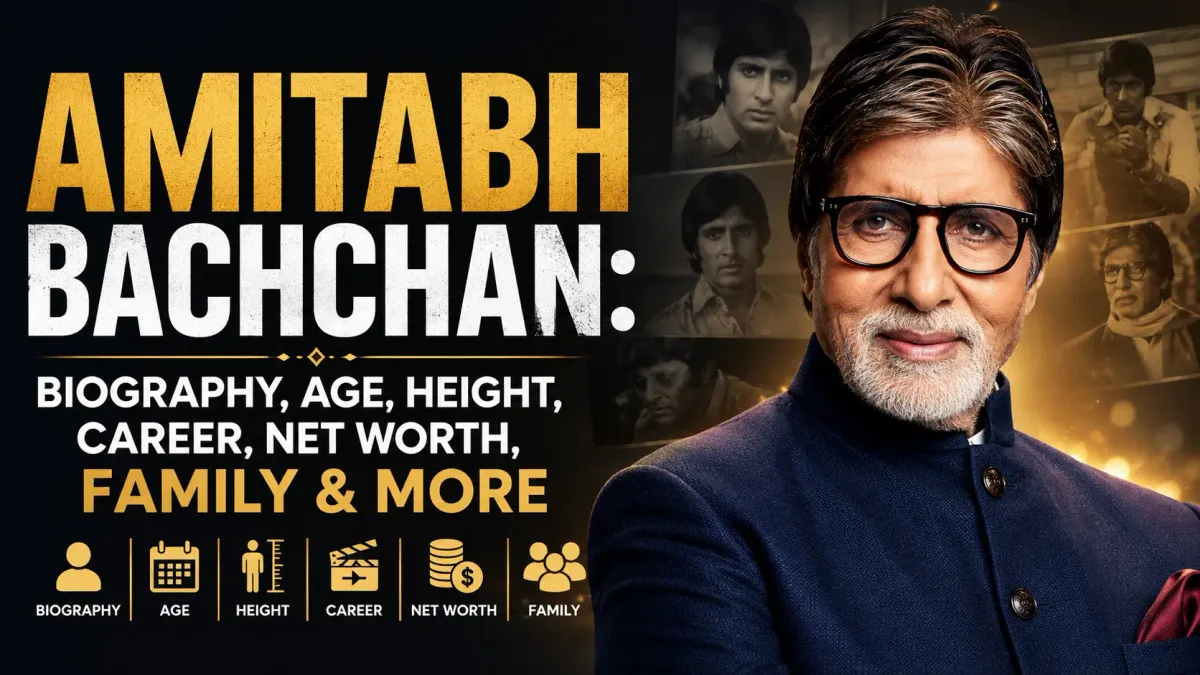
Amitabh Bachchan (born 11 October 1942) is an Indian actor, producer, television host, and former politician, widely regarded as the greatest and most influential actor in the history of Hindi cinema. Known as the "Shahenshah of Bollywood" and "Big B," he has appeared in over 200 films across a career spanning more than five decades. He is the recipient of the Dadasaheb Phalke Award, Padma Vibhushan, and six National Film Awards, among hundreds of other accolades.
There are legends, and then there is Amitabh Bachchan. Few names in the history of world cinema carry the weight, reverence, and raw emotional power that this one does. For over five decades, the man known simply as "Big B" has been more than a movie star — he has been a mirror to India itself, reflecting its aspirations, its anger, its grief, and its triumphs in every role he has inhabited.
Born into a family of poets and intellectuals in Allahabad in 1942, Amitabh Bachchan arrived in Mumbai with nothing but a dream, a distinctive baritone voice, and an unyielding work ethic. He faced rejection, endured eleven consecutive box-office failures, survived a near-fatal on-set accident, navigated political controversy, weathered bankruptcy, and still came back — each time more powerful than before. His story is not just the biography of a film star; it is the story of one of the most extraordinary second acts, third acts, and fourth acts in the history of public life.
Voted "the greatest star of stage or screen" in a BBC millennium poll ahead of Charles Chaplin, Laurence Olivier, and Marlon Brando, Bachchan is the only Indian actor whose influence transcends the subcontinent into a global cultural phenomenon. Today, at 83 years of age, he continues to act in major productions, host the beloved quiz show Kaun Banega Crorepati, and inspire generations of fans who were not even born when he first set the screen on fire.
This is the complete story of the Shahenshah of Bollywood.
Quick Biography Infobox
| Field | Information |
|---|---|
| Full Name | Amitabh Harivansh Bachchan (born Amitabh Srivastava) |
| Nickname | Big B, Shahenshah, Sadi ke Mahanayak, The Angry Young Man |
| Profession | Actor, Producer, Television Host, Former Politician, Playback Singer |
| Famous For | Revolutionizing Bollywood with the "angry young man" persona; hosting Kaun Banega Crorepati; films like Zanjeer, Sholay, Deewar, Black, Piku |
| Date of Birth | 11 October 1942 |
| Age | 83 years old (as of 2026) |
| Birthplace | Allahabad (now Prayagraj), Uttar Pradesh, British India |
| Nationality | Indian |
| Religion | Hinduism |
| Zodiac Sign | Libra |
| Height | 6 ft 2 in (1.88 m) |
| Weight | Approx. 80 kg |
| Eye Color | Dark Brown |
| Hair Color | Salt and Pepper (naturally grey) |
| Education | Bachelor of Arts (Science stream) |
| School | Boys' High School, Allahabad; Sherwood College, Nainital |
| College/University | Kirori Mal College, University of Delhi |
| Marital Status | Married |
| Spouse | Jaya Bhaduri Bachchan (married June 3, 1973) |
| Children | Shweta Bachchan Nanda (daughter), Abhishek Bachchan (son) |
| Parents | Father: Harivansh Rai Bachchan (poet); Mother: Teji Bachchan (social activist) |
| Siblings | Ajitabh Bachchan (younger brother) |
| Net Worth | Approx. ₹1,630–3,600 crore (~$190–450 million, as of 2025–26) |
| Monthly Income | Approx. ₹7–30 crore (from films, KBC, endorsements) |
| Hobbies | Blogging, poetry, reading, travel, fitness |
| Current Residence | Jalsa, Juhu, Mumbai, Maharashtra, India |
| Languages Known | Hindi, English, Urdu |
| Official Website | amitabhbachchan.com |
| Social Media Profiles | @SrBachchan (Twitter/X), @amitabhbachchan (Instagram, Facebook) |
Early Life and Background
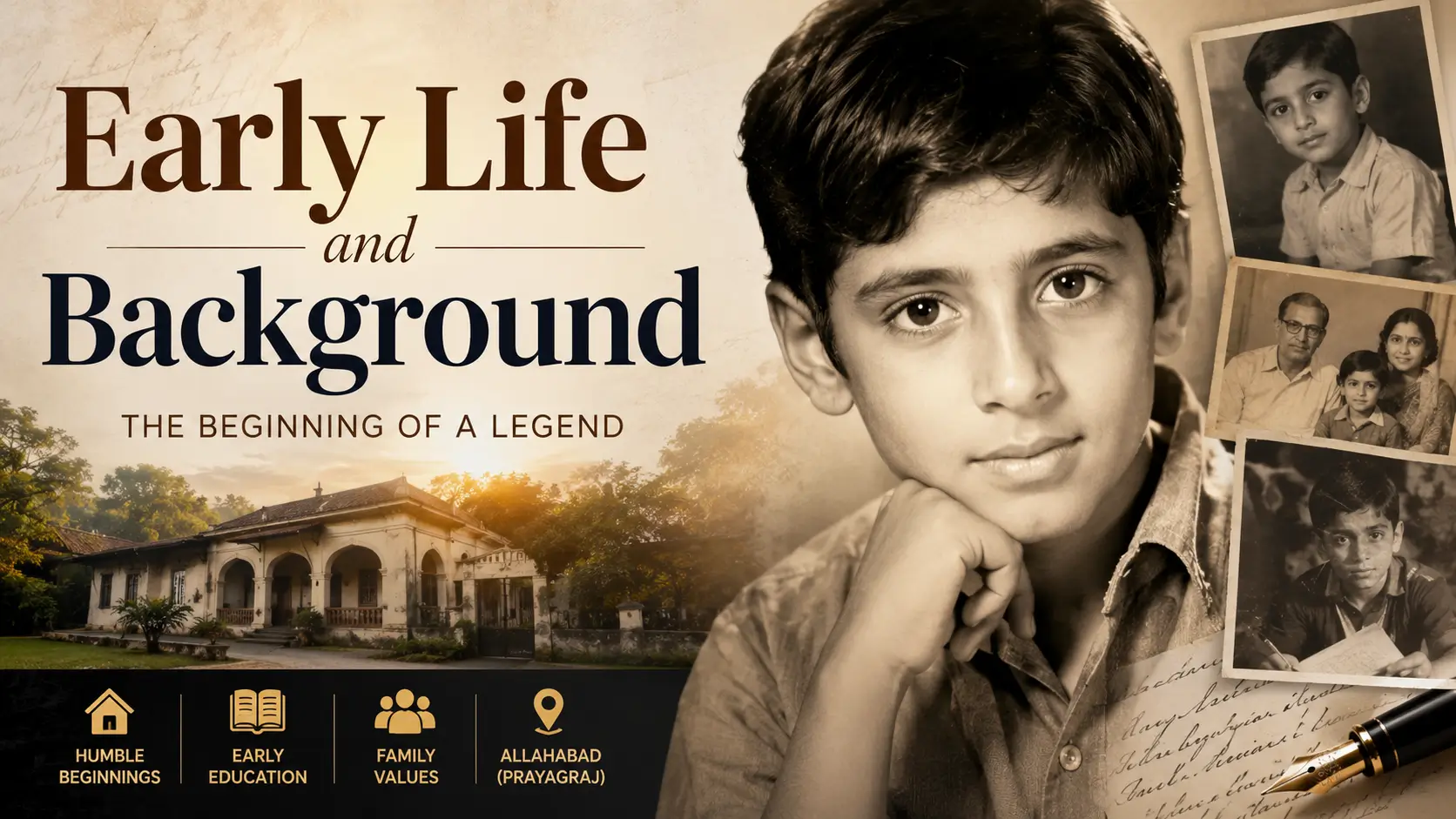
A Child Born Into Poetry
On the morning of 11 October 1942, in the city of Allahabad in what was then British India, a child was born into a household steeped in language, literature, and culture. His parents gave him the name Amitabh — a Sanskrit word meaning "one with everlasting light" or "the light that never dies." It would prove to be a remarkably prophetic name.
His father was Harivansh Rai Bachchan, one of the most celebrated Hindi-language poets of the 20th century, best known for his iconic work Madhushala (1935). The surname "Bachchan" — a pen name meaning "child-like" in Awadhi — was adopted as the family name on the advice of social reformers, replacing the ancestral surname "Srivastava." Amitabh's mother, Teji Bachchan, was a social activist of Punjabi Sikh origin, known for her warmth, grace, and sharp intellect. Together, they created a home where art, literature, and progressive values coexisted naturally.
Growing up in the culturally rich intellectual atmosphere of Allahabad, young Amitabh was surrounded by leading luminaries of Indian literature and politics. Family friends included the Nehru-Gandhi family — a connection that would later shape his path in unusual ways. He was quiet by temperament but deeply observant, absorbing the poetry recited in his father's study and developing an early sensitivity to language and expression that would later define his on-screen presence.
He has a younger brother, Ajitabh Bachchan, who chose a path in business rather than the arts.
A Towering Presence, Literally and Figuratively
Even as a child, Amitabh stood out physically. He grew unusually tall — eventually reaching 6 feet 2 inches — and developed a deep, resonant voice that drew attention. This distinctive baritone, often described as a voice from the gods, would simultaneously be his greatest professional asset and an early source of rejection.
He was also thoughtful and somewhat introverted, traits that perhaps explain his extraordinary ability to inhabit complex, layered characters on screen rather than simply playing the surface of a role.
Education
School Days: Nainital and Allahabad
Amitabh attended Boys' High School and College in Allahabad for his early schooling and the Jnana Prabodhini school. He was later enrolled at Sherwood College in Nainital — one of India's premier boarding schools — where he completed his Senior Cambridge. Sherwood College, nestled in the hills of Uttarakhand, was known for its rigorous academic discipline, its emphasis on discipline and character, and its strong Anglo-Indian traditions.
Bachchan has recalled his school years fondly. The boarding school environment, away from home, built the self-reliance and quiet resilience that would serve him through decades of professional ups and downs.
University: Delhi
After Sherwood College, Bachchan enrolled at Kirori Mal College, University of Delhi, where he studied science, graduating with a Bachelor of Arts degree. Delhi in the late 1950s was a city buzzing with post-Independence energy, and the university environment exposed Bachchan to a wide circle of thinkers, debaters, and artists.
It was during this period that his interest in performance and expression began to crystallize. He was drawn to theatre and public speaking, and his remarkable voice — which had not yet found its professional outlet — was already attracting attention among his peers.
After graduation, rather than heading to Bombay immediately, Bachchan took a detour to Calcutta, where he worked as a freight broker and executive with the shipping firm Shaw and Wallace & Co. for several years. It was a period of introspection — a young man of deep cultural sensibilities doing a corporate job, quietly preparing himself for the leap he was about to take.
Career Journey
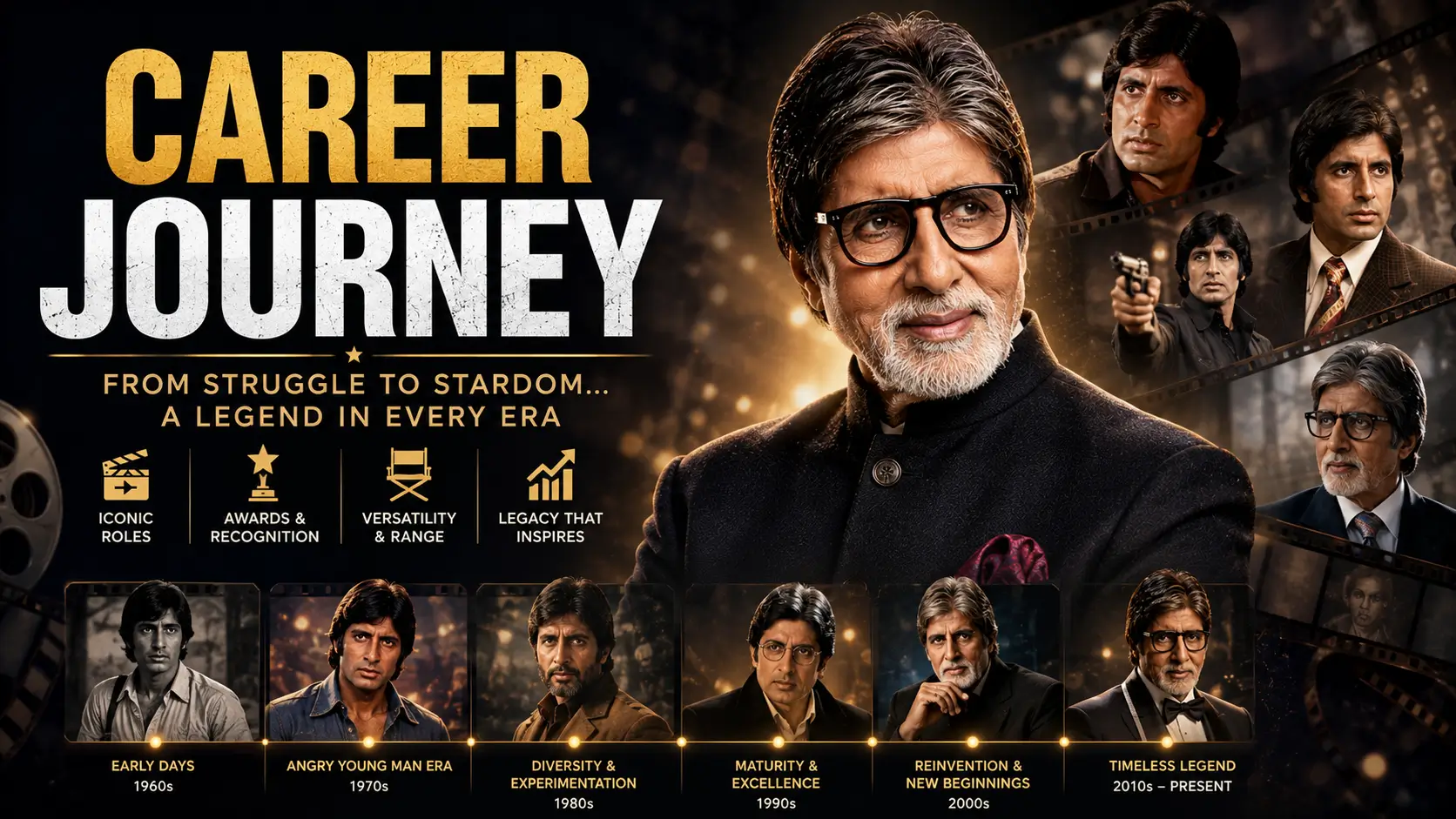
The Early Struggles (1969–1972): Eleven Flops and a Dream
When Amitabh Bachchan arrived in Bombay in 1968, the city's film industry was in love with fair-complexioned, romantically inclined heroes. The tall, dark, deep-voiced young man from Allahabad did not fit the mold. He was rejected by multiple producers on the basis of his looks. One famously noted that he did not have "the look" required for Hindi cinema.
Ironically, it was his voice — the very baritone that All India Radio had rejected him for (finding it too heavy) — that first got him work. He provided voice narration for Mrinal Sen's acclaimed 1969 film Bhuvan Shome, though he did not appear on screen.
His acting debut came with Saat Hindustani (1969), a patriotic drama directed by Khwaja Ahmad Abbas. The film flopped, but Bachchan won the National Film Award for Best Newcomer — a sign that talent evaluators could see something in him that the masses had not yet discovered.
What followed was one of the most painful stretches of any superstar's early career: eleven consecutive box-office failures. Films like Parwana (1971), Reshma Aur Shera (1971), Bombay to Goa (1972), and Raaste Kaa Patthar (1972) came and went without making a dent. Producers were not calling. The future seemed bleak.
He considered abandoning acting altogether.
The Angry Young Man Era (1973–1984): The Explosion
Everything changed in 1973 with a single film — and with two writers who changed the language of Indian cinema.
Screenwriting duo Salim Khan and Javed Akhtar (known collectively as Salim-Javed) had written a script for a crime film unlike anything Hindi cinema had seen before. It was raw, angry, and real. Director Prakash Mehra was attached, but they couldn't find a star willing to play the brooding, conflict-driven lead role. Every major name turned it down — the role went against the romantic-hero template of the era.
Salim Khan had a candidate in mind. He introduced Bachchan to Prakash Mehra and insisted on his casting. The film was Zanjeer (1973), and the rest, as they say, is history.
Zanjeer was a thunderclap. Bachchan's portrayal of the haunted, righteous police officer Vijay Khanna — a man driven by personal trauma, fighting a corrupt world with his fists and his fury — resonated with audiences who were themselves frustrated with social injustice and institutional corruption. A new archetype was born: the Angry Young Man. India had found its cinematic voice, and it sounded like Amitabh Bachchan.
The films that followed were a cascade of iconic performances:
- Deewaar (1975) – The gangster-versus-cop epic that gave Indian cinema its most quoted line: "Mere paas maa hai."
- Sholay (1975) – Still the highest-grossing film in Indian cinema history when adjusted for inflation, Sholay featured Bachchan as Jai, the quiet, self-sacrificing outlaw with a heart of gold. The film is considered the greatest Indian film ever made by many.
- Don (1978) – A slick, stylish double-role crime thriller that became a cultural phenomenon.
- Trishul (1978), Muqaddar Ka Sikandar (1978), Kaala Patthar (1979), Shakti (1982) – A relentless parade of blockbusters.
Between 1975 and 1984, Amitabh Bachchan was not merely the most popular actor in India — he was a force of nature. The queues for his films stretched for kilometers. Police were routinely called in to manage crowds. His face appeared on everything from posters to comic books. François Truffaut, the legendary French New Wave director, called him "a one-man industry."
He was also remarkably versatile within this era, demonstrating range in romantic films like Muqaddar Ka Sikandar and comedies like Namak Halaal (1982) and Satte Pe Satta (1982).
The Near-Fatal Accident (1982)
In 1982, while filming an action sequence for Coolie in Bangalore, Amitabh Bachchan suffered a near-fatal injury. His co-star, Puneet Issar, accidentally delivered a blow that caused severe internal injuries — a near-perforated intestine that required emergency surgery and left him hospitalized for weeks in critical condition.
The entire nation held its breath. Prayers were offered in temples, churches, mosques, and gurudwaras across India. Hema Malini said she had never seen crowds pray so fervently for any one person. Prime Minister Indira Gandhi visited him in hospital. The accident left him with chronic pain that he has lived with ever since, and it became a turning point in his thinking about his career and mortality.
Political Detour (1984–1987)
In the aftermath of Indira Gandhi's assassination in 1984, Amitabh Bachchan made a decision that surprised everyone: he quit Bollywood to contest the parliamentary election from Allahabad on a Congress party ticket, in honor of his close friend Rajiv Gandhi (now Prime Minister). He won by a landslide — the largest margin of victory in Indian electoral history at that time — and became a Member of Parliament.
But politics proved to be a world for which Bachchan had little patience. He found the environment disillusioning and resigned after barely three years, in 1987, citing his dissatisfaction with the institution. It was a rare public admission of personal disappointment from a man known for his stoicism.
His departure was further complicated when he and his brother Ajitabh were named in the Bofors scandal — allegations of receiving commissions in an arms deal — by Indian Express journalist Chitra Subramaniam. Bachchan vehemently denied the allegations, and he was eventually cleared of all charges, but the episode damaged his reputation and marked the beginning of a difficult period.
The Dark Years and Near-Bankruptcy (1990s)
The late 1980s and early 1990s were professionally turbulent. His return to films was initially successful — Shahenshah (1988) and Agneepath (1990), for which he won his second National Film Award — but a string of films underperformed, and audience tastes were shifting toward younger heroes like Salman Khan, Shah Rukh Khan, and Aamir Khan.
In 1996, Bachchan launched Amitabh Bachchan Corporation Limited (ABCL), an ambitious entertainment conglomerate he hoped would establish a new model for Indian cinema. The company secured the rights to the 1996 Miss World pageant held in Bangalore — a massive event — but was financially underprepared for its scale. The event's losses, combined with several film production failures, pushed ABCL toward insolvency.
Canara Bank sued him for outstanding loans. He sold assets to repay debts. His tax liabilities mounted. At one point, it appeared possible that one of India's greatest-ever stars could lose everything he had built. The man who had filled stadiums and paralyzed cities with adoration was now fighting courtroom battles.
But Amitabh Bachchan was not finished.
The Great Comeback (2000): KBC and Mohabbatein
In 2000, Bachchan accepted an offer to host the Indian version of Who Wants to Be a Millionaire? — Kaun Banega Crorepati on Star Plus. Some in the film industry raised eyebrows. Television was still considered a lesser medium.
What happened next was nothing short of spectacular.
KBC became a national sensation, and Bachchan was at its center — warm, authoritative, emotionally intelligent, and genuinely connected with every contestant who sat across from him. His famous phrase "Computer ji, lock kar dijiye" entered the vocabulary of the nation. The show's ratings shattered records. More importantly, it reminded a new generation of audiences what charisma truly looks like.
Simultaneously, Mohabbatein (2000), Kabhi Khushi Kabhie Gham (2001), and Baghban (2003) delivered box-office hits. The comeback was real, and it was complete. Filmfare called him the Superstar of the Millennium in 2000.
The Renaissance Years (2010–2020): Quality Over Quantity
If the 1970s established Bachchan's legend, the 2000s and 2010s confirmed his greatness. He shifted away from big-budget actioners toward complex, character-driven films that showcased the depth of his craft:
- Black (2005) – A devastating portrayal of a man teaching a deaf-blind woman, directed by Sanjay Leela Bhansali. Won the National Film Award for Best Actor.
- Paa (2009) – He played Auro, a 12-year-old boy with the rare aging disease Progeria, opposite his own son Abhishek Bachchan. The physical and emotional transformation was remarkable. Won the National Film Award for Best Actor.
- Piku (2015) – A delightful comedy-drama in which he played a curmudgeonly, hypochondriac father. Won the National Film Award for Best Actor.
- Pink (2016) – A powerful courtroom drama on consent and victim-blaming. Won his sixth National Film Award.
- 102 Not Out (2018) – A heartwarming film co-starring Rishi Kapoor.
- Badla (2019) – A slick Sujoy Ghosh thriller that became a massive commercial hit.
He also made his Hollywood debut in Baz Luhrmann's The Great Gatsby (2013), playing the Jewish gangster Meyer Wolfsheim.
Still Ruling at 80+ (2020–2026)
At an age when most careers have long concluded, Bachchan remains one of Indian cinema's most active and compelling performers:
- Gulabo Sitabo (2020) – A quirky, memorable comedy with Ayushmann Khurrana.
- Jhund (2022) – A passionate sports biopic about Vijay Barse, founder of Slum Soccer.
- Uunchai (2022) – A deeply moving film about friendship in old age.
- Brahmastra Part One: Shiva (2022) – A pivotal role in one of Bollywood's biggest fantasy epics.
- Kalki 2898 AD (2024) – Playing the immortal warrior Ashwatthama in this massive pan-Indian sci-fi epic alongside Prabhas and Deepika Padukone. The film grossed over ₹1,100 crore worldwide, becoming one of the highest-grossing Indian films of its year.
- Section 84 (2026) – Among his latest upcoming releases, further cementing his relevance at 83.
Filmography Highlights
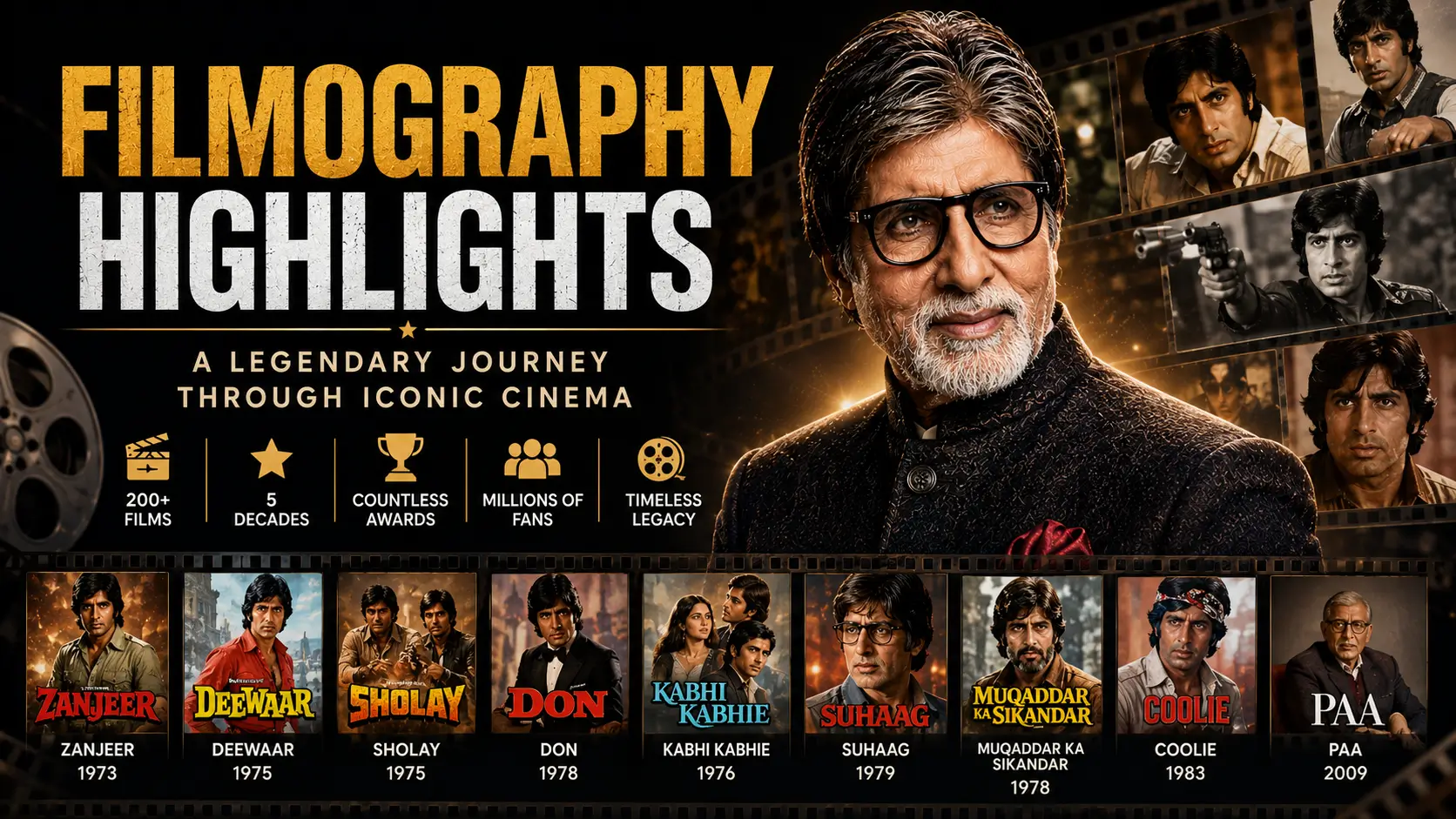
Iconic Films by Era
| Era | Film | Year | Role | Notable For |
|---|---|---|---|---|
| Early Career | Saat Hindustani | 1969 | Multiple | Debut film; National Award for Newcomer |
| Early Career | Anand | 1971 | Bhaskar Bannerjee | Breakthrough dramatic role |
| Angry Young Man | Zanjeer | 1973 | Vijay Khanna | Birth of the "Angry Young Man" |
| Angry Young Man | Deewaar | 1975 | Vijay Verma | Iconic gangster drama |
| Angry Young Man | Sholay | 1975 | Jai | Greatest Indian film ever made |
| Angry Young Man | Don | 1978 | Don/Vijay | Double-role classic |
| Angry Young Man | Muqaddar Ka Sikandar | 1978 | Sikandar | Romantic blockbuster |
| Angry Young Man | Kaala Patthar | 1979 | Vijay | Social drama classic |
| Comeback | Agneepath | 1990 | Vijay Chauhan | National Award #2 |
| Comeback | Mohabbatein | 2000 | Narayan Shankar | Commercial comeback |
| Renaissance | Black | 2005 | Debraj Sahai | National Award #3 |
| Renaissance | Paa | 2009 | Auro | National Award #4 |
| Renaissance | Piku | 2015 | Bhaskor Banerjee | National Award #5 |
| Renaissance | Pink | 2016 | Deepak Sehgal | National Award #6 |
| Modern Era | Brahmastra | 2022 | Guru | Fantasy blockbuster |
| Modern Era | Kalki 2898 AD | 2024 | Ashwatthama | ₹1,100+ crore gross |
Television: Kaun Banega Crorepati
Kaun Banega Crorepati (KBC) is not just a television show — it is a national institution, and Amitabh Bachchan is its soul. Since its debut in 2000 (an Indian adaptation of Who Wants to Be a Millionaire?), KBC has aired for 17+ seasons, with Bachchan hosting all but one (Season 3, hosted by Shah Rukh Khan in 2007).
The show has given ordinary Indians — farmers, teachers, homemakers, labourers — the chance to transform their lives. Bachchan's role as host goes beyond reading questions: he brings genuine empathy, humor, dignity, and emotional intelligence to every episode, connecting with contestants across every class, caste, and region.
For Season 17, he reportedly charged ₹5 crore per episode, making his weekly KBC income approximately ₹25 crore.
He also hosted one season of Bigg Boss (2009) and the miniseries Yudh (2014) — his first leading role in a TV drama.
Social Media Presence
Amitabh Bachchan is not merely a legacy actor with a token digital presence — he is a genuinely active and engaged social media personality. His Twitter/X account is consistently among the most engaged celebrity accounts in India, and his personal blog (BigBlog) has been a platform for his poetic, introspective, and often philosophical thoughts for over a decade.
| Platform | Username | Approx. Followers (2025) |
|---|---|---|
| Twitter/X | @SrBachchan | 49+ million |
| @amitabhbachchan | 38+ million | |
| Amitabh Bachchan | 34+ million | |
| YouTube | Amitabh Bachchan | 2+ million |
| Total Combined | — | ~124.5 million |
His social media is distinctive for its personal tone. He writes in a mix of Hindi, English, and Urdu, often posting late at night, sharing poetry, candid photographs from his daily life, health updates, and messages of gratitude to his fans. He famously greets fans gathered outside his home Jalsa every Sunday — a tradition he has maintained for decades that now brings hundreds of people to Juhu every week.
Physical Appearance
The Iconic Physique
Amitabh Bachchan stands at 6 feet 2 inches (1.88 m) — an uncommon height in Indian cinema of the 1970s, which made him an immediately commanding screen presence. His tall, lean, broad-shouldered build was tailor-made for the action roles that defined his early career.
He weighs approximately 80 kg, and despite his age, maintains a disciplined fitness routine. He has spoken publicly about his health challenges — including chronic back pain stemming from the 1982 Coolie accident, surgeries for various injuries over the years, and a battle with COVID-19 in 2020 — while continuing to take on physically demanding roles.
His most distinctive physical features are:
- Voice: A deep, resonant baritone that has been described as one of the most recognizable voices on the planet.
- Eyes: Dark, intense, expressive eyes that convey entire emotional landscapes without dialogue.
- Hair: Now naturally salt-and-pepper, his silver hair has become as iconic as his films.
Fashion Style
Bachchan has always been a style icon. In his youth, he popularized the kurta-pajama look, bell-bottom trousers, and the turtleneck in 1970s Bollywood. Today, he favors classic Indian formal wear — sherwani, kurta — combined with sharp Western suits, and his personal style is characterized by understated elegance rather than flamboyance.
He has no visible tattoos, and his public image is one of dignified gravitas combined with warmth.
Net Worth & Wealth Breakdown
Amitabh Bachchan's net worth is estimated variously between ₹1,630 crore (Hurun India Rich List 2025) and ₹3,600 crore, depending on whether brand valuation and the full extent of his real estate and investment portfolio are included. In US dollar terms, this places his wealth between approximately $190 million and $450 million.
He was reportedly one of India's top personal income tax payers in a recent financial year, having earned approximately ₹350 crore in a single year.
Net Worth Breakdown Table
| Income Source | Estimated Annual/Periodic Value |
|---|---|
| Film Acting Fees | ₹6–10 crore per film |
| KBC Hosting (Season 17) | ₹5 crore per episode (~₹25 crore/week during shooting) |
| Brand Endorsements | ₹5–15 crore per campaign; 15–20 active campaigns |
| Real Estate Portfolio | Estimated ₹400+ crore (total property value) |
| Investments (Stocks, Startups) | Multiple crore across PB Fintech, Stepapp, etc. |
| Production/Business Ventures | ABCL and related entities |
| Social Media & Digital Revenue | Multiple crore annually |
Properties
Bachchan's real estate portfolio is extensive and iconic:
- Jalsa – His 10,125 sq ft two-storey family home in Juhu, Mumbai, gifted to him by director Ramesh Sippy as remuneration for Satte Pe Satta (1982). Current value: ₹100–120 crore. This is where fans gather every Sunday.
- Pratiksha – His first Mumbai bungalow, bought in 1976 with Jaya Bachchan. Current value: ~₹50 crore. (Recently gifted to daughter Shweta Nanda.)
- Janak – Office bungalow in Juhu, worth ~₹9 crore.
- Vatsa – Commercially leased bungalow.
- Andheri Penthouse – Four merged bungalows on the 31st floor of the Parthenon Building, worth ~₹50 crore.
- Paris Apartment – Reportedly gifted to him by Jaya Bachchan.
- Agricultural land in Pawna (Pune) and other locations.
- In January 2025, he made a 168% profit on the resale of a Mumbai duplex.
Car Collection
| Car | Estimated Value |
|---|---|
| Rolls Royce Phantom | ₹10+ crore |
| Mercedes Benz GL 63 | ₹2+ crore |
| Porsche Cayman | ₹1.5+ crore |
| Range Rover | ₹1+ crore |
| Toyota Innova Crysta | ₹20+ lakh |
Brand Endorsements
Bachchan endorses brands across multiple categories, including Cadbury Dairy Milk, Dabur Chyawanprash, Kalyan Jewellers, Gujarat Tourism, JustDial, ICICI Prudential, upGrad, Cycle Agarbatti, Mankind Pharma, FirstCry, Navratna Oil, and many others. His endorsement value is driven not just by reach but by the credibility and trust he brings to every brand.
Family and Relationships
Parents: A Literary Legacy
Harivansh Rai Bachchan (1907–2003) was one of the most beloved Hindi poets of the 20th century, whose Madhushala (The Tavern) remains a timeless work of poetry read and recited across India to this day. He was a Padma Bhushan recipient and a towering figure in the Nayi Kavita (New Poetry) movement. His son absorbed his love of language, his work ethic, and his philosophical depth.
Teji Bachchan (1914–2007) was a social activist of Punjabi origin who converted to Hinduism upon marriage. She was known for her cultural activities, her connections to prominent political and literary figures, and her quiet strength. She lived to 93 and remained close to Amitabh until her passing.
Marriage: Jaya Bhaduri
Amitabh Bachchan met Jaya Bhaduri — already an acclaimed actress in her own right, having starred in Hrishikesh Mukherjee's beloved films — during the filming of Guddi (1971) and Zanjeer (1973). They married on 3 June 1973 in a quiet ceremony in Mumbai, shortly after the release of Zanjeer made it clear that Amitabh's career was about to explode.
Jaya chose to largely retire from acting after marriage, though she returned to the screen periodically and won a National Film Award herself for her performance in Aandhi (1975). She later entered politics, becoming a Member of Parliament (Rajya Sabha) for the Samajwadi Party — a position she has held for multiple terms.
The Bachchan marriage is one of the most enduring in Bollywood history — over 50 years and counting. Despite persistent media speculation over the decades, the couple have maintained their family life with dignity and privacy.
Children
Shweta Bachchan Nanda – Born in 1974, Shweta chose a path away from the film industry, marrying businessman Nikhil Nanda (grandson of Raj Kapoor) and working as a fashion contributor, author, and entrepreneur. She is an active presence on social media and at family events. She has two children: daughter Navya Naveli Nanda and son Agastya Nanda (who has recently made his own Bollywood debut).
Abhishek Bachchan – Born in 1976, Abhishek is a Bollywood actor with over 35 films to his credit, including Guru (2007), Manmarziyaan (2018), and the Dhoom series. He is married to Aishwarya Rai Bachchan, the former Miss World and one of Bollywood's most celebrated actresses. Their daughter Aaradhya Bachchan was born on 16 November 2011, making Amitabh Bachchan a grandfather for the first time.
The Bachchan family is often described as Bollywood's first family — a dynasty whose influence on Indian cinema spans three generations.
Controversies
The Bofors Scandal (1987–1988)
In 1987, Amitabh Bachchan and his brother Ajitabh were named by journalists in connection with the Bofors arms deal controversy, in which Swedish arms manufacturer Bofors allegedly paid commissions to Indian middlemen to secure a defense contract. The allegations caused significant personal and professional harm to Bachchan, contributing to his decision to leave Parliament.
He consistently and categorically denied any wrongdoing. Investigations by both the Swedish and Indian governments ultimately found no evidence to implicate him, and he was fully cleared of the allegations. He pursued legal action against the newspaper that had named him, and the case was eventually settled.
The experience left a lasting mark on Bachchan's relationship with politics and the media, making him more guarded in his public statements on political matters.
ABCL Financial Crisis (1990s)
His entertainment company ABCL's financial collapse, particularly after the costly 1996 Miss World event in Bangalore, led to public bankruptcy proceedings and lawsuits from creditors including Canara Bank. This was a very public fall from grace for a man who had been at the absolute pinnacle of fame. He resolved his debts over time and rebuilt his finances — but the episode remains a cautionary tale about the challenges of transitioning from artistic to entrepreneurial success.
Health Scares and Public Concern
Multiple health crises over the years — including the 1982 Coolie accident, his COVID-19 diagnosis in 2020, various surgeries, and most recently a routine hospitalization in May 2026 — have caused waves of public concern each time. His transparency with fans through his blog and social media about these episodes has been praised for its dignity and openness.
Alleged Relationship Rumors
Over the years, tabloids have published unsubstantiated rumors about Bachchan's personal relationships, most notably a long-running media narrative about his friendship with actress Rekha. Both parties have consistently declined to engage with these speculations in the press, and neither has confirmed or elaborated on them. These rumors are generally treated as a chapter of 1980s Bollywood mythology rather than documented fact.
Achievements & Awards
National & Government Honors
| Year | Award | Presented By |
|---|---|---|
| 1984 | Padma Shri (4th highest civilian award) | Government of India |
| 2001 | Padma Bhushan (3rd highest civilian award) | Government of India |
| 2007 | Officer of the Légion d'Honneur | Government of France |
| 2015 | Padma Vibhushan (2nd highest civilian award) | Government of India |
| 2019 | Dadasaheb Phalke Award (Lifetime Achievement) | Government of India |
National Film Awards (Best Actor)
| Year | Film | Notes |
|---|---|---|
| 1969 | Saat Hindustani | Best Newcomer |
| 1991 | Agneepath | Best Actor |
| 2006 | Black | Best Actor |
| 2010 | Paa | Best Actor |
| 2016 | Piku | Best Actor |
| 2017 | Pink | Best Actor |
Filmfare Awards (Selected)
- 16 Filmfare Awards total (most nominated performer in Filmfare history with 42 nominations)
- Filmfare Lifetime Achievement Award (1991) — the first recipient of this honor
- Filmfare Superstar of the Millennium (2000)
- Filmfare Best Actor for: Zanjeer, Deewaar, Don, Amar Akbar Anthony, Satte Pe Satta, Black, Piku, Pink, and others
International Honors
| Year | Honor |
|---|---|
| 1999 | BBC Your Millennium Poll: Greatest Star of Stage or Screen |
| 2000 | First living Asian modeled in wax at Madame Tussauds, London |
| 2001 | Actor of the Century – Alexandria International Film Festival |
| 2003 | Time magazine: "Undisputed Godfather of Bollywood" |
| 2005 | Walter Reade Theater, Lincoln Center, New York: "Biggest Film Star in the World" |
| 2014 | Scholarship named after him at La Trobe University, Australia |
Interesting Facts
- He was rejected by All India Radio for his audition as a newsreader — they said his voice was too deep. It became the most recognizable voice in India.
- He almost didn't become an actor. After 11 consecutive flops, he seriously considered walking away from cinema entirely.
- His Sholay character, Jai, was not originally written for him. The role was redesigned significantly after Bachchan was cast.
- He maintains a personal blog — writing in an evocative stream-of-consciousness style, often late at night — that he has updated almost daily for years. It is one of the most widely-read celebrity blogs in India.
- He hates the word "Bollywood." He has said in multiple interviews that he finds the portmanteau disrespectful to Indian cinema's legacy and prefers the term "Hindi cinema."
- His wax figure at Madame Tussauds was the first for a living Asian person when it was unveiled in June 2000.
- He received the Légion d'Honneur from France in 2007 — the first Indian actor to receive this honor. France's ambassador described him as "the number-one actor of Indian cinema."
- He reportedly jumped from a height of 30 feet alongside Manoj Bajpai at the age of 58 during the filming of Aks (2001).
- Jalsa, his home, was a gift. Director Ramesh Sippy reportedly gave him the Juhu bungalow as payment for his role in Satte Pe Satta (1982). It is now one of the most famous private residences in India.
- He is a trained playback singer. Several of his songs — including "Rang Barse" from Silsila — have become classics in their own right.
- He named his production company ABCL — his initials, standing for Amitabh Bachchan Corporation Limited.
- He co-owns a tennis team — the OUE Singapore Slammers in the International Premier Tennis League.
- He was an early adopter of Twitter in India, amassing tens of millions of followers and helping establish celebrity social media culture in the country.
- The Sholay character Jai was supposed to survive. Director Ramesh Sippy originally planned for both Jai and Veeru to live. Bachchan's death scene at the film's climax became one of the most emotionally devastating moments in Indian cinema history.
- His father's poetry is still quoted at his film promotion events. The connection between Madhushala and Sholay in the Indian cultural imagination speaks to how deeply the Bachchan legacy runs.
Career & Life Timeline
| Year | Event |
|---|---|
| 1942 | Born on 11 October in Allahabad, UP, British India |
| 1958 | Enrolls at Kirori Mal College, University of Delhi |
| 1963 | Moves to Calcutta; works at Shaw and Wallace & Co. |
| 1968 | Moves to Bombay to pursue acting |
| 1969 | Film debut: Saat Hindustani; wins National Award for Best Newcomer |
| 1969–1972 | Eleven consecutive box-office failures |
| 1973 | Zanjeer becomes a blockbuster; marries Jaya Bhaduri on 3 June |
| 1975 | Deewaar and Sholay released; becomes superstar |
| 1978 | Don and Muqaddar Ka Sikandar released |
| 1979 | Kaala Patthar released |
| 1982 | Near-fatal injury on the sets of Coolie; gifted Jalsa bungalow |
| 1984 | Wins Padma Shri; elected MP from Allahabad with record majority |
| 1987 | Resigns from Parliament |
| 1990 | Agneepath – wins second National Film Award |
| 1991 | Receives first-ever Filmfare Lifetime Achievement Award |
| 1996 | Founds ABCL; company later faces financial crisis |
| 1999 | Voted Greatest Star of Stage or Screen in BBC Millennium Poll |
| 2000 | KBC Season 1 launches; named Filmfare Superstar of the Millennium |
| 2001 | Receives Padma Bhushan; first living Asian at Madame Tussauds |
| 2005 | Black – wins third National Film Award |
| 2007 | Receives France's Légion d'Honneur |
| 2009 | Paa – wins fourth National Film Award |
| 2013 | Hollywood debut in Baz Luhrmann's The Great Gatsby |
| 2015 | Piku – wins fifth National Film Award; receives Padma Vibhushan |
| 2016 | Pink – wins sixth National Film Award |
| 2019 | Receives Dadasaheb Phalke Award – India's highest film honor |
| 2020 | Tests positive for COVID-19; recovers; Gulabo Sitabo released |
| 2022 | Jhund, Uunchai, and Brahmastra released |
| 2024 | Kalki 2898 AD grosses ₹1,100+ crore worldwide |
| 2026 | Section 84 and other projects in pipeline; continues KBC hosting |
Popular Quotes
"I am not the richest man in the world, but I am the happiest. I have a family that loves me."
"I have never really been confident about my career at any stage."
"Everyone must accept that we will age and age is not always flattering."
"Don't live in the glory of the past. The present is where the challenge lies."
"Like any other father I feel proud to see my son on the silver screen."
"I wish I had time to learn all the languages of our country. I wish I knew how to play a musical instrument. There are many things I feel I have missed out on."
Public Image & Legacy
The Cultural Phenomenon
Amitabh Bachchan is not simply famous — he is a cultural institution. His impact on Indian cinema, society, and popular culture is so extensive that it requires its own framework to understand.
In the 1970s, his "Angry Young Man" persona gave voice to the frustrations of a generation of educated, unemployed young Indians who felt failed by the post-Independence promise. His characters — named Vijay almost reflexively, battling corrupt systems, fighting injustice with their fists — were not just entertainment. They were therapy. He articulated a national mood that no politician or journalist had captured.
This is why the French New Wave's most analytical director called him "a one-man industry" — Truffaut understood that Bachchan was doing cultural work at a scale that dwarfed what any individual normally accomplishes.
The Comeback Story
Beyond his artistic legacy, Bachchan's biography as a story of resilience has itself become a part of his myth. The man who faced 11 flops. The man who almost died on a film set. The man who entered politics and felt disillusioned. The man who faced bankruptcy. The man who came back — each time — to heights greater than where he had been before. For Indians who have faced personal failure and found the courage to persist, Amitabh Bachchan is not just a star. He is proof that second acts are possible.
The Digital Elder Statesman
In his eighties, Bachchan has navigated the transition to digital culture with a grace that eludes most legacy entertainers. His blog is literary. His Twitter presence is personal. He does not perform for the algorithm — he simply shares himself, and the response is enormous. He represents a version of celebrity that is built on decades of earned trust rather than manufactured virality.
Impact on Indian Cinema
He is the single most influential figure in the evolution of the Hindi-film hero. Before him, heroes were romantic and passive. After him, the action hero with moral depth became the template. Virtually every major Bollywood actor of the subsequent three generations — from Shah Rukh Khan to Hrithik Roshan to Ranveer Singh — has at some point named him as a primary influence.
He has also been a champion of socially relevant cinema, taking on films about disability (Black, Paa), gender justice (Pink), elderly dignity (Uunchai, Piku), and social exclusion (Jhund) at a stage in his career when lesser actors would be resting on their laurels.
Latest News & Current Status (2026)
As of June 2026, Amitabh Bachchan at 83 remains one of the most active and sought-after figures in Indian entertainment.
Health: In May 2026, reports briefly circulated of a hospital visit. Sources close to the actor confirmed it was a routine monthly checkup at Nanavati Hospital, and he returned home the same day. He publicly continued his Sunday fan-greeting tradition and maintained his active social media presence — including late-night posts on his blog — throughout the period, dispelling concerns about his wellbeing.
Upcoming Films: His pipeline includes Section 84 (2026), the sequel Kalki 2898 AD Part 2, Aankhen 2, and other projects currently in production or pre-production. He was reportedly in discussions for a powerful social thriller as well.
KBC: As host of Kaun Banega Crorepati, he continues to be one of Indian television's most commanding presences, with Season 17 having wrapped to massive viewership.
Family: His grandson Agastya Nanda (son of Shweta Bachchan Nanda) has recently made his Bollywood debut, extending the Bachchan dynasty into its third generation on screen.
The Shahenshah of Bollywood shows no signs of abdication.
Frequently Asked Questions (FAQs)
Q1: Who is Amitabh Bachchan?
Amitabh Bachchan is an Indian actor, producer, television host, and former politician, widely regarded as the greatest actor in the history of Hindi cinema. He is known as "Big B" and the "Shahenshah of Bollywood," with a career spanning over 55 years and 200+ films.
Q2: How old is Amitabh Bachchan?
Amitabh Bachchan was born on 11 October 1942. He is 83 years old as of 2026.
Q3: What is Amitabh Bachchan's net worth in 2026?
His net worth is estimated between ₹1,630 crore (Hurun India Rich List 2025) and ₹3,600 crore, depending on the methodology, making him one of the wealthiest actors in India.
Q4: Is Amitabh Bachchan married?
Yes. He has been married to actress and politician Jaya Bhaduri Bachchan since 3 June 1973. They have two children: Shweta Bachchan Nanda and Abhishek Bachchan.
Q5: What is Amitabh Bachchan famous for?
He is famous for revolutionizing the Bollywood action hero with the "Angry Young Man" persona, for iconic films like Zanjeer (1973), Sholay (1975), Deewaar (1975), Black (2005), and Piku (2015), and for hosting the television quiz show Kaun Banega Crorepati.
Q6: Where was Amitabh Bachchan born?
He was born in Allahabad (now renamed Prayagraj), Uttar Pradesh, in what was then British India.
Q7: What is Amitabh Bachchan's height?
Amitabh Bachchan is 6 feet 2 inches tall (1.88 metres).
Q8: How many National Film Awards has Amitabh Bachchan won?
He has won six National Film Awards as Best Actor (for Agneepath, Black, Paa, Piku, and Pink), plus a National Award for Best Newcomer (Saat Hindustani), and the prestigious Dadasaheb Phalke Award in 2019.
Q9: What is the Dadasaheb Phalke Award?
The Dadasaheb Phalke Award is India's highest honor in cinema, awarded by the Government of India for outstanding contribution to the growth and development of Indian cinema. Amitabh Bachchan received it in 2019.
Q10: What was Amitabh Bachchan's breakthrough film?
Zanjeer (1973), directed by Prakash Mehra and written by Salim-Javed, was his breakthrough film. It established his "Angry Young Man" persona and launched him to superstardom.
Q11: Does Amitabh Bachchan have children?
Yes. He has a daughter, Shweta Bachchan Nanda, and a son, Abhishek Bachchan (a Bollywood actor married to actress Aishwarya Rai Bachchan).
Q12: What are Amitabh Bachchan's most recent films?
His most recent major releases include Kalki 2898 AD (2024) and Uunchai (2022). Upcoming releases in 2026 include Section 84 and Kalki 2898 AD Part 2.
Q13: Did Amitabh Bachchan ever appear in Hollywood?
Yes. He made his Hollywood debut in Baz Luhrmann's The Great Gatsby (2013), playing the character Meyer Wolfsheim.
Q14: What is Amitabh Bachchan's religion?
He follows Hinduism.
Q15: What awards has Amitabh Bachchan received from the Government of India?
He has been honored with the Padma Shri (1984), Padma Bhushan (2001), Padma Vibhushan (2015), and Dadasaheb Phalke Award (2019).
Q16: What is KBC (Kaun Banega Crorepati)?
Kaun Banega Crorepati is the Indian adaptation of Who Wants to Be a Millionaire?, hosted by Amitabh Bachchan since its launch in 2000. It has run for 17+ seasons and is one of India's most popular television programs.
Q17: Where does Amitabh Bachchan live?
He lives at Jalsa, his iconic two-storey bungalow in Juhu, Mumbai, Maharashtra.
Q18: What is Amitabh Bachchan's father famous for?
His father, Harivansh Rai Bachchan, was one of India's most beloved Hindi poets, best known for Madhushala (1935), a philosophical work about life and wine that remains widely read and recited today.
Q19: Has Amitabh Bachchan ever been involved in politics?
Yes. He was elected as a Member of Parliament from Allahabad in 1984, winning by the largest margin in Indian electoral history at the time. He resigned in 1987, citing disillusionment with political life.
Q20: What is Amitabh Bachchan's education?
He attended Sherwood College, Nainital, and graduated with a Bachelor of Arts from Kirori Mal College, University of Delhi.
Q21: What is Amitabh Bachchan's nickname?
He is widely known as "Big B," "Shahenshah" (Emperor), "Sadi ke Mahanayak" (Superstar of the Century), and "The Angry Young Man."
Q22: Is Amitabh Bachchan active on social media?
Yes. He is active on Twitter/X (@SrBachchan, 49+ million followers), Instagram (@amitabhbachchan, 38+ million followers), Facebook (34+ million followers), and maintains a personal blog. His combined social media following exceeds 124.5 million.
Q23: What is Amitabh Bachchan's monthly income?
His monthly income from all sources — films, KBC, brand endorsements — is estimated at approximately ₹7 crore or more during active working periods, and significantly higher during KBC shooting seasons (up to ₹25 crore per week from KBC alone).
Q24: What is Amitabh Bachchan's legacy in Indian cinema?
He transformed the Hindi film hero from a passive romantic figure into an action-oriented, morally complex character. He is credited with revolutionizing Bollywood storytelling in the 1970s, inspiring three generations of actors, and using his later career to champion socially significant films on topics from gender justice to disability.
Q25: How did Amitabh Bachchan overcome his early career failures?
Despite 11 initial box-office failures, he persisted through the belief of screenwriters Salim-Javed and director Prakash Mehra, who cast him in Zanjeer (1973). The film's success launched the greatest run of stardom in Indian cinema history. Throughout his career, he has repeatedly overcome adversity — financial, physical, and professional — through discipline, reinvention, and sheer talent.
Last updated: June 2026. This article is regularly reviewed and updated to reflect the most current information available about Amitabh Bachchan.