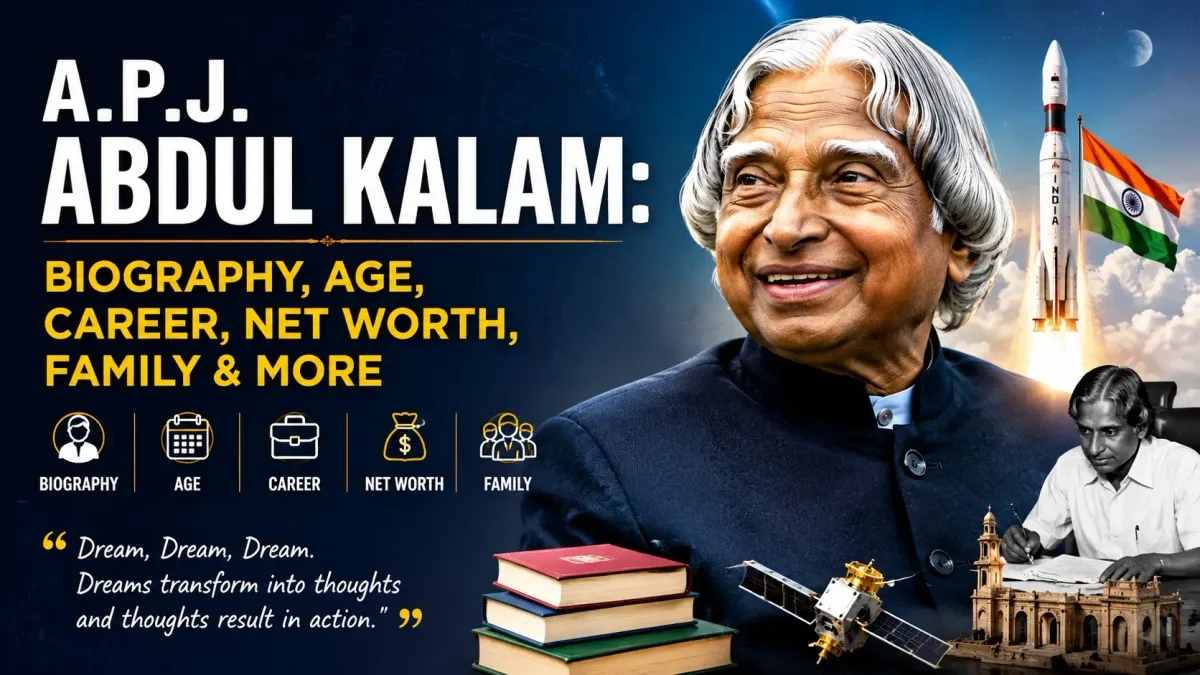
A.P.J. Abdul Kalam: Biography, Age, Career, Net Worth, Family & More

Few names evoke as much collective warmth and respect in India as Dr. A.P.J. Abdul Kalam. A boy who once sold newspapers on the streets of a small pilgrim town grew up to become one of the architects of India's missile and space programmes, and later, its 11th President — fondly remembered as the "People's President." His story is not just a biography; it is a masterclass in humility, discipline, and the audacity to dream big regardless of circumstance.
Born Avul Pakir Jainulabdeen Abdul Kalam on 15 October 1931 in Rameswaram, Tamil Nadu, he was an Indian aerospace engineer and statesman who served as the president of India from 2002 to 2007. Long before politics, he spent the next four decades as a scientist and science administrator, mainly at the Defence Research and Development Organisation (DRDO) and Indian Space Research Organisation (ISRO), where he was intimately involved in India's civilian space programme and military missile development efforts. This body of work earned him the enduring nickname "Missile Man of India" for his role in developing ballistic missile and launch vehicle technology, and he also played a pivotal organisational, technical, and political role in the Pokhran-II nuclear tests of 1998, India's second such test after the first in 1974.
What makes Kalam's story so widely loved isn't just the science or the presidency — it's the humanity behind it. He never married, lived a famously simple life, wrote poetry, played the veena, and spent his final years doing what he loved most: teaching. He collapsed and passed away in 2015 while delivering a lecture to students, a fittingly symbolic end to a life devoted to igniting young minds.
This in-depth biography walks through his childhood, education, scientific career, presidency, personal life, books, awards, controversies, legacy, and the many ways India continues to honor him today.
Quick Facts: A.P.J. Abdul Kalam Infobox
| Field | Information |
|---|---|
| Full Name | Avul Pakir Jainulabdeen Abdul Kalam |
| Nickname | Missile Man of India, People's President |
| Profession | Aerospace Scientist, Author, Professor, 11th President of India |
| Famous For | India's missile & space programmes, Pokhran-II nuclear tests, presidency (2002–2007) |
| Date of Birth | 15 October 1931 |
| Date of Death | 27 July 2015 (aged 83) |
| Birthplace | Rameswaram (Dhanushkodi), Madras Presidency, British India (now Tamil Nadu) |
| Nationality | Indian |
| Religion | Islam (widely admired for his interfaith outlook) |
| Zodiac Sign | Libra |
| Height | Approx. 5 ft 5 in (165 cm) |
| Weight | Not publicly documented |
| Eye Color | Dark Brown |
| Hair Color | White/Grey (later years) |
| Education | Physics; Aeronautical/Aerospace Engineering |
| School | Schwartz Higher Secondary School, Ramanathapuram |
| College/University | St. Joseph's College, Tiruchirappalli; Madras Institute of Technology (MIT), Chennai |
| Marital Status | Unmarried (Bachelor) |
| Boyfriend/Girlfriend/Partner | None publicly known |
| Spouse | None — Kalam never married; he chose to focus on his career and his passion for science and technology |
| Children | None |
| Parents | Father: Jainulabdeen, a boat owner; Mother: Ashiamma, a homemaker |
| Siblings | Four siblings — three elder brothers and one elder sister |
| Net Worth | Estimated modest personal wealth; lived a famously frugal lifestyle |
| Monthly Income | Presidential pension, book royalties, honoraria from lectures (post-presidency) |
| Hobbies | Reading, writing poetry, playing the veena, teaching, bird-watching |
| Current Residence | N/A (deceased; resided at 10 Rajaji Marg, New Delhi, before his passing) |
| Languages Known | Tamil, English, Hindi |
| Official Website | Archived presidential profile at presidentofindia.nic.in |
| Social Media Profiles | Legacy accounts maintained by APJ Abdul Kalam Foundation |
Early Life and Background
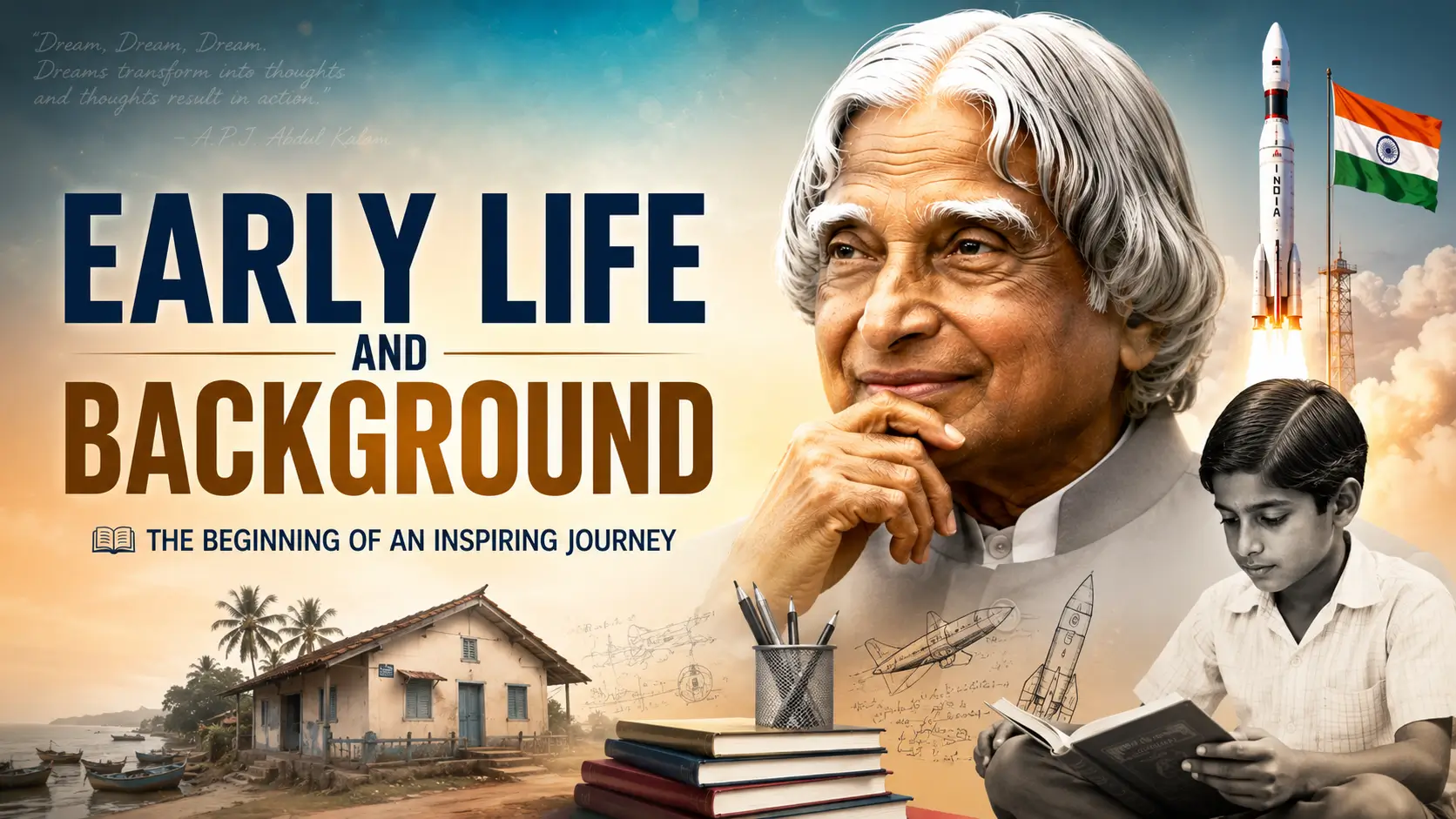
Avul Pakir Jainulabdeen Abdul Kalam was born on 15 October 1931 to a Tamil Muslim family in the pilgrimage center of Rameswaram on Pamban Island, Madras Presidency — now part of Tamil Nadu. Some accounts place his precise birthplace as the nearby island town of Dhanushkodi, though Rameswaram is most widely cited.
His household was anything but wealthy. His father, Jainulabdeen, was a boat owner, and his mother, Ashiamma, was a homemaker. Interestingly, several accounts note that Jainulabdeen also served as an imam of a local mosque, giving the family a respected, if modest, standing in their community. Some sources add a fascinating historical detail: Kalam's ancestors were once wealthy merchants and landowners who traded groceries between the mainland and the island, and to and from Sri Lanka, and ferried pilgrims across to Pamban Island — a legacy of trade and seafaring that had faded by the time of Kalam's birth.
Kalam was the youngest in a large family. Reports vary slightly on the exact number of siblings, but he was raised alongside three elder brothers and one elder sister in a home defined by warmth despite limited means. To help support the household, young Kalam sold newspapers, remaining dedicated to his studies even as he juggled these responsibilities.
Even as a child, Kalam displayed an unusual intensity of curiosity. He developed an early fascination with flight simply from watching birds, and this blossomed into a serious interest in aeronautics after he came across a newspaper article about a British fighter plane. This childhood wonder — watching gulls wheel over the Rameswaram coastline — would eventually set the course for one of India's most consequential scientific careers.
Teachers and neighbors often described him as an "average" student in the conventional sense, but one with an unmistakable hunger to learn, particularly drawn to mathematics and the physical sciences. Growing up in a religiously mixed and culturally rich pilgrim town also shaped his lifelong belief in interfaith harmony — a theme he would return to often in his later writing and speeches.
Education
Kalam's academic path, while unglamorous by elite standards, was marked by steady determination.
- Schooling: He completed his early education at the Schwartz Higher Secondary School in Ramanathapuram, near his hometown.
- Undergraduate Studies: He went on to study physics at St. Joseph's College, Tiruchirappalli, graduating in 1954, an institution affiliated with the University of Madras.
- Aerospace Engineering: Driven by his childhood dream of flight, Kalam then moved to Chennai to pursue aeronautical engineering at the Madras Institute of Technology (MIT). He is widely reported to have graduated around 1960.
His time at MIT proved formative — the rigorous, hands-on engineering training here gave him the technical foundation he would later apply across satellite launch vehicles and missile systems. Kalam himself often spoke of one incident at MIT where a professor threatened to withdraw his scholarship if he failed to complete a challenging aircraft design project on time; Kalam met the deadline, an early sign of the discipline that would define his career.
Notably, Kalam initially dreamed of becoming a fighter pilot. His hopes of joining the Indian Air Force were dashed when he narrowly missed out on a coveted slot — reportedly finishing just short of qualifying in the selection process. Rather than see this as defeat, Kalam redirected his ambitions toward aerospace engineering and research, a pivot that arguably changed the course of Indian science.
In later decades, Kalam's academic achievements were recognized well beyond his original degrees: he received honorary doctorates from institutions across India and abroad, including universities in the United Kingdom and the United States.
Career Journey
Entry into Science: DRDO and Early Struggles
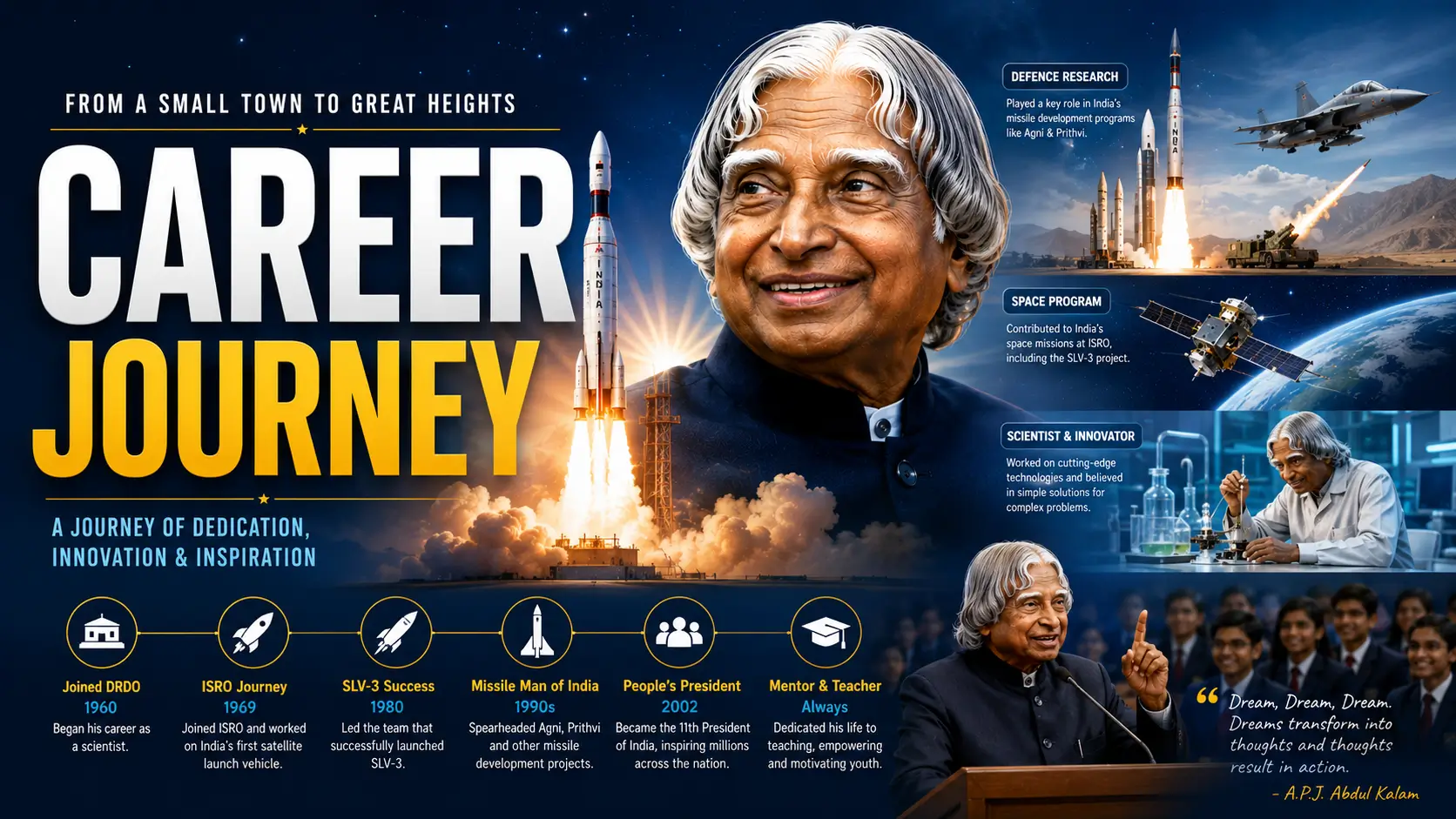
Kalam's professional career began in 1958, when he joined the Defence Research and Development Organisation (DRDO) as a senior scientific assistant. These early years were not glamorous — Kalam worked on hovercraft designs and other technical projects that offered little public recognition, but they honed his engineering instincts.
Rise at ISRO: Building India's Launch Vehicle Programme
A turning point came in 1969, when Kalam moved to the newly formed Indian Space Research Organisation (ISRO), where he was named project director of the SLV-III, India's first satellite launch vehicle. This was an extraordinarily high-stakes assignment: India's space programme was still nascent, resources were limited, and expectations were sky-high.
Kalam made a landmark contribution as Project Director in developing India's first indigenous Satellite Launch Vehicle (SLV-III), which successfully placed the Rohini satellite into near-earth orbit in July 1980, making India an exclusive member of the global "space club" — a group of nations capable of launching their own satellites. It's worth noting the road here wasn't smooth; earlier SLV test attempts had failed publicly, and Kalam later wrote candidly about the pressure and disappointment of those setbacks before the eventual 1980 success. He was also responsible for shaping the evolution of ISRO's broader launch vehicle programme, particularly the configuration of the PSLV, which remains one of ISRO's most reliable workhorse rockets to this day.
Back to DRDO: The "Missile Man" Emerges
In 1982, Kalam returned to DRDO, this time in a leadership capacity. He planned the Integrated Guided Missile Development Programme (IGMDP), which went on to produce a number of successful missiles. Among these was Agni, India's first intermediate-range ballistic missile, which incorporated technology derived from the SLV-III and was first launched in 1989. The programme also delivered the surface-to-surface tactical missile Prithvi. Earlier missile projects under his stewardship, referenced in several accounts as "Project Devil" and "Project Valiant," laid the technical groundwork for these later successes.
It was this body of work — transforming India from a country dependent on imported defense technology into one capable of designing and building its own missile systems — that earned Kalam the nickname that would follow him for the rest of his life: the Missile Man of India.
Scientific Advisor and the Pokhran-II Nuclear Tests
From 1992 to 1999, Kalam served as scientific adviser to India's defense minister, and he later served as principal scientific adviser to the government from 1999 to 2001, holding the rank of a cabinet minister. During this period, he played a key role in the government's weaponization of missile systems, contributing significantly to India's nuclear capability. In 1998, he was one of the chief coordinators of the Pokhran-II series of nuclear tests, in which five bombs were detonated at a test range in Pokhran, Rajasthan. This achievement placed India firmly among the world's nuclear-capable nations, though it also drew international scrutiny and sanctions — a subject explored later in the Controversies section.
Beyond missiles and nuclear tests, Kalam also chaired the Technology Information, Forecasting and Assessment Council (TIFAC), where he led a team of around 500 experts to develop "Technology Vision 2020," a roadmap for transforming India from a developing nation into a developed one.
A Rare Human Touch: The Kalam-Raju Stent
One of the lesser-known but deeply human chapters of Kalam's scientific career involves medicine rather than missiles. In 1998, working alongside cardiologist Dr. Soma Raju, Kalam helped develop a low-cost coronary stent, which was later named the "Kalam-Raju Stent." The duo also designed an affordable tablet PC intended for healthcare use in rural areas, named the "Kalam-Raju Tablet." Both inventions reflected Kalam's enduring belief that science should directly serve ordinary citizens, particularly in underserved regions.
Presidency: India's 11th President
By the early 2000s, Kalam had become one of India's most publicly beloved scientists — a status that eventually propelled him toward the country's highest constitutional office.
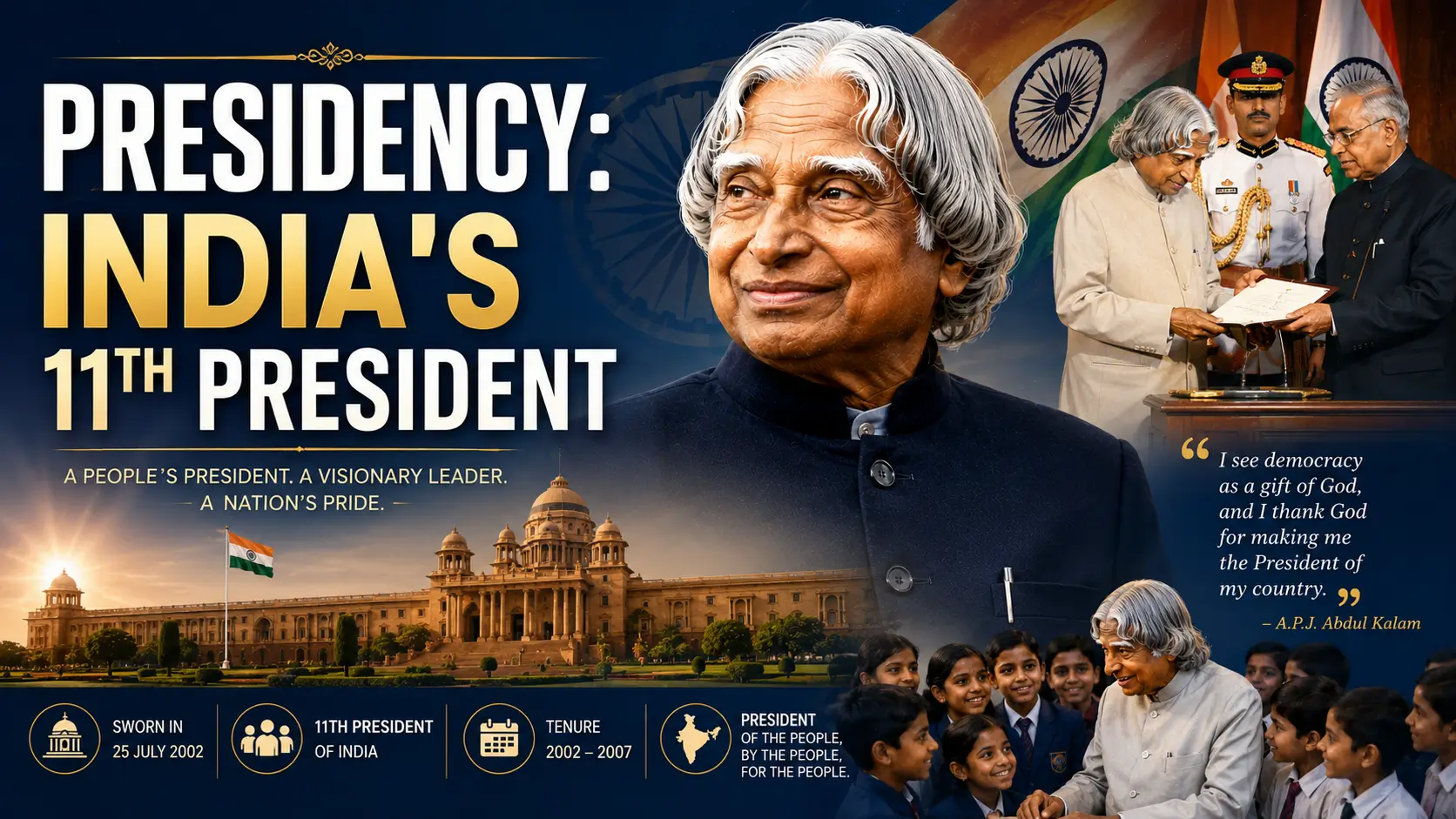
In 2002, India's ruling National Democratic Alliance (NDA) put forward Kalam to succeed outgoing President Kocheril Raman Narayanan. What made his candidacy remarkable was its cross-party appeal: Kalam's stature and popular appeal were such that he was nominated by the Hindu nationalist NDA despite being Muslim, and even the main opposition party, the Indian National Congress, proposed his candidacy. Kalam went on to comfortably win the vote of the electoral college, defeating former revolutionary leader Lakshmi Sahgal, reportedly securing around 922,884 votes in the process.
He was sworn in as India's 11th president — a largely ceremonial post — in July 2002, officially assuming office on 25 July 2002. Throughout his five-year term, Kalam distinguished himself not through political maneuvering but through direct, warm engagement with citizens, especially students. He set a goal of conducting 500,000 one-on-one meetings with young people over the course of his term, and multiple sources note he personally interacted with more than one million students throughout his life. This approachable style earned him the affectionate title "People's President."
His time in Rashtrapati Bhavan was also historically notable for another reason: Kalam was the first unmarried scientist to occupy the presidential residence. Rather than surrounding himself with the trappings of high office, he maintained a visibly simple lifestyle, reportedly donating a significant portion of his salary to charitable causes and continuing to write and read voraciously even while in office.
Not every decision during his presidency was without controversy — a notable and difficult one, discussed further below, involved his handling of mercy petitions from death-row convicts. Kalam himself later described the toughest call of his presidency as the decision to sign the Office of Profit Bill.
Kalam left office at the end of his term in 2007 and was succeeded by Pratibha Patil, India's first woman president. In 2012, as speculation grew about a potential second term amid the expiry of Pratibha Patil's tenure, social media saw a surge of public support for Kalam's candidature, with the BJP and Trinamool Congress reportedly keen on backing him, while the Congress opposed the idea. Kalam ultimately declined to contest, stating with characteristic humility that while he was moved by the public's affection, he respected the collective wish and thanked citizens for their trust.
Upon returning to civilian life, Kalam remained committed to using science and technology to transform India into a developed country, and he served as a lecturer at a number of universities, a role that would occupy him until the very last day of his life.
Social Media Presence & Digital Legacy
Because Kalam passed away in 2015, before Indian public life became saturated with modern influencer-style social media engagement, he never personally built a large following on platforms like Instagram or TikTok in the way contemporary public figures do. However, his digital footprint and posthumous influence remain enormous:
- Twitter/X: Kalam maintained an active presence in his later years, frequently posting messages encouraging students, sharing reflections on national development, and engaging directly with young followers. Legacy content and archived posts continue to circulate widely.
- YouTube: Thousands of his lectures, interviews, and speeches — many delivered at schools, colleges, and public forums — remain among the most-watched educational and motivational content related to any Indian public figure, frequently re-uploaded and subtitled for new generations.
- Facebook: Official tribute pages and the APJ Abdul Kalam Foundation maintain a substantial following, regularly posting his quotes, anniversaries, and archival photographs.
- Instagram: Fan-run and foundation-affiliated accounts share daily quote graphics, historical images, and motivational content drawing from his books and speeches.
Social Media Snapshot (Legacy & Tribute Accounts)
| Platform | Account Type | Estimated Following |
|---|---|---|
| Twitter/X | Legacy/Archived Posts & Tribute Pages | Millions of cumulative engagements |
| YouTube | Speech & Lecture Archives | Tens of millions of cumulative views |
| APJ Abdul Kalam Foundation & Tribute Pages | Several million combined followers | |
| Fan & Foundation Pages | Millions of combined followers |
His digital influence is unusual in that it grows after death — every October 15 (his birthday, observed as World Students' Day) and July 27 (his death anniversary), social media in India sees a massive resurgence of tributes, quote-sharing, and retrospective content, led by everyone from ordinary citizens to the Prime Minister of India.
Physical Appearance
Kalam was known less for physical flamboyance and more for a distinctive, instantly recognizable personal style:
- Height & Build: He stood at approximately 5 feet 5 inches, with a slight, unassuming build that belied his towering intellectual stature.
- Signature Look: Kalam was almost always seen with his characteristic side-swept white hair in his later years, a warm smile, and simple attire — typically plain shirts or the classic bandhgala/safari suits favored by Indian statesmen, without ostentatious accessories.
- Fitness & Lifestyle: He maintained an active, disciplined routine well into his 80s, reportedly sleeping only a few hours a night and dedicating much of his time to reading, writing, and travel for lectures.
- Fashion Style: Kalam avoided luxury branding entirely; his wardrobe was famously modest, in keeping with his broader philosophy of simple living.
- Public Image: His appearance — humble, approachable, more "favorite professor" than "head of state" — became inseparable from his public persona as the People's President.
Net Worth
Unlike many public figures whose biographies emphasize wealth, business empires, or luxury assets, A.P.J. Abdul Kalam is remembered precisely for the opposite — a life of conspicuous simplicity despite reaching the highest office in the country.
Kalam's income during his lifetime came primarily from:
- Government salary as a senior DRDO/ISRO scientist and later as Principal Scientific Adviser (Cabinet Minister rank)
- Presidential salary and post-presidency pension
- Book royalties from his numerous bestselling titles, including Wings of Fire and Ignited Minds
- Honoraria from lectures delivered at universities and institutions in India and abroad after his presidency
- Awards and prize money associated with honors such as the Bharat Ratna
He was widely reported to have donated substantial portions of his income and royalties to charitable trusts, educational initiatives, and causes supporting underprivileged students — consistent with his public philosophy that "wealth without work" and vanity were among the deadly pitfalls of a meaningful life. He did not own significant real estate, luxury vehicles, or business interests, and there is no reliable public estimate of net worth in the way it is calculated for entertainers or entrepreneurs, largely because Kalam's life was not built around asset accumulation.
Net Worth & Income Breakdown (Illustrative)
| Income Source | Description |
|---|---|
| Government/Scientific Salary | Earnings from DRDO, ISRO, and Principal Scientific Adviser roles |
| Presidential Salary & Pension | Compensation during and after his 2002–2007 term |
| Book Royalties | Multiple bestselling titles across two decades |
| Lecture Honoraria | Fees from academic and public speaking engagements post-2007 |
| Awards & Prize Money | Bharat Ratna and other civilian/international honors |
| Luxury Assets | None significant publicly documented |
| Charitable Giving | Reported substantial donations from royalties and honoraria |
Family and Relationships
Kalam's family life was rooted firmly in his humble Rameswaram upbringing.
- Parents: His father, Jainulabdeen, was a boat owner, and his mother, Ashiamma, was a homemaker, with several sources noting his father also served as a local imam.
- Siblings: He was the youngest among a total of five siblings — three elder brothers (Qasim Mohammad, Mustafa Kamal, and Mohd Muthu Meera Lebai Marikayar) and one elder sister (Asim Zohra), according to several biographical accounts (spellings and exact sibling counts vary slightly across sources, and readers should treat these specific names as commonly cited but not universally verified).
- Marriage & Relationships: Kalam remained unmarried throughout his life. He chose to focus on his career and his passion for science and technology, dedicating his time and energy to his work and to inspiring young people rather than starting a family of his own. When later asked about this choice, Kalam remarked candidly that regarding marriage, "it — somehow, it didn't happen," adding that one person remaining unmarried in such a large family was not really an issue.
- Children: He had no children of his own but is widely described as a father figure to generations of Indian students, many of whom referred to him affectionately as a mentor or "Kalam sir."
- Close Relationships: Kalam was known for close, lasting friendships with fellow scientists and collaborators, including cardiologist Dr. Soma Raju (his stent-development partner) and co-author Arun Tiwari, with whom he wrote several books, including his celebrated autobiography.
- Dating Rumors: There are no credible or documented dating rumors associated with Kalam; his public image remained consistently centered on his professional and academic life rather than romantic relationships.
Despite never marrying or having biological children, Kalam is frequently remembered as one of the most emotionally accessible public figures in Indian history — a man who prioritized relationships with students, teachers, and everyday citizens over conventional family structures.
Controversies
True to his largely non-partisan, service-oriented public image, Kalam's career was relatively free of major personal scandal. However, a few genuine points of public debate and criticism did arise during his presidency and after:
- Mercy Petitions Controversy: During his presidential tenure, Kalam faced criticism for delays in deciding the fate of mercy petitions submitted by death-row convicts. Critics argued that several cases remained pending for extended periods without resolution, though defenders noted the genuine legal and moral complexity involved in capital punishment decisions, and that subsequent presidents also faced similar backlogs.
- Bihar President's Rule Decision (2005): As President, Kalam approved putting the state of Bihar under President's Rule in 2005, a move that drew political criticism from some quarters as premature or influenced by the central government of the time, though it was later validated through subsequent legal and political processes.
- Pokhran-II International Fallout: While celebrated domestically, the 1998 Pokhran-II nuclear tests, in which Kalam played a central role, resulted in international condemnation and economic sanctions from several world powers. Domestically, however, Kalam was hailed as a national hero for his staunch defense of the country's security, and this remains the dominant narrative in India.
Beyond these specific episodes, Kalam largely avoided the personal scandals, financial controversies, or public disputes that mark many political careers. His post-presidency reputation, if anything, grew stronger over time, cementing his status as one of independent India's most universally respected public figures across the political spectrum.
Achievements & Awards
Kalam's decades of contribution to Indian science, defense, and public life earned him an extraordinary list of honors.
Major Civilian Awards
| Award | Year |
|---|---|
| Padma Bhushan | 1981 |
| Padma Vibhushan | 1990 |
| Bharat Ratna (India's highest civilian honor) | 1997 |
| Indira Gandhi Award for National Integration | 1997 |
| Veer Savarkar Award | 1998 |
| Ramanujan Award | 2000 |
| King Charles II Medal (Royal Society) | 2007 |
| Hoover Medal (ASME Foundation, USA) | 2009 |
| Von Braun Award (National Space Society) | 2013, for excellence in the management and leadership of a space-related project |
Academic and Institutional Honors
- Honorary doctorates from approximately 40 universities worldwide, including institutions such as the University of Edinburgh and Oakland University.
- Ranked second in the "Greatest Indian" poll conducted by Outlook magazine in 2012.
- Kalam's birthday, 15 October, is observed nationally as World Students' Day, and the Tamil Nadu government separately declared it "Youth Renaissance Day" in 2015.
- In September 2014, India and the United States launched the Fulbright-Kalam Climate Fellowship, enabling Indian doctoral researchers to collaborate with U.S. institutions.
Memorials and Namesakes
- In August 2015, Aurangzeb Road in New Delhi was renamed Dr. APJ Abdul Kalam Road in his honor.
- In September 2015, the national missile test site on Wheeler Island, Odisha, was renamed Abdul Kalam Island.
- In October 2015, a 6,180-meter Himalayan peak near the Bara Shigri Glacier was named Mount Kalam.
- Several institutions, including the Dr. APJ Abdul Kalam Missile Complex in Hyderabad, Dr. A.P.J. Abdul Kalam Science City in Patna, and the Dr. Abdul Kalam Science Centre and Planetarium in Puducherry, bear his name.
- A large-scale memorial and the Tamil Nadu government's "Dr. APJ Abdul Kalam Award" were established in his honor, recognizing individuals who advance science, humanities, or student welfare.
Interesting Facts About A.P.J. Abdul Kalam
- Kalam was the first scientist and the first unmarried individual to become President of India.
- As a boy, he supported his family financially by selling newspapers before and after school.
- His childhood dream was to become a fighter pilot; he fell just short of qualifying for the Indian Air Force.
- He authored his autobiography "Wings of Fire," which chronicles his journey from a small coastal town to the presidency of India.
- He was famously vegetarian and known for a strict, disciplined daily routine, often sleeping only a handful of hours each night.
- Kalam co-invented a low-cost coronary stent with cardiologist Dr. Soma Raju, applying his engineering mind to public healthcare.
- He played the veena, a South Indian classical string instrument, and enjoyed listening to Carnatic music.
- His birth anniversary, October 15, is celebrated nationally as World Students' Day.
- In 2017, a new species of bacterium discovered aboard the International Space Station, Solibacillus kalamii, was named in his honor.
- Despite reaching the highest office in the land, he remained known for his humility and deep, personal connection with children and students throughout his life.
- He passed away doing what he loved most — delivering a lecture to students at IIM Shillong.
Career and Life Timeline
| Year | Event |
|---|---|
| 1931 | Born on 15 October in Rameswaram, Madras Presidency |
| 1954 | Graduated in Physics from St. Joseph's College, Tiruchirappalli |
| ~1960 | Graduated in Aeronautical Engineering from Madras Institute of Technology |
| 1958 | Joined DRDO as a senior scientific assistant |
| 1969 | Moved to ISRO; named project director of the SLV-III |
| 1980 | SLV-III successfully launches the Rohini satellite, making India a "space club" member |
| 1981 | Awarded the Padma Bhushan |
| 1982 | Returns to DRDO; begins the Integrated Guided Missile Development Programme |
| 1989 | First launch of the Agni intermediate-range ballistic missile |
| 1990 | Awarded the Padma Vibhushan |
| 1992–1999 | Serves as Scientific Adviser to India's Defence Minister |
| 1997 | Awarded the Bharat Ratna, India's highest civilian honor |
| 1998 | Plays a key coordinating role in the Pokhran-II nuclear tests |
| 1999 | Publishes autobiography Wings of Fire |
| 1999–2001 | Serves as Principal Scientific Adviser to the Government of India (Cabinet Minister rank) |
| 2002 | Elected as the 11th President of India, sworn in on 25 July |
| 2005 | Approves President's Rule in Bihar |
| 2007 | Completes presidential term; succeeded by Pratibha Patil |
| 2012 | Ranked second in Outlook magazine's "Greatest Indian" poll; declines potential second presidential term |
| 2013 | Receives the Von Braun Award from the National Space Society |
| 2015 | Passes away on 27 July after collapsing while lecturing at IIM Shillong |
| 2017 | A memorial is inaugurated near his hometown of Rameswaram |
Popular Quotes
Kalam's speeches and books produced some of the most widely circulated inspirational lines in Indian public discourse. A few of his most enduring reflections (paraphrased below, in keeping with careful sourcing practice):
- On dreams and ambition, Kalam often described a genuine dream as something so powerful it keeps a person from sleeping rather than something experienced while asleep.
- He frequently urged young people to set audacious goals, warning that having only a small aim was itself a kind of failure.
- On resilience, he described difficulties as necessary companions to success — without struggle, achievement loses its meaning.
- He often spoke about the role of family and teachers in building a corruption-free society, naming fathers, mothers, and teachers as the three pillars capable of shaping a nation's character.
- On learning from failure, he liked to reframe setbacks as the "first attempt" in a longer process of learning, rather than an endpoint.
- He often reminded audiences that confidence paired with hard work was the most reliable antidote to failure.
For direct quotations from his books and speeches, readers can explore his own works, particularly Wings of Fire and Ignited Minds, or verified quote archives such as Wikiquote and Goodreads.
Books, Projects & Missions
Kalam was a remarkably prolific author, publishing steadily from the late 1990s until his death.
Selected Bibliography
| Title | Year | Notes |
|---|---|---|
| Wings of Fire: An Autobiography | 1999 | His celebrated autobiography, co-written with Arun Tiwari |
| Ignited Minds: Unleashing the Power within India | 2002 | Explores India's potential through youth empowerment |
| India 2020: A Vision for the New Millennium | — | Outlines his vision for a developed India |
| Envisioning an Empowered Nation | 2004 | Co-authored with A. Sivathanu Pillai |
| The Luminous Sparks: A Biography in Verse and Colours | 2004 | A creative, poetry-driven work |
| Guiding Souls: Dialogues on the Purpose of Life | 2005 | Co-authored with Arun Tiwari |
| Mission India: A Vision for Indian Youth | 2005 | Co-authored with Manav Gupta |
| Inspiring Thoughts: Quotation Series | 2007 | A curated collection of quotations |
| You Are Born to Blossom | 2010 | Co-authored with Arun Tiwari |
| Target 3 Billion | 2011 | Co-authored with Srijan Pal Singh, on sustainable development |
| My Journey: Transforming Dreams into Actions | — | Reflective memoir-style work |
| Reignited: Scientific Pathways to a Brighter Future | 2015 | Co-authored with Srijan Pal Singh |
| Transcendence: My Spiritual Experiences with Pramukh Swamiji | 2015 | Co-authored with Arun Tiwari |
| Advantage India: From Challenge to Opportunity | 2015 | Co-authored with Srijan Pal Singh |
Major Missions and Programmes
- SLV-III Programme (ISRO): India's first indigenous satellite launch vehicle
- Integrated Guided Missile Development Programme (IGMDP): Producing the Agni and Prithvi missile families
- Pokhran-II Nuclear Test Coordination (1998)
- Technology Vision 2020 (TIFAC)
- Kalam-Raju Coronary Stent and Tablet PC (with Dr. Soma Raju)
- "What Can I Give?" Movement: A post-presidency initiative encouraging Indian youth to contribute to fighting corruption and serving the nation
- PURA (Providing Urban Amenities in Rural Areas): A rural development vision Kalam championed extensively
On-Screen Depictions
In 2008, a documentary titled "A Little Dream," directed by P. Dhanapal, was released in India. In the 2011 Hindi film "I Am Kalam," a poor but bright Rajasthani boy renames himself Kalam in honor of his idol. "People's President," a 2016 Indian documentary directed by Pankaj Vyas, was produced by the Government of India's Films Division. A biopic titled "A.P.J. Abdul Kalam: The Missile Man" was also announced, with its first look released in February 2020.
Public Image & Legacy
Few Indian public figures have straddled the worlds of hard science and popular affection as seamlessly as Kalam. He was, at once, a serious defense scientist responsible for some of India's most sensitive strategic programmes, and a beloved, almost grandfatherly figure to millions of schoolchildren.
His legacy operates on multiple levels:
As a Scientist: Kalam is remembered as one of the principal architects of India's indigenous space launch capability and missile deterrent, transforming the country from a technology importer into a self-reliant defense and space power.
As a Statesman: His presidency, though largely ceremonial in constitutional terms, redefined public expectations of the office. Political leaders continue to describe him as "a visionary who ignited young minds and inspired our nation to dream big", a sentiment echoed across the political spectrum regardless of party affiliation.
As an Educator: Perhaps his most enduring legacy is educational. His relentless engagement with students — reportedly over a million interactions across his lifetime — cemented his reputation as a teacher first and a politician a distant second.
As a Cultural Icon: Kalam's image — simple, warm, endlessly curious — has become a kind of civic shorthand in India for integrity and meritocratic achievement against long odds. His story is taught in schools nationwide as an example of what discipline and curiosity can achieve regardless of economic background.
Government leaders continue to invoke his memory regularly; for instance, Prime Minister Narendra Modi has referred to Kalam as a "Rashtra Ratna" (Jewel of the Nation), highlighting his journey from humble beginnings in Rameswaram — where he sold newspapers to support his family — to becoming India's leading aerospace scientist and its 11th President.
Latest News & Current Status
Although Kalam passed away in July 2015, his presence in Indian public life remains remarkably active through tributes, commemorations, and institutional honors.
- Annual Tributes: Every year on his birth anniversary (15 October, observed as World Students' Day) and death anniversary (27 July), Indian leaders across party lines, government bodies, and citizens pay public tribute. In a recent commemoration, Prime Minister Modi chaired tributes describing Kalam's presidency as focused on "transforming India into a self-reliant and developed nation," a legacy he said "continues to inspire generations".
- Institutional Recognition: Kalam continues to be formally honored as one of India's most distinguished scientists, with events such as seminars, lectures, and workshops organized nationwide around his anniversaries.
- Ongoing Cultural Presence: His books remain consistent bestsellers in Indian nonfiction, particularly among students preparing for competitive exams and young readers seeking motivational literature.
- Memorial Developments: The Dr. A.P.J. Abdul Kalam Memorial in Rameswaram, developed by the DRDO, continues to draw visitors as a pilgrimage site of sorts for admirers of his life and work.
His name and legacy remain deeply embedded in India's ongoing conversations about science policy, youth empowerment, and public service.
Frequently Asked Questions (FAQs)
1. Who is A.P.J. Abdul Kalam?
A.P.J. Abdul Kalam was an Indian aerospace scientist and statesman who served as the 11th President of India from 2002 to 2007, widely known as the "Missile Man of India."
2. When was A.P.J. Abdul Kalam born?
He was born on 15 October 1931 in Rameswaram, Tamil Nadu.
3. When did A.P.J. Abdul Kalam die, and how old was he?
He passed away on 27 July 2015 at the age of 83, after collapsing while delivering a lecture at IIM Shillong.
4. What is A.P.J. Abdul Kalam's full name?
His full name was Avul Pakir Jainulabdeen Abdul Kalam.
5. Why is Kalam called the "Missile Man of India"?
He earned the nickname for his central role in developing India's ballistic missile programme, particularly the Agni and Prithvi missiles, through the Integrated Guided Missile Development Programme.
6. Was A.P.J. Abdul Kalam married?
No, Kalam remained unmarried throughout his life, choosing to dedicate himself fully to science, teaching, and public service.
7. What is A.P.J. Abdul Kalam's net worth?
There is no standard net-worth figure associated with Kalam; he lived a notably modest lifestyle and did not accumulate significant personal wealth, luxury assets, or business holdings.
8. What was Kalam's role in India's nuclear programme?
He served as one of the chief coordinators of the 1998 Pokhran-II nuclear tests, which established India's nuclear-capable status.
9. What is A.P.J. Abdul Kalam famous for?
He is famous for his contributions to India's missile and space programmes, his role in the Pokhran-II nuclear tests, and his tenure as India's 11th President.
10. Where did A.P.J. Abdul Kalam study?
He studied physics at St. Joseph's College, Tiruchirappalli, and aeronautical engineering at the Madras Institute of Technology.
11. What books did A.P.J. Abdul Kalam write?
He authored numerous books, including "Wings of Fire," "Ignited Minds," "India 2020," "My Journey," and "Target 3 Billion," among others.
12. Did A.P.J. Abdul Kalam receive the Bharat Ratna?
Yes, he was awarded the Bharat Ratna, India's highest civilian honor, in 1997.
13. What was Kalam's role at ISRO?
He served as project director of the SLV-III, India's first satellite launch vehicle, which successfully placed the Rohini satellite into orbit in 1980.
14. When did Kalam become President of India?
He was sworn in as India's 11th President on 25 July 2002.
15. Who succeeded Kalam as President of India?
Pratibha Patil succeeded him as President in 2007, becoming India's first woman president.
16. Why is Kalam called the "People's President"?
He earned this title for his accessible, humble style of governance and his extensive direct engagement with ordinary citizens, particularly students.
17. Did Kalam ever consider a second presidential term?
In 2012, there was significant public support for a second term, but Kalam declined to contest, citing respect for the collective wishes of political stakeholders.
18. What is Kalam's connection to World Students' Day?
His birthday, 15 October, is observed as World Students' Day in recognition of his lifelong dedication to education and youth mentorship.
19. What controversies did Kalam face during his presidency?
He faced criticism over delays in deciding mercy petitions from death-row convicts and for approving President's Rule in Bihar in 2005.
20. Did A.P.J. Abdul Kalam have children?
No, he had no children of his own but is widely regarded as a mentor figure to generations of Indian students.
21. What medical invention is Kalam associated with?
He co-developed a low-cost coronary stent with cardiologist Dr. Soma Raju, known as the "Kalam-Raju Stent."
22. Where was A.P.J. Abdul Kalam buried?
He was buried with full state honors at Rameswaram's Pei Karumbu ground, where a memorial now stands in his honor.
23. What awards did Kalam receive besides the Bharat Ratna?
He also received the Padma Bhushan (1981), Padma Vibhushan (1990), Hoover Medal, King Charles II Medal, and honorary doctorates from around 40 universities.
24. Is there a movie based on A.P.J. Abdul Kalam's life?
Yes, several films and documentaries reference his life, including "I Am Kalam" (2011) and the documentary "People's President" (2016), along with an announced biopic, "A.P.J. Abdul Kalam: The Missile Man."
25. What is Kalam's lasting legacy in India?
He is remembered as a scientific pioneer, a unifying statesman, and above all, an educator whose life continues to inspire discipline, curiosity, and public service among young Indians.
Note on sourcing: This article draws on Wikipedia, Encyclopaedia Britannica, the official Presidential archive, and multiple independent biographical sources. Sibling names, exact birthplace (Rameswaram vs. Dhanushkodi), and a few minor personal details vary slightly across sources; where discrepancies exist, the most widely corroborated version has been used and flagged for transparency.