Badruddin Ajmal: Biography, Age, Career, Net Worth, Family & More

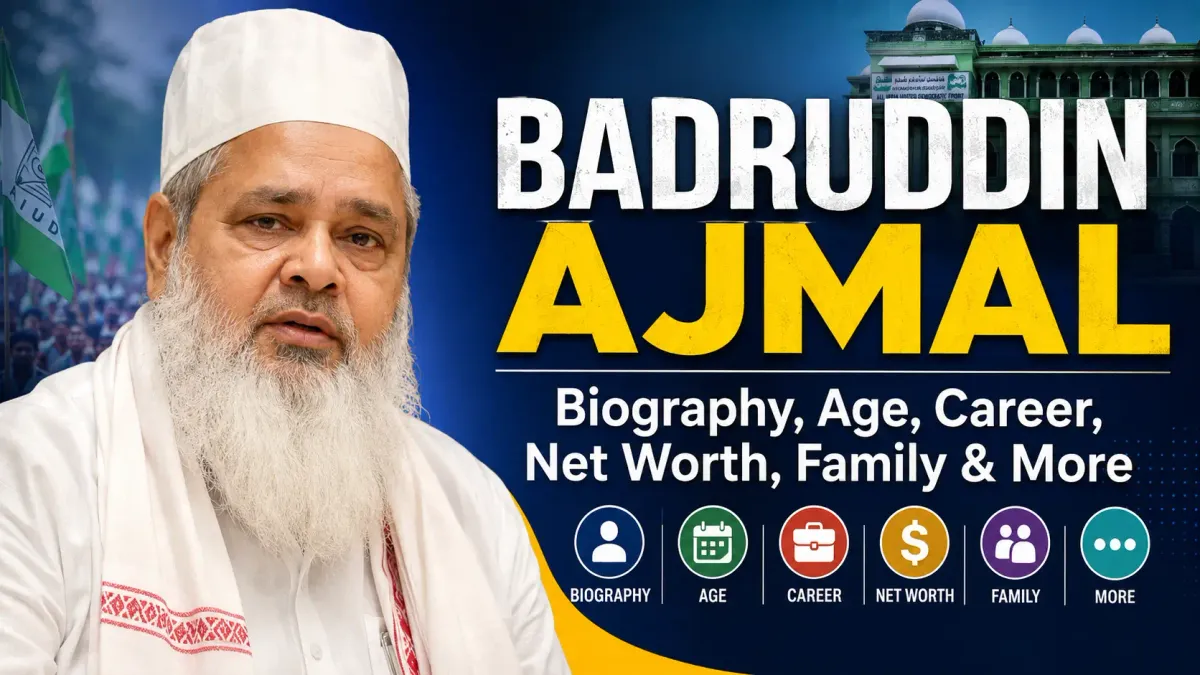
Badruddin Ajmal is one of the most recognizable names in Assam politics — a perfume-business heir who built a religious-charitable network before turning that influence into a political party of his own. As the founder-president of the All India United Democratic Front (AIUDF), a three-term Member of Parliament from Dhubri, and now the MLA from Assam's newly created Binnakandi constituency, Ajmal has spent two decades at the center of the state's most contested political fault lines — immigration, minority representation, and communal politics in the Brahmaputra and Barak valleys.
Away from politics, he is also a director of the Ajmal Group of Companies, the family business behind Ajmal Perfumes, a fragrance house that grew from a small Assam trading operation into an international brand with stores across the Middle East and beyond. That dual identity — "perfume baron" and "Maulana" — has made him one of the wealthiest and most talked-about legislators in Northeast India.
This article covers his early life, education, business background, political rise and setbacks, family, net worth, controversies, and his return to the Assam Legislative Assembly in the 2026 election.
Quick Facts: Badruddin Ajmal Infobox
| Field | Information |
|---|---|
| Full Name | Mohammed Badruddin Ajmal (widely known as Maulana Badruddin Ajmal) |
| Nickname | Maulana (honorific title); "Perfume Baron" (media nickname) |
| Profession | Politician, businessman, Islamic scholar, philanthropist |
| Famous For | Founder-President of AIUDF; Ajmal Perfumes business family; three-term MP from Dhubri (2009–2024); MLA from Binnakandi (2026–present) |
| Date of Birth | 12 February 1950 (one source cites 1956 — see note below) |
| Age | 76 years (as of August 2026, based on the 1950 birth year) |
| Birthplace | Hojai district, Assam, India (village cited variously as Ali Nagar or Gopal Nagar) |
| Nationality | Indian |
| Religion | Islam |
| Zodiac Sign | Aquarius |
| Height | Not publicly disclosed |
| Weight | Not publicly disclosed |
| Eye Color | Not publicly disclosed |
| Hair Color | Not publicly disclosed |
| Education | Fazil-e-Deoband (postgraduate-equivalent degree in Islamic Theology and Arabic) |
| School | Not publicly documented |
| College/University | Darul Uloom Deoband, Uttar Pradesh (completed 1975) |
| Marital Status | Married |
| Spouse | Rezwana Ajmal (also referred to in official filings as Rizwaana Badruddin Ajmal); married 30 December 1979 |
| Children | 7 (6 sons, 1 daughter), including Abdur Rahim Ajmal and Abdur Rehman Ajmal, both practicing politicians |
| Parents | Father: Haji Ajmal Ali (founder, Ajmal Perfumes); mother's name not publicly documented |
| Siblings | Multiple brothers, most frequently named as Mohammad Sirajuddin Ajmal (politician), Fakhruddin Ajmal, Abdulla Ajmal, and Amiruddin Ajmal |
| Net Worth | Reports vary — approximately ₹169 crore to ₹226 crore per 2026 election-affidavit disclosures (see Net Worth section) |
| Monthly Income | Not disclosed; annual income reported at approximately ₹3.21 crore for FY 2024–25 |
| Hobbies | Not publicly documented |
| Current Residence | Guwahati, Assam; also maintains residences in Mumbai and New Delhi |
| Languages Known | Bengali, Assamese, Urdu, Arabic, and Hindi (inferred from background and public communications; not officially confirmed) |
| Official Website | aiudf.org |
| Social Media Profiles | X (Twitter): @BadruddinAjmal |
Early Life and Background
Badruddin Ajmal was born on 12 February 1950 into a Bengali Muslim family with roots in Hojai, a town in central Assam. His family's ancestral ties trace back further to the Sylhet district, now part of Bangladesh, a lineage shared by many Bengali-origin Muslim families settled across Assam's Barak Valley and adjoining districts.
His father, Haji Ajmal Ali, began life not as a businessman but as a rice farmer. In the early 1950s, seeking better prospects, Haji Ajmal Ali moved to Mumbai to try his hand in the perfume trade, reportedly starting with as little as Rs 500 in capital. That modest beginning would eventually grow into Ajmal Perfumes, a business that shaped the family's fortunes for the next three generations — including Badruddin's own path into public life.
Growing up in a household that straddled two very different worlds — a religious, Deoband-oriented education on one side and a fast-expanding commercial enterprise on the other — gave young Badruddin an early exposure to both scholarship and trade. Multiple biographical profiles describe him as having been drawn toward religious learning from a young age, a trait that eventually led him to Darul Uloom Deoband, one of the most influential Islamic seminaries in South Asia. This dual grounding — theology and commerce — would go on to define his entire adult career, first as a businessman and religious-charitable figure, and later as a politician who leaned heavily on both his business network and his standing within the Muslim religious community to build a political base.
Education
Ajmal's formal education centered on Islamic theology rather than a conventional school-to-college track, which is why detailed information about his primary or secondary schooling is not widely documented in public biographical sources.
His most significant credential is the Fazil-e-Deoband, a degree broadly equivalent to a master's degree in Islamic Theology and Arabic, which he completed in 1975 at Darul Uloom Deoband in Uttar Pradesh — one of the oldest and most respected Islamic seminaries in the world, and the institution from which the Deobandi school of Sunni Islamic thought takes its name. Completing this degree earned him recognition as a religious scholar, and he is commonly addressed with the honorific "Maulana" as a result.
After finishing his studies in 1975, Ajmal joined the family's perfume business rather than pursuing further formal academic degrees. In 1982, he became chairperson of the Markazul Ma'arif Education and Research Centre (MMERC) in Mumbai, an institution that focuses on socio-religious and economic research and also provides English-language instruction to madrasa graduates — a project aimed at helping students from religious educational backgrounds gain skills for the modern job market. This early involvement in educational philanthropy foreshadowed the much larger network of schools and colleges he would go on to establish through the Ajmal Foundation after 2005.
Career Journey
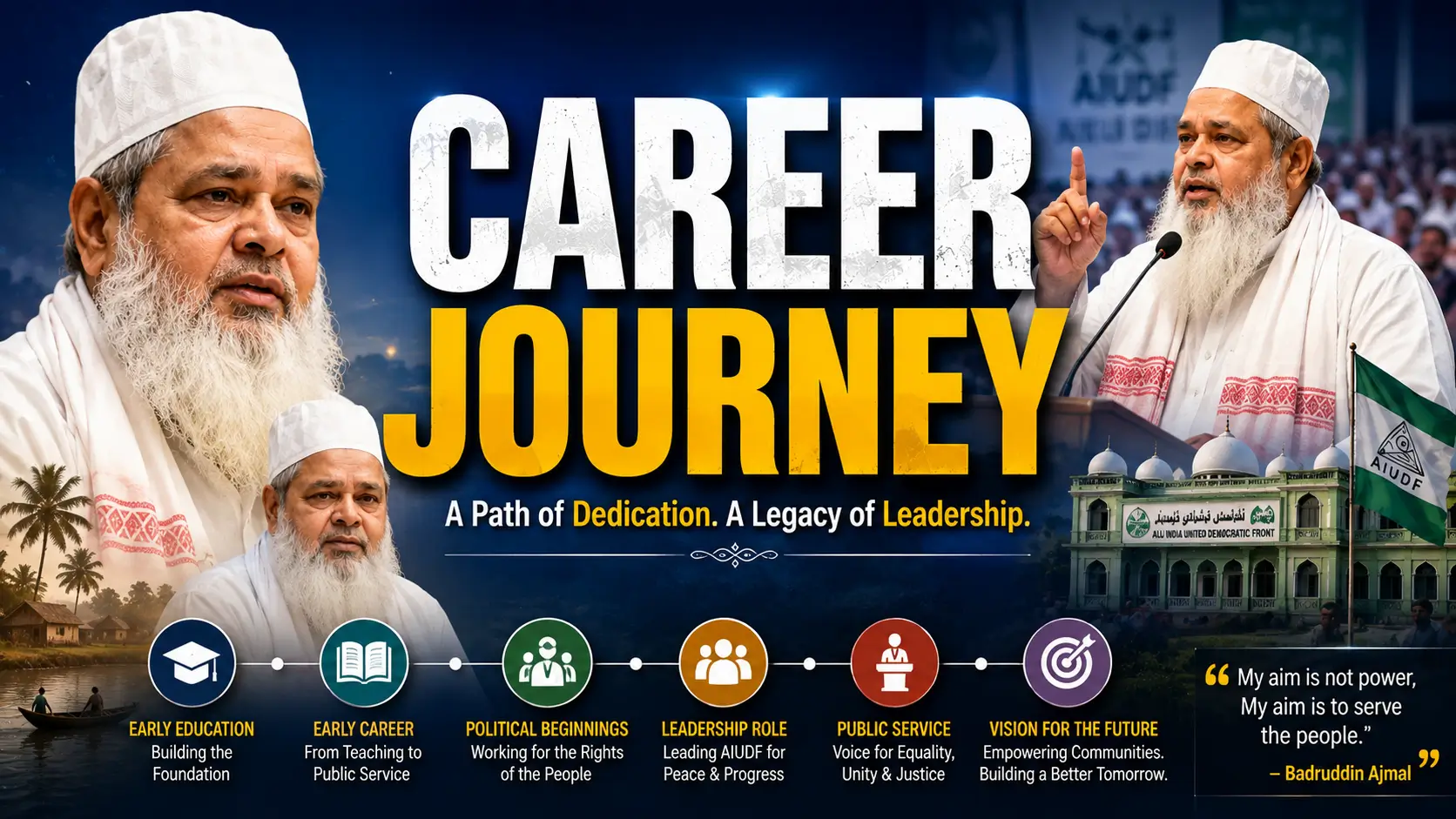
From Family Business to Public Life
Before entering politics, Badruddin Ajmal was primarily known as a businessman and philanthropist tied to his family's perfume empire and his charitable trusts. He became the managing trustee of the Haji Abdul Majid Memorial (HAMM) Public Trust in Hojai, which runs a large charitable hospital in the district, and he also helped establish Badarpur Hospital in Malua, near Karimganj. His 1982 role at the Markazul Ma'arif Education and Research Centre in Mumbai further built his reputation as someone investing in religious-community welfare and education, well before he built a political organization.
Founding the AUDF and Early Political Breakthrough (2005–2009)
Ajmal's formal entry into politics came in 2005, when he founded the Assam United Democratic Front (AUDF). The party was widely seen as representing the interests of Bengali-origin Muslims in Assam, a demographic that had historically felt underrepresented by the state's mainstream parties. Remarkably, the AUDF was formed just months before the 2006 Assam Assembly elections — and still went on to win 10 seats, an unexpected result for a brand-new party that, according to Ajmal himself, was not even taken seriously by the sitting Chief Minister at the time.
In that 2006 election, Ajmal personally contested and won from two constituencies simultaneously — South Salmara and Jamunamukh — later vacating the Jamunamukh seat in favor of his brother, Mohammad Sirajuddin Ajmal, and continuing to represent South Salmara.
Ahead of the 2009 general election, the party rebranded itself as the All India United Democratic Front (AIUDF), positioning itself as a national party rather than a strictly regional one. That same year, Ajmal made the jump to national politics, winning the Dhubri Lok Sabha seat for the first time — a constituency he would go on to represent for the next fifteen years.
Consolidation and Peak Influence (2011–2019)
The 2011 Assam Assembly elections marked the high point of AIUDF's state-level influence, with the party winning 18 seats and emerging as the largest opposition party in the Assam Legislative Assembly. Ajmal was re-elected to the Lok Sabha from Dhubri in 2014, and AIUDF secured three of Assam's fourteen Lok Sabha seats that year — a strong showing that cemented the party's role as a significant regional force, particularly in Muslim-majority constituencies in Lower and Central Assam.
The 2016 Assam Assembly election, however, brought a reversal: the BJP swept the polls statewide, and AIUDF's own tally fell to 13 seats. Ajmal himself lost his Salmara South assembly seat that year, though this did not affect his position as a sitting Member of Parliament. In the 2019 Lok Sabha election, Ajmal was the only AIUDF candidate to retain his seat, winning Dhubri for a third consecutive term even as the party's broader momentum slowed.
Alliance Politics and the 2024 Setback
Ahead of the 2021 Assam Assembly elections, AIUDF entered into a seat-sharing arrangement with the Indian National Congress, and the alliance won a combined tally that included around 15–16 seats for AIUDF, keeping the party relevant in the opposition camp. That alliance, however, did not survive into the 2024 Lok Sabha campaign — the Congress publicly distanced itself from AIUDF, at one point excluding the party from a coordination meeting of opposition parties, which triggered a public complaint from Congress accusing Ajmal of making derogatory remarks about its state leadership.
The 2024 Lok Sabha election proved to be Ajmal's most significant political setback. Contesting from Dhubri for a fourth term, he lost to Congress candidate Rakibul Hussain by a record margin of more than 10 lakh (1 million) votes, ending his 15-year run as the constituency's MP. AIUDF failed to win a single Lok Sabha seat that year — its worst national result since the party's founding.
Rebuilding: Solo Strategy and the 2026 Assam Assembly Election
Following the 2024 defeat, AIUDF leadership — meeting at Ajmal's Mumbai residence — decided to contest the 2026 Assam Assembly election without any pre-poll alliance, announcing plans to field candidates in at least 35 of the state's 126 seats. This was a deliberate return to the party's original, independent-contest strategy from 2005, on the reasoning that no other party had shown interest in a pre-poll tie-up.
Ajmal himself returned to state-level electoral politics for the first time since 2006, contesting from the newly delimited Binnakandi Assembly constituency in Hojai district. He won decisively, polling 1,19,721 votes against AJP candidate Rejaul Karim Choudhury's 84,341 votes — a margin of 35,380 votes — on a turnout of roughly 87–88 percent. He was formally sworn in as MLA later that year. The win marked a personal comeback to legislative office less than two years after his Lok Sabha defeat, and reaffirmed AIUDF's continuing hold over pockets of Bengali-speaking Muslim-majority Assam even after its 2024 rout.
Social Media Presence
Unlike entertainment celebrities or younger digital-first politicians, Badruddin Ajmal's social media footprint is relatively modest and functions mainly as a platform for political statements, election updates, and religious greetings rather than personal branding or influencer-style content.
His verified X (formerly Twitter) account, @BadruddinAjmal, describes him as President of AIUDF, former Member of Parliament for Dhubri, Director of the Ajmal Group of Companies, and CEO of Ajmal CSR Organisations. The account had accumulated roughly 192,500 followers, having joined the platform in September 2015. Content on the account is a mix of political commentary, party announcements — including his June 2026 post about being sworn in as the Binnakandi MLA — and seasonal greetings posted in Assamese and Bengali.
Reliable, independently verified follower figures for Facebook, Instagram, or YouTube accounts specifically belonging to Ajmal were not found in public sources at the time of writing, and this article does not include invented numbers for those platforms.
| Platform | Username | Followers |
|---|---|---|
| X (Twitter) | @BadruddinAjmal | ~192.5K |
| Not independently verified | Not publicly documented | |
| Not independently verified | Not publicly documented | |
| Official Website | aiudf.org | N/A |
Physical Appearance and Public Image
Badruddin Ajmal is not typically covered by lifestyle or fashion media in the way entertainment celebrities are, so detailed information about his height, weight, or specific physical measurements is not part of the public record. What is consistently reflected across news photography and public appearances is his traditional appearance: he is generally seen in modest, religiously-inflected attire befitting his standing as a Deoband-trained Islamic scholar and the honorific "Maulana" by which he is widely known, rather than in Western business or fashion-forward clothing.
His public image is built less around physical presentation and more around his dual identity as a religious-community elder and a wealthy business figure — a combination that has made him both a trusted figure among his political base and a frequent target of criticism from opposing parties.
Net Worth
Badruddin Ajmal is consistently described in Indian media as one of the wealthiest sitting legislators in Assam, and among the wealthiest in the country, with his fortune traced primarily to the family's Ajmal Perfumes business rather than to his political career.
Note on conflicting figures: Public reporting on Ajmal's exact net worth varies noticeably depending on the source and the election cycle referenced, and this article flags that inconsistency rather than presenting one number as definitive.
- His 2024 Lok Sabha election affidavit listed declared assets exceeding ₹155 crore, making him the wealthiest Lok Sabha candidate from Assam that year.
- Ahead of the 2026 Assam Assembly election, one set of reports — citing his election affidavit directly — put his declared assets at over ₹169 crore, describing a roughly 330 percent increase over the preceding decade, with annual income for FY 2024–25 reported at approximately ₹3.21 crore and liabilities of over ₹4.45 crore, mostly institutional loans.
- A separate report, citing analysis by the election watchdog Association for Democratic Reforms (ADR) of the same affidavit cycle, placed his total declared net worth at approximately ₹226 crore, describing him as the richest MLA in Assam following the 2026 results. This report broke down his movable assets at roughly ₹52.43 crore (including about ₹11.3 lakh in cash, roughly ₹9.73 crore in bank deposits across HDFC, ICICI, DCB, IDBI and SBI, and about ₹10.9 crore in bonds and shares, including holdings in Ajmal Estates & Properties Pvt. Ltd.) and immovable assets at approximately ₹149.12 crore.
- An earlier report placed his declared assets at around ₹78 crore in a 2019 ADR filing analysis, underscoring how sharply his declared wealth has grown across successive election cycles.
Income Sources
- Ajmal Group of Companies / Ajmal Perfumes: The primary source of family wealth, spanning fragrance manufacturing and retail, agarwood (oud) trading, and diversification into real estate, oil, and textiles.
- Real estate: Residential and commercial holdings in Mumbai and Assam, along with extensive agricultural and non-agricultural landholdings across multiple Assam districts.
- Investments: Bonds and shares in both listed companies and private family enterprises, including Ajmal Estates & Properties Pvt. Ltd.
- Political office: Parliamentary and legislative salary and allowances, a comparatively minor share of his overall wealth.
Net Worth Breakdown (2026 Affidavit, ADR-Cited Figures)
| Asset Category | Approximate Value |
|---|---|
| Cash in Hand | ₹11.3 lakh |
| Bank Deposits | ₹9.73 crore |
| Bonds/Shares (Investments) | ₹10.89 crore |
| Total Movable Assets | ₹52.43 crore |
| Total Immovable Assets | ₹149.12 crore |
| Spouse's Movable Assets | ₹31.08 lakh |
| Spouse's Immovable Assets | ₹6.82 lakh |
| Reported Liabilities | Over ₹4.45 crore |
Specific details on personal luxury assets such as a private car collection are not documented in available public sources; his affidavit-based disclosures focus on land, buildings, cash, and financial investments rather than itemized lifestyle assets.
Family and Relationships
Parents and Siblings
Badruddin Ajmal is the son of Haji Ajmal Ali, the founder of Ajmal Perfumes, who began as a rice farmer before moving to Mumbai and eventually building a perfume trading business that would grow into a multinational brand. Ajmal has several brothers, most consistently identified across sources as Mohammad Sirajuddin Ajmal (a politician and former MP who has also served as an AIUDF MLA), Fakhruddin Ajmal (Group Director and COO for real estate at Ajmal Group of Companies), and Abdulla Ajmal (Deputy COO of Ajmal Perfumes). A few sources also list an Amiruddin Ajmal and a Nazirul Haq Ajmal among his siblings, though exact naming and the total sibling count vary slightly between sources.
Marriage and Children
Ajmal married Rezwana Ajmal (also recorded in some official filings as Rizwaana Badruddin Ajmal) on 30 December 1979. The couple has seven children — six sons and one daughter — which reportedly makes him one of very few Members of the Lok Sabha with that many children.
Two of his sons have followed him directly into politics:
- Abdur Rahim Ajmal (born 1 July 1986) — represented the Jamunamukh Assam Assembly constituency from 2014 to 2021.
- Abdur Rehman Ajmal (born 12 May 1983) — represented the Salmara South Assam Assembly constituency from 2011 to 2016.
A third son, Abdul Majid Ajmal, is also named in family records, though detailed public information about his specific role is limited. Ajmal's family, taken together, represents one of the more prominent multi-generational political-business dynasties in Assam, spanning legislative politics, party leadership, and the running of the Ajmal Group's diversified businesses.
Dating Rumors and Public Relationships
There are no publicly documented dating rumors or extramarital relationship controversies associated with Badruddin Ajmal in available sources — consistent with his public identity as a religious scholar and long-married family patriarch.
Controversies
As the leader of a party built around minority political representation in a state where questions of migration, language, and religious identity are persistently contentious, Badruddin Ajmal has been at the center of numerous political disputes over the course of his career. This section presents the documented controversies neutrally, without taking a position on the competing claims involved.
February 2026 exchange with Assam's Chief Minister: Ahead of the 2026 Assam Assembly election, Ajmal publicly accused Chief Minister Himanta Biswa Sarma of making a series of speeches targeting the Muslim community over the preceding six months, and specifically referenced a video that appeared to show the Chief Minister pointing a firearm toward members of the Muslim community. Ajmal called for Sarma's arrest and for a court order barring him from contesting the election. The Assam Pradesh Congress Committee filed a related police complaint describing the video as "highly provocative and communal," and the CPI(M) separately approached the Supreme Court seeking directions on the matter; the Chief Justice of India indicated a hearing would be scheduled. Sarma responded that he was unaware the video had circulated and said he was willing to face legal proceedings if a case were registered. The BJP characterized the broader allegations against Sarma as politically motivated.
Gujarat-era remarks on marriage and community: In an earlier controversy, Ajmal was reported to have made comments advising Hindu communities to encourage earlier marriage in order to increase birth rates, remarks that were interpreted by critics as communally charged. Political opponents linked the timing of the remarks to that year's Gujarat Assembly election campaign, and complaints were filed against him by the Assam Jatiya Parishad; some political commentators suggested the comments inadvertently served the BJP's messaging in Gujarat, an interpretation Ajmal's camp disputed.
Doctored video misinformation: Separately, a viral video clip circulated on social media that purportedly showed Ajmal declaring that "India will become an Islamic state." Independent fact-checking organizations subsequently determined the clip had been doctored and that Ajmal had not made the statement attributed to him — an example of misinformation directed at him rather than a controversy of his own making.
2024 Congress complaint: Following AIUDF's exclusion from a Congress-led opposition coordination meeting ahead of the 2024 Lok Sabha election, the Assam Pradesh Congress Committee filed a police complaint alleging Ajmal had made "unparliamentary" and defamatory remarks against its state president and other party leaders.
2015 defamation suit filed by Ajmal: In a case where Ajmal was the complainant rather than the target, he filed a ₹125 crore defamation suit against then-Assam Congress chief Anjan Dutta, after Dutta publicly alleged Ajmal had accepted a ₹150 crore payment from the BJP as part of an alleged secret political understanding — an allegation Ajmal denied and pursued through the courts.
Across these episodes, a consistent pattern emerges: Ajmal has frequently found himself positioned by opposing parties, particularly the BJP, as a polarizing figure in Assam's identity-driven politics, while he and his supporters have characterized much of the criticism as politically motivated attacks tied to his role representing Bengali-origin Muslim voters.
Achievements and Recognition
| Recognition | Detail |
|---|---|
| World's 500 Most Influential Muslims | Featured in the 2015–16 edition, published by the Royal Islamic Strategic Studies Centre of Jordan, and cited as a recurring listee in subsequent years |
| Wealthiest Lok Sabha candidate from Assam (2024) | Based on declared assets exceeding ₹155 crore in his election affidavit |
| Richest MLA in Assam (2026) | Per ADR-cited affidavit analysis following the 2026 Assam Assembly election results |
| Founder-President, AIUDF | Built the party from a six-month-old outfit that won 10 seats in 2006 into a recognized national party and Assam's largest opposition bloc in 2011 |
| Three-term Member of Parliament | Represented Dhubri Lok Sabha constituency continuously from 2009 to 2024 |
| Educational philanthropy | Ajmal Foundation, founded in 2005, has established approximately 25 educational institutions, schools, and hospitals across Assam |
| Healthcare philanthropy | Managing trustee of the Haji Abdul Majid Memorial Trust, which runs a large charitable hospital in Hojai reported by some sources to be among the largest such facilities in the region |
Interesting Facts About Badruddin Ajmal
- He is the son of the founder of Ajmal Perfumes, a business that began with roughly Rs 500 in capital and grew into an international fragrance brand with stores across the Middle East.
- He holds a Fazil-e-Deoband degree, roughly equivalent to a master's in Islamic Theology and Arabic, and is addressed with the honorific "Maulana" as a result.
- His political party won 10 assembly seats within six months of being founded in 2005 — an unusually fast breakthrough for a new regional outfit.
- He is reportedly one of very few Lok Sabha members in Indian history to have seven children.
- Two of his sons — Abdur Rahim Ajmal and Abdur Rehman Ajmal — have both served as Assam MLAs, making the family a multi-generational political dynasty.
- He lost his 2024 Lok Sabha seat by a margin of more than 10 lakh votes, one of the more emphatic defeats of his long political career, before rebuilding and winning a state assembly seat less than two years later.
- He returned to state assembly politics in 2026 after a 20-year gap, having last contested an Assam Assembly election in 2006.
- He has been the target of viral misinformation, including a doctored video, later debunked by fact-checkers, that falsely attributed inflammatory remarks to him.
Timeline: Life and Career
| Year | Event |
|---|---|
| 1950 | Born on 12 February in Hojai district, Assam (some sources cite 1956) |
| 1975 | Completes Fazil-e-Deoband examination at Darul Uloom Deoband; joins the family perfume business |
| 1979 | Marries Rezwana Ajmal on 30 December |
| 1982 | Becomes chairperson of the Markazul Ma'arif Education and Research Centre, Mumbai |
| 2005 | Founds the Assam United Democratic Front (AUDF); establishes the Ajmal Foundation |
| 2006 | AUDF wins 10 seats in the Assam Assembly election; Ajmal elected from South Salmara and Jamunamukh |
| 2009 | Party renamed the All India United Democratic Front (AIUDF); Ajmal wins the Dhubri Lok Sabha seat for the first time |
| 2011 | AIUDF wins 18 seats in the Assam Assembly election, becoming the largest opposition party in the state |
| 2014 | Ajmal re-elected to the Dhubri Lok Sabha seat; AIUDF wins 3 Lok Sabha seats nationally |
| 2015–16 | Featured in the World's 500 Most Influential Muslims list |
| 2016 | AIUDF's Assam Assembly tally falls to 13 seats; Ajmal loses his own assembly seat (though remains sitting MP) |
| 2019 | Ajmal wins a third consecutive term from Dhubri — the only AIUDF candidate to retain a Lok Sabha seat that year |
| 2021 | AIUDF contests the Assam Assembly election in alliance with Congress |
| 2024 | Loses the Dhubri Lok Sabha seat to Congress's Rakibul Hussain by a margin of over 10 lakh votes, ending 15 years as MP |
| 2025–early 2026 | AIUDF announces a solo electoral strategy for the 2026 Assam Assembly election, contesting at least 35 seats |
| February 2026 | Public dispute with Assam CM Himanta Biswa Sarma over alleged hate speech, drawing legal and political fallout |
| May 2026 | Wins the newly created Binnakandi Assembly constituency with 1,19,721 votes, a margin of 35,380 |
| June 2026 | Sworn in as MLA for Binnakandi |
Business Ventures and Institutions
The Ajmal family business, Ajmal Perfumes, traces its origins to the early 1950s, when Haji Ajmal Ali began trading in oud (agarwood) and oil-based perfumes in Assam before relocating operations to Mumbai. The brand opened its first Dubai store in 1976, and by the company's 70th anniversary had grown to more than 280 stores across the Middle East, with an export network reaching roughly 45 countries. An earlier company disclosure put group turnover at approximately $200 million annually. The business is now run by the second and third generations of the Ajmal family, with Badruddin Ajmal holding the position of Director of the Ajmal Group of Companies and several of his brothers holding senior operating roles.
Beyond perfumery, the Ajmal Group has diversified into real estate, oil, and textiles, and the family's wealth — reflected in Badruddin Ajmal's own election-affidavit disclosures — is heavily weighted toward land, buildings, and long-term investments rather than liquid assets.
On the philanthropic side, Ajmal established the Ajmal Foundation in 2005, which operates roughly 25 educational institutions across Assam, including the Mariyam Ajmal Women's College of Science and Technology in Hojai. He is also the managing trustee of the Haji Abdul Majid Memorial (HAMM) Public Trust, which runs a large charitable hospital in Hojai, and he helped establish Badarpur Hospital in Malua, near Karimganj — extending the family's community investment beyond education into healthcare infrastructure for the region.
Public Image and Legacy
Badruddin Ajmal occupies an unusual position in Indian politics: a wealthy business figure who built his political base not primarily on that wealth, but on religious standing and community trust earned through decades of charitable work in education and healthcare. Within his core constituency — Bengali-speaking Muslim voters concentrated in Lower and Central Assam — he is widely regarded as a consolidating figure, someone whose party has repeatedly proven able to win seats in specific pockets even when the broader political tide runs against it, as demonstrated by AIUDF's 2026 Assembly comeback following its 2024 Lok Sabha wipeout.
Outside that base, his legacy is more contested. National and state-level opposition to AIUDF — most visibly from the BJP, but at various points from the Congress as well — has consistently framed Ajmal as a polarizing figure tied to sensitive debates over migration and religious demographics in Assam, a state where the National Register of Citizens (NRC) process and questions about undocumented migration from Bangladesh remain politically charged. Ajmal and his supporters, in turn, have generally characterized this framing as a deliberate political strategy aimed at marginalizing Muslim political representation.
What is not contested is the scale of the institutional footprint he leaves through the Ajmal Foundation and associated trusts — dozens of schools and at least two hospitals serving communities in Hojai and Karimganj districts — nor his role in keeping a specific regional political current alive in Assam for over two decades, through electoral cycles that have alternately rewarded and punished his party.
Latest News and Current Status
As of mid-2026, Badruddin Ajmal serves as the MLA for Binnakandi, having been sworn in following his May 2026 election victory, and continues to lead the All India United Democratic Front as its founding president. His political focus has shifted from national Lok Sabha politics — where AIUDF was shut out entirely in 2024 — back to consolidating the party's position within the Assam Legislative Assembly.
His public statements in early 2026, including his sharp public exchange with Chief Minister Himanta Biswa Sarma over allegations of hate speech, reflect his continuing role as one of the more vocal opposition voices on issues affecting Assam's Muslim community, even as AIUDF's overall parliamentary influence has diminished compared to its 2011–2019 peak. Given his renewed legislative mandate, Ajmal is expected to remain a prominent, if polarizing, figure in Assam's ongoing political realignment ahead of future election cycles.
Frequently Asked Questions (FAQs)
1. Who is Badruddin Ajmal?
Badruddin Ajmal is an Indian politician, businessman, and Islamic scholar from Assam. He is the founder-president of the All India United Democratic Front (AIUDF), a former three-term Member of Parliament from Dhubri, and the current MLA from Binnakandi.
2. How old is Badruddin Ajmal?
He was born on 12 February 1950, making him 76 years old as of August 2026, based on the most widely cited birth year. One source cites 1956 as his birth year instead.
3. What is Badruddin Ajmal's net worth?
Reports vary between roughly ₹169 crore and ₹226 crore, based on different readings of his 2026 Assam Assembly election affidavit. His 2024 Lok Sabha affidavit listed assets exceeding ₹155 crore.
4. Is Badruddin Ajmal married?
Yes. He married Rezwana Ajmal (also recorded as Rizwaana Badruddin Ajmal) on 30 December 1979.
5. What is Badruddin Ajmal famous for?
He is best known as the founder of the AIUDF political party, as a three-term MP from Dhubri, and as a member of the family behind the international perfume brand Ajmal Perfumes.
6. Where was Badruddin Ajmal born?
He was born in Hojai district, Assam, India.
7. What is Badruddin Ajmal's educational qualification?
He holds a Fazil-e-Deoband degree, equivalent to a master's degree in Islamic Theology and Arabic, from Darul Uloom Deoband, completed in 1975.
8. How many children does Badruddin Ajmal have?
He has seven children — six sons and one daughter.
9. Which political party did Badruddin Ajmal found?
He founded the Assam United Democratic Front (AUDF) in 2005, which was renamed the All India United Democratic Front (AIUDF) in 2009.
10. Did Badruddin Ajmal win the 2024 Lok Sabha election?
No. He lost the Dhubri seat to Congress's Rakibul Hussain by a margin of over 10 lakh votes, ending his 15-year tenure as MP.
11. Which seat does Badruddin Ajmal represent now?
He represents the Binnakandi Assembly constituency in Assam's Hojai district, having won the seat in the 2026 Assam Assembly election.
12. What is Badruddin Ajmal's connection to Ajmal Perfumes?
He is the son of Ajmal Perfumes founder Haji Ajmal Ali and currently serves as a Director of the Ajmal Group of Companies, the parent business group.
13. Are any of Badruddin Ajmal's children in politics?
Yes. His sons Abdur Rahim Ajmal and Abdur Rehman Ajmal have both served as MLAs in Assam.
14. Does Badruddin Ajmal have siblings in politics?
Yes. His brother Mohammad Sirajuddin Ajmal is also a politician who has served as both an MP and an MLA.
15. What is the Ajmal Foundation?
It is a non-governmental organization founded by Badruddin Ajmal in 2005, which has established approximately 25 educational institutions, schools, and hospitals across Assam.
16. Has Badruddin Ajmal been involved in any controversies?
Yes. He has been involved in several political disputes, including a 2026 public clash with Assam's Chief Minister over hate-speech allegations, past complaints over communal remarks, and a defamation suit he filed against a Congress leader in 2015.
17. What language does Badruddin Ajmal typically speak in public?
Based on his background and public statements, he communicates in Bengali, Assamese, Hindi, and Urdu, though a comprehensive official list of his languages has not been published.
18. Is Badruddin Ajmal the richest politician in Assam?
According to ADR-cited analysis of his 2026 election affidavit, he was reported as the richest MLA in Assam following that year's Assembly election.
19. What hospitals is Badruddin Ajmal associated with?
He is the managing trustee of the Haji Abdul Majid Memorial (HAMM) Public Trust hospital in Hojai and helped establish Badarpur Hospital near Karimganj.
20. When did Badruddin Ajmal first enter Parliament?
He first won the Dhubri Lok Sabha seat in the 2009 Indian general election.
21. How many times has Badruddin Ajmal been elected to the Lok Sabha?
He was elected three times — in 2009, 2014, and 2019 — before losing the seat in 2024.
22. What is AIUDF's current standing in Assam politics?
Following a poor 2024 Lok Sabha performance in which the party won no seats, AIUDF rebuilt through a solo strategy in the 2026 Assam Assembly election, in which Ajmal himself won the Binnakandi seat.
23. Was Badruddin Ajmal ever a Chief Minister candidate?
Public reporting indicates he has stated he has no personal ambition for the Chief Minister's post, focusing instead on his role as AIUDF's leader in the Assam Assembly.
24. Is the viral video claiming Ajmal said "India will become an Islamic state" real?
No. Independent fact-checkers determined the widely circulated clip was doctored and that he did not make the statement attributed to him in it.
25. Where can I find official updates from Badruddin Ajmal?
His party's official website is aiudf.org, and he is active on X (Twitter) under the handle @BadruddinAjmal.
Sources consulted include Wikipedia, election-affidavit-based reporting from ADR-cited outlets, and contemporaneous news coverage of the 2024 and 2026 election cycles. Where sources disagreed on specific figures, this article has noted the range rather than presenting a single unverified number as fact.