
Jadav Payeng: Biography, Age, Career, Net Worth, Family & More

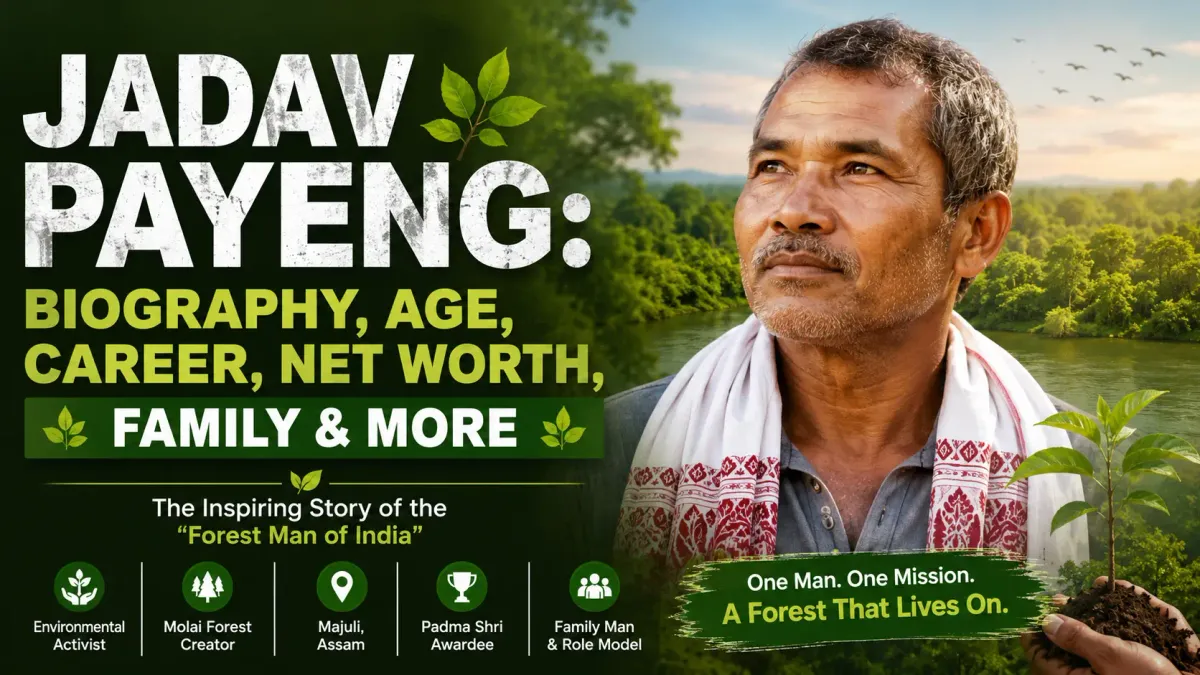
When people talk about ordinary individuals doing extraordinary things, Jadav Payeng is often the first name that comes to mind in India. Known across the world as the "Forest Man of India," Payeng is an environmental activist and forestry worker from Majuli, Assam, who spent more than four decades single-handedly planting and nurturing a forest on a barren sandbar of the Brahmaputra River.
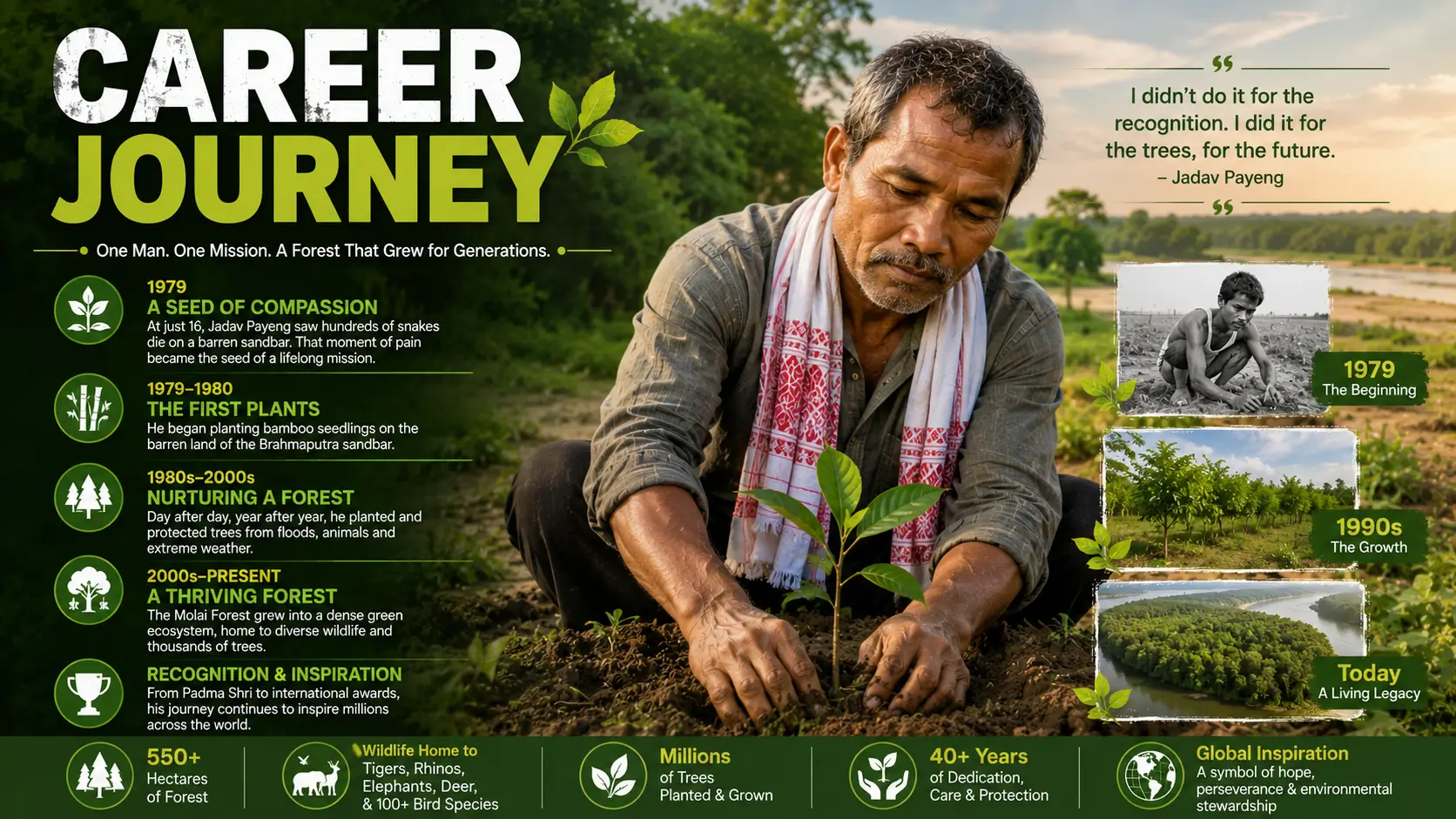
What began as the simple act of a teenage cowherd planting bamboo saplings in 1979 eventually grew into the Molai Forest, a sprawling green ecosystem covering roughly 550 hectares (about 1,360 acres) — an area larger than New York City's Central Park. Today, this forest is home to Bengal tigers, Indian rhinoceroses, herds of elephants, deer, rabbits, monkeys, and a wide variety of birds, including vultures.
Payeng's story has been featured in international documentaries, inspired a children's book, and earned him India's fourth-highest civilian honor, the Padma Shri, in 2015. He continues to live near his forest in Majuli, advocating for tree plantation, environmental education, and the protection of Assam's shrinking green cover.
This article covers everything about Jadav Payeng — his early life, education, career journey, family, achievements, net worth, and the remarkable legacy of the Molai Forest.
Quick Info / Infobox
| Field | Information |
|---|---|
| Full Name | Jadav "Molai" Payeng |
| Nickname | Molai, Forest Man of India |
| Profession | Environmental Activist, Forestry Worker, Cattle Herder |
| Famous For | Single-handedly creating the Molai Forest on a Brahmaputra sandbar |
| Date of Birth | 31 October 1959 (some sources cite 1963) |
| Age | 66 years (as of 2026) |
| Birthplace | Aruna Sapori (a river island near Jorhat), Assam, India |
| Nationality | Indian |
| Religion | Hindu (follows traditional Mising tribal customs) |
| Zodiac Sign | Scorpio |
| Height | Approx. 5 ft 6 in (168 cm) — approximate, not officially confirmed |
| Weight | Approx. 65 kg — approximate, not officially confirmed |
| Eye Color | Dark Brown |
| Hair Color | Black (greying) |
| Education | Studied up to Class X (10th Standard) |
| School | Local school in Jorhat district, Assam |
| College/University | Did not pursue formal college education; later received honorary doctorates |
| Marital Status | Married |
| Boyfriend/Girlfriend/Partner | Not applicable |
| Spouse | Binita Payeng |
| Children | 3 (one son and two daughters, as widely reported) |
| Parents | Father was a poor buffalo herder/farmer from the Mising community; mother's name not publicly documented |
| Siblings | Not publicly documented |
| Net Worth | Estimated modest; primarily symbolic/social-impact based (see Net Worth section) |
| Monthly Income | Earnings primarily from cattle rearing, government honorarium, and occasional speaking engagements |
| Hobbies | Tree plantation, animal rearing, environmental advocacy, storytelling |
| Current Residence | A hut near Molai Forest, Kokilamukh, Jorhat district, Assam |
| Languages Known | Mising (Mishing), Assamese, Hindi |
| Official Website | No official personal website |
| Social Media Profiles | Facebook page "Forest Man of India" (fan/tribute pages); Instagram tribute accounts |
Early Life and Background
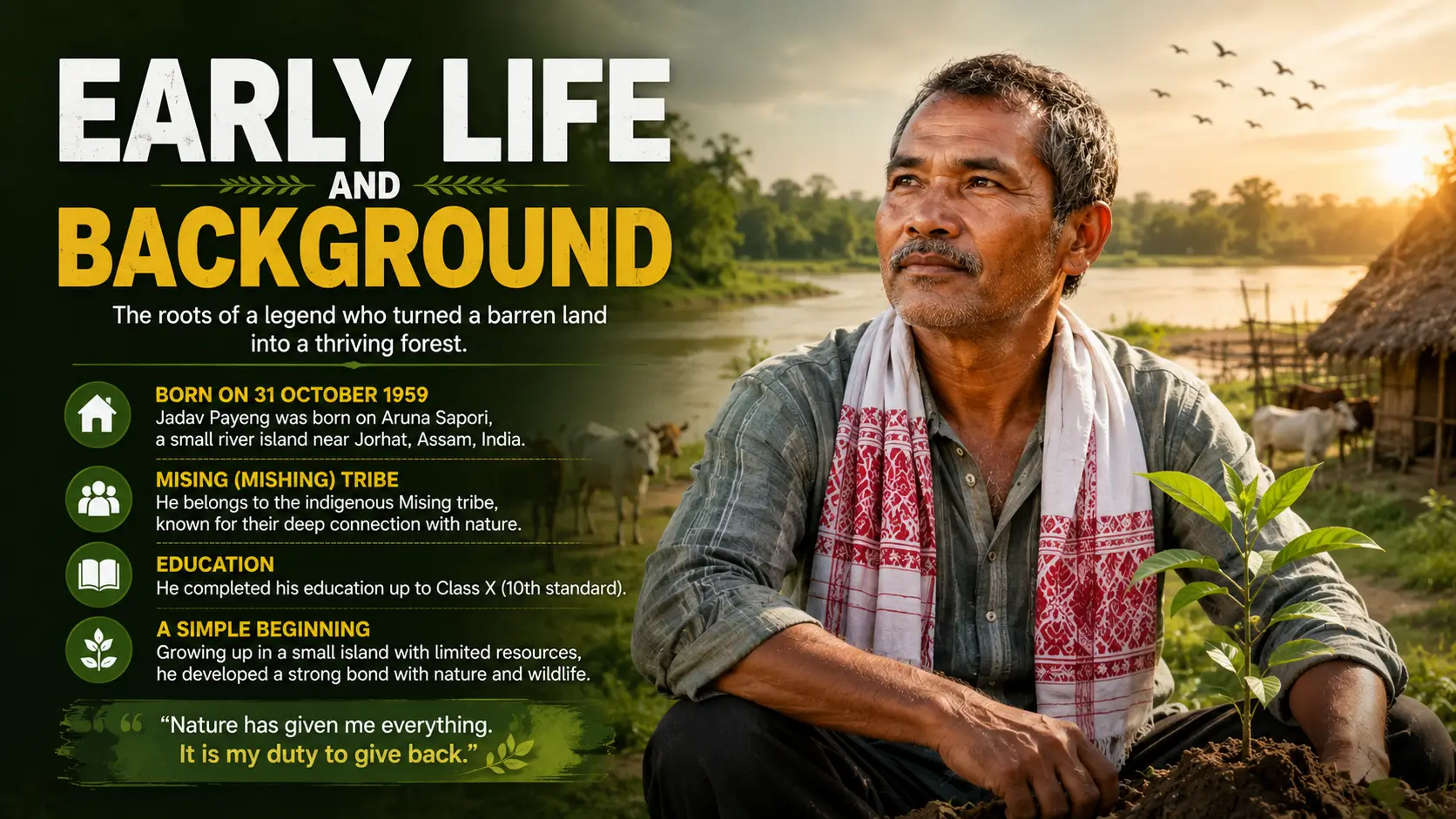
Jadav "Molai" Payeng was born into a poor family belonging to the Mising (Mishing) tribe, one of the largest indigenous communities of Assam, known for their close relationship with the rivers and forests of the Brahmaputra valley. His father worked as a buffalo herder, and the family originally lived on Aruna Sapori, a small river island near Jorhat district.
In 1965, devastating floods from the Brahmaputra submerged Aruna Sapori, forcing Payeng's family to relocate to Majuli, the world's largest river island. This early experience of displacement due to river erosion would later shape much of Payeng's life's mission — protecting Majuli from the very forces that had uprooted his own family as a child.
Growing up in a Mising household meant growing up close to nature. Cattle herding, fishing, and farming were part of daily life, and young Jadav developed a deep familiarity with the rhythms of the river island — its floods, its sandbars, and its wildlife. He was known among locals as a quiet but observant boy, more comfortable around animals and open land than in classrooms.
The defining moment of his childhood came in 1979, when Jadav was just 16 years old. During that year's monsoon floods, the Brahmaputra washed hundreds of snakes onto a barren sandbar near his village. With no trees or shade to protect them, the snakes died from the scorching heat. The sight left a deep impression on the teenager — he realized that the absence of vegetation was not just an environmental issue but a matter of life and death for the creatures of the island.
That same year, acting almost entirely on instinct, Jadav planted around 20 bamboo seedlings on the barren sandbar. He had no formal training in forestry, no funding, and no support — only a conviction that the land needed trees to survive. This single act, born out of compassion for dead snakes on a forgotten sandbar, would eventually grow into one of the most remarkable reforestation stories in modern history.
Education
Jadav Payeng's formal education was modest by conventional standards. He completed his studies up to the 10th standard (Class X) in a school in the Jorhat district of Assam. After finishing his secondary schooling, he returned to his native village rather than pursuing higher education in a city.
For Payeng, the "real education" came not from textbooks but from decades of hands-on experience with soil, water, and trees. Over more than 40 years, he developed an intricate, almost scientific understanding of:
- Which native tree species thrive on sandy, erosion-prone riverbanks
- How bamboo root systems help bind soil and prevent further erosion
- How forest ecosystems naturally attract wildlife once vegetation reaches a certain density
- How to manage human-wildlife coexistence, including with large predators like tigers
This self-taught ecological expertise eventually earned him recognition from academic institutions. He received honorary doctorate degrees from Assam Agricultural University and Kaziranga University, an extraordinary achievement for someone who never attended college. Forestry researchers and environmental scientists have since studied his methods, and his story has been incorporated into school curricula in parts of the United States and other countries as a case study in grassroots ecological restoration.
Career Journey
The Humble Beginning (1979)
Jadav Payeng's "career" did not begin in an office or institution — it began on a desolate, treeless sandbar of the Brahmaputra. After witnessing the mass death of snakes in 1979, the 16-year-old approached the local Forest Department, asking whether trees could be planted on the sandbar to provide shelter for wildlife.
According to widely circulated accounts of his story, forest officials reportedly told him that nothing would grow there and suggested he try planting bamboo himself if he was so concerned. Rather than being discouraged, Payeng took this literally — he planted bamboo, and when that survived, he kept going.
Decades of Solitary Work
What followed was nothing short of extraordinary. For more than 30 years, Payeng worked almost entirely alone, planting seeds and saplings, watering them by hand, and protecting young trees from grazing cattle and the harsh sun. He moved to live on the sandbar itself, in a small hut, dedicating his entire life to the forest.
His method was simple but relentless:
- Collecting seeds of native species
- Planting bamboo first to stabilize the sandy soil and reduce erosion
- Gradually introducing hardier tree species such as arjun (Terminalia arjuna), ejar (Lagerstroemia speciosa), gulmohar/goldmohur (Delonix regia), koroi (Albizia procera), moj (Archidendron bigeminum), and himolu (Bombax ceiba)
- Allowing natural regeneration to take over as the soil improved
It is worth noting that an earlier, official reforestation effort had also been attempted on the sandbar. In 1980, Assam's Forest Department had launched a project to reforest around 200 hectares of the area, but the program was abandoned in 1983. Payeng, however, continued his personal effort uninterrupted, eventually expanding far beyond the original project's scope.
The Breakthrough Moment (2007–2012)
For nearly three decades, Payeng's work went almost entirely unnoticed by the outside world. The turning point came around 2007, when a photojournalist exploring the Brahmaputra's sandbars stumbled upon a dense forest where maps and records showed nothing but barren land. Stunned, he discovered that the forest had been created by one man, working alone, over decades.
The story soon reached forest department officials and the wider public. In 2012, on Earth Day (April 22), Payeng was honored at a public function organized by the School of Environmental Sciences, Jawaharlal Nehru University (JNU). The then Vice-Chancellor of JNU, Sudhir Kumar Sopory, gave him the title that would define his public identity from then on: the "Forest Man of India."
In October 2013, he was further honored at the Indian Institute of Forest Management (IIFM) during its annual event, "Coalescence."
National Recognition and Continued Work
In 2015, the Government of India conferred upon Payeng the Padma Shri, the country's fourth-highest civilian award, recognizing his decades-long contribution to environmental conservation. Around the same period, international media outlets, documentary filmmakers, and organizations such as NPR and One Earth began featuring his story, bringing global attention to the Molai Forest.
Despite offers, Payeng reportedly declined a formal position with the Forest Department, expressing concern that official responsibilities and bureaucratic duties would distract him from his life's true purpose: tending the forest.
Expanding the Mission
In the years since gaining recognition, Payeng has not slowed down. He has spoken at international conferences, collaborated with environmental organizations, and continued to push for large-scale afforestation along the Brahmaputra. He has expressed ambitions to extend tree cover across thousands of additional acres on Majuli to help combat the island's severe erosion problem, and has written directly to the Prime Minister of India regarding forest conservation efforts, including around the Amchang region near Guwahati.
He now serves as an inspirational figure and consultant of sorts for reforestation projects, frequently invited to schools, universities, and government-organized environmental events across India and abroad.
Social Media Presence
Unlike typical celebrities or influencers, Jadav Payeng does not personally manage a large social media following. Given his life centered around the forest in Majuli — an area with limited connectivity — his digital footprint is largely shaped by fan pages, tribute accounts, and media organizations that cover his story.
- Facebook: Pages titled "Forest Man of India" share photos, news updates, and videos about Payeng and the Molai Forest. These are largely fan-run or media-affiliated tribute pages rather than a personal profile managed by Payeng himself.
- Instagram: Accounts referencing "@forestmanofindia" feature photographs of Payeng and the forest, often used by journalists and bloggers covering his story.
- YouTube: Numerous documentaries, news features, and short films about Payeng circulate widely, including NPR's audio feature "A Lifetime of Planting Trees on a Remote River Island."
- Twitter/X: Mentions and threads about Payeng frequently go viral, especially around Earth Day and World Environment Day, often resurfacing his story to new audiences.
Social Media Snapshot
| Platform | Username/Page | Followers |
|---|---|---|
| "Forest Man of India" (tribute/fan pages) | Varies by page; combined reach in the hundreds of thousands | |
| "@forestmanofindia" (tribute accounts) | Tens of thousands | |
| YouTube | Various documentary/news channels | Millions of cumulative views across videos |
| Twitter/X | No verified personal account | Story shared widely via news handles |
His "brand collaborations," if they can be called that, are limited to partnerships with environmental NGOs, educational institutions, and government bodies rather than commercial endorsements — a reflection of his consistent focus on conservation over personal publicity.
Physical Appearance
Jadav Payeng's physical presence reflects the decades of outdoor, manual labor that have defined his life. He is often pictured wearing simple, traditional Assamese or Mising attire — a gamosa (traditional Assamese towel/scarf) draped over his shoulder is a common feature in photographs, especially during award ceremonies.
- Build: Lean and weathered, consistent with a lifetime of physical outdoor work
- Fitness: Remarkably active well into his sixties, still regularly walking through dense forest terrain
- Fashion Style: Traditional and simple — cotton shirts, dhotis or trousers, and the iconic gamosa; no interest in modern fashion trends
- Tattoos: None publicly documented
- Personality Style: Calm, soft-spoken, and humble, often described by journalists as someone who seems more comfortable in the forest than in front of cameras
- Public Image: Widely seen as the embodiment of quiet, selfless dedication — a "living legend" whose appearance matches his reputation as a man rooted in nature rather than glamour
Net Worth
Unlike film stars, YouTubers, or business figures, Jadav Payeng's "net worth" cannot be measured in the same commercial terms. He has never pursued wealth through his environmental work, and by his own choice, he continues to live a simple life near the Molai Forest, largely sustained by traditional occupations like cattle rearing.
That said, for informational purposes, here is an overview of his likely income sources:
Estimated Net Worth Overview
| Category | Details |
|---|---|
| Estimated Net Worth | Modest; widely estimated in the range of a few lakh Indian rupees (no verified figure exists) |
| Primary Income Source | Cattle rearing and small-scale agriculture |
| Government Honorarium | Padma Shri awardees may receive certain state benefits, though the award itself carries no large cash prize |
| Award-Linked Income | Cash prizes from honors such as the Asom Nakshatra Award (e.g., ₹10,000 cash prize in 2026) |
| Speaking Engagements | Occasional honorariums for talks at universities, conferences, and environmental events |
| Brand Endorsements | None reported |
| Businesses | None; does not run a commercial enterprise |
| Investments | None publicly documented |
| Cars Collection | None reported; uses local/traditional transport |
| House Details | Lives in a simple hut/home near the Molai Forest in Kokilamukh, Majuli area, Jorhat district |
| Luxury Lifestyle | None — Payeng is known for deliberately maintaining a simple, non-materialistic lifestyle |
It's important to note that Payeng has consistently prioritized his environmental mission over financial gain, even reportedly turning down a salaried Forest Department position to avoid being tied down by official duties that might limit his ability to continue his forest work.
Family and Relationships
Parents and Early Family Life
Jadav Payeng's father was a buffalo herder from the Mising tribal community, and his family lived a traditional agrarian and pastoral life on Aruna Sapori before floods forced their relocation to Majuli in 1965. Detailed information about his mother and siblings has not been widely documented in public sources, reflecting the family's modest, low-profile background.
Marriage and Children
Payeng is married to Binita Payeng. The couple has three children. His family has stood by him throughout his decades of unconventional, unpaid work in the forest — a commitment that, for many years, brought the family little recognition and modest financial security.
In several interviews and award ceremonies, including his Commonwealth Points of Light Award, Payeng has been seen accompanied by family members, reflecting their continued support of his mission even after he became a public figure.
Relationship History
There are no dating rumors or controversies associated with Payeng's personal life — his public image has remained consistently centered on his environmental work rather than personal relationships.
Close Associates
Beyond his immediate family, Payeng's "close circle" includes a wide network of:
- Forest officials who eventually came to support and study his work
- Environmental scientists and researchers, including those who interviewed him for journals such as Current Science
- Journalists and documentary filmmakers who have told his story to global audiences
- Fellow environmentalists, including figures honored alongside or in connection with causes he supports
Controversies
Jadav Payeng's public life has been remarkably free of personal controversy. As an individual whose entire reputation is built on selfless, decades-long environmental work, he has not been associated with scandals, legal disputes, or public conflicts.
If anything resembling controversy exists, it relates to broader debates around forest department recognition and land rights — for years, Payeng's forest existed without formal protected status, and questions have occasionally been raised in environmental and policy circles about how informally created forests like Molai should be legally recognized, managed, and protected from future encroachment or exploitation.
Additionally, Payeng has spoken candidly about losing livestock — reportedly around 100 cows and buffaloes over the years — to tigers that now inhabit the forest he created. Rather than expressing resentment, he has publicly stated he does not blame the animals, framing it as a natural consequence of restoring a functioning ecosystem. This response has been widely praised rather than criticized, reinforcing his image as a man who genuinely prioritizes nature over personal loss.
Overall, Payeng remains one of the most universally respected public figures in Assam and India, with an almost entirely positive public legacy.
Achievements and Awards
Jadav Payeng's recognition has grown steadily since his story first reached the public in the late 2000s. Below is a summary of his major honors:
| Year | Award/Honor | Awarding Body |
|---|---|---|
| 2012 | Title "Forest Man of India" | School of Environmental Sciences, Jawaharlal Nehru University (Earth Day) |
| 2013 | Honored at "Coalescence" annual event | Indian Institute of Forest Management (IIFM) |
| 2015 | Padma Shri (4th highest civilian award in India) | Government of India |
| — | Honorary Doctorate | Assam Agricultural University |
| — | Honorary Doctorate | Kaziranga University |
| 2019 (approx.) | Commonwealth Points of Light Award (128th recipient) | UK Government / Commonwealth |
| 2026 | Asom/Assam Nakshatra Award | Asomiya Suraksha Mancha (10th Foundation Anniversary, Tezpur) |
Additional Recognitions
- His work has been the subject of multiple award-winning documentaries, bringing international acclaim
- His story has been incorporated into school curricula in parts of the United States and other countries as an example of grassroots ecological restoration
- He has been invited as a chief guest at numerous environmental conferences, including events titled "Green Earth: A Panoramic View"
- Recognized informally by global media as a pioneering example of individual climate action, often cited alongside other grassroots environmental heroes
Interesting Facts About Jadav Payeng
- He began his forest with just 20 bamboo seedlings in 1979 — with no funding, training, or institutional support.
- The Molai Forest is named after his nickname, "Molai" — a name his community has called him since childhood.
- The forest he created is now estimated to cover roughly 550 hectares (about 1,360 acres), larger than New York City's Central Park.
- His forest is now home to Bengal tigers, Indian rhinoceroses, elephants, deer, rabbits, monkeys, and vultures — species that would have had no habitat on the barren sandbar decades earlier.
- Herds of elephants reportedly visit and stay in the forest for around six months each year, and several elephant calves have been born there.
- He has lost an estimated 100 cattle and buffaloes to tigers over the years but has never expressed resentment toward the animals.
- A children's book titled "Jadav and the Tree Place" was written based on his life story.
- He turned down a job offer from the Forest Department, fearing it would limit his ability to continue his independent forest work.
- His story was featured by NPR in a widely shared audio segment titled "A Lifetime of Planting Trees on a Remote River Island."
- Despite international fame, he continues to live a simple, traditional life near his forest in Majuli.
- He frequently emphasizes that children should plant a tree the day they start school and nurture it as they grow — a message he has repeated at multiple public events.
- He has written directly to the Prime Minister of India urging stronger forest conservation policies.
Timeline
| Year | Event |
|---|---|
| 1959 | Born on Aruna Sapori, a river island near Jorhat, Assam |
| 1965 | Family relocates to Majuli after floods submerge Aruna Sapori |
| 1979 | At age 16, witnesses dead snakes on a barren sandbar; begins planting bamboo seedlings |
| 1980–1983 | Official Forest Department reforestation project on the sandbar begins and is later abandoned |
| 1980s–2000s | Continues planting and tending the forest single-handedly for decades |
| 2007 | A photojournalist discovers the forest, bringing it to wider attention |
| 2012 | Honored at JNU on Earth Day; given the title "Forest Man of India" |
| 2013 | Honored at IIFM's "Coalescence" event |
| 2014 | Documentary "Forest Man" released, gaining international recognition |
| 2015 | Awarded the Padma Shri by the Government of India |
| Mid-2010s | Receives honorary doctorates from Assam Agricultural University and Kaziranga University |
| 2019 (approx.) | Receives the Commonwealth Points of Light Award |
| 2026 | Honored with the Asom Nakshatra Award by Asomiya Suraksha Mancha in Tezpur |
Popular Quotes
While Jadav Payeng is not widely quoted in the manner of public speakers or authors, several of his statements have been frequently cited in interviews and articles:
"We are all connected."
"I am so honoured by the recognition bestowed on me. This gives me added responsibility to work hard."
"Children across all 195 countries of the world are like my own family."
These reflect his consistent message: that environmental responsibility is a shared, global duty, and that recognition only strengthens his resolve to continue his work rather than serving as an endpoint.
Documentaries, Books and Projects
As an environmental activist rather than an entertainer, Payeng's "filmography" consists primarily of documentaries and educational features made about him:
| Title | Type | Notes |
|---|---|---|
| Forest Man | Documentary | Directed by William Douglas McMaster (2014); won international acclaim and festival recognition |
| Foresting Life | Documentary | Short documentary by Aarti Shrivastava (2013), among the earliest films covering his story |
| A Lifetime of Planting Trees on a Remote River Island | Audio/Radio Feature | Produced by NPR, profiling his decades-long mission |
| Jadav and the Tree Place | Children's Book | Inspired by his life story, used to introduce young readers to environmental themes |
| Various school curriculum modules | Educational Content | His story is used as a case study in environmental science lessons in parts of the US and elsewhere |
Ongoing Projects
- Continued expansion and protection of the Molai Forest ecosystem in Majuli
- Advocacy for large-scale afforestation along the Brahmaputra riverbanks to combat erosion
- Participation in environmental education initiatives, encouraging tree-planting practices in schools
- Correspondence with government bodies, including letters to the Prime Minister's Office, regarding forest conservation in regions such as Amchang
Public Image and Legacy
Jadav Payeng occupies a unique place in India's cultural and environmental consciousness. He is frequently invoked as a symbol of what individual determination can achieve in the face of large-scale environmental crises like deforestation, climate change, and river erosion.
Influence on Society
His story has become a touchstone in discussions about grassroots environmentalism — proof that meaningful ecological restoration doesn't always require massive funding or government programs, but can begin with a single, sustained personal commitment.
Fan Following and Internet Popularity
While Payeng himself avoids the trappings of celebrity, his story circulates widely on social media, especially around Earth Day and World Environment Day, when articles, videos, and posts about the Molai Forest frequently go viral across platforms.
Media Perception
Indian and international media — including outlets like NPR, One Earth, and numerous Indian newspapers and magazines — consistently portray Payeng in overwhelmingly positive terms, often using language like "real-life hero," "living legend," and "one-man army against deforestation."
Cultural Impact
In Assam specifically, Payeng has become a point of regional pride, frequently referenced in discussions about Majuli's ongoing battle against erosion and the broader cultural identity of the Mising community. His honorary doctorates and Padma Shri have also elevated the visibility of indigenous environmental knowledge in mainstream Indian discourse.
Legacy
Perhaps Payeng's most enduring legacy is the Molai Forest itself — a living, growing ecosystem that continues to expand and support biodiversity decades after he began. Beyond the forest, his repeated calls for child-centered environmental education — encouraging every child to plant and nurture a tree from the day they start school — represent an attempt to ensure his philosophy outlives any single forest or individual.
Latest News and Current Status
As of early-to-mid 2026, Jadav Payeng remains an active and sought-after voice in India's environmental movement, despite being in his mid-to-late sixties.
In February 2026, he was honored with the Asom Nakshatra Award by the Asomiya Suraksha Mancha during its 10th foundation anniversary celebration in Tezpur, Assam. At the event, Payeng reiterated his long-standing message about environmental education, urging that children across the world be encouraged to plant and nurture a tree from the day they begin school. He also expressed concern over rising environmental degradation in Assam and called on the government to pursue development without sacrificing forest cover, noting that he has written to the Prime Minister of India regarding conservation concerns in areas such as Amchang.
His story continues to be widely shared and republished across Indian and international media — including profiles in regional language outlets — keeping his message about individual environmental action relevant to new audiences. He continues to live near the Molai Forest in Majuli, remaining closely involved in its upkeep while also participating in conferences, school programs, and award ceremonies that highlight grassroots conservation efforts.
Frequently Asked Questions (FAQs)
1. Who is Jadav Payeng?
Jadav Payeng, also known as Molai, is an Indian environmental activist from Assam known as the "Forest Man of India" for single-handedly creating the Molai Forest on a Brahmaputra sandbar.
2. How old is Jadav Payeng?
Jadav Payeng was born on 31 October 1959, making him 66 years old as of 2026 (though some sources cite his birth year as 1963).
3. What is Jadav Payeng's net worth?
Payeng does not have a verified commercial net worth. He lives modestly, earning primarily through cattle rearing, with occasional honorariums from awards and speaking engagements.
4. Is Jadav Payeng married?
Yes, Jadav Payeng is married to Binita Payeng, and the couple has three children.
5. What is Jadav Payeng famous for?
He is famous for single-handedly planting and nurturing the Molai Forest, a forest covering around 550 hectares (1,360 acres) on a sandbar of the Brahmaputra River in Majuli, Assam.
6. Where was Jadav Payeng born?
He was born on Aruna Sapori, a small river island near Jorhat, Assam, India.
7. What tribe does Jadav Payeng belong to?
He belongs to the Mising (Mishing) tribe, an indigenous community of Assam.
8. How did Jadav Payeng start planting the forest?
In 1979, after witnessing hundreds of snakes die from heat exposure on a barren sandbar, 16-year-old Jadav began planting bamboo seedlings, eventually expanding to other native tree species.
9. How big is the Molai Forest today?
The Molai Forest covers approximately 550 hectares (about 1,360 acres), an area larger than New York City's Central Park.
10. What animals live in the Molai Forest?
The forest is home to Bengal tigers, Indian rhinoceroses, elephants, deer, rabbits, monkeys, and various bird species, including vultures.
11. When did Jadav Payeng receive the Padma Shri?
He was awarded the Padma Shri, India's fourth-highest civilian honor, in 2015.
12. Who gave Jadav Payeng the title "Forest Man of India"?
The title was given to him in 2012 by Sudhir Kumar Sopory, then Vice-Chancellor of Jawaharlal Nehru University, during an Earth Day event.
13. Did Jadav Payeng go to college?
No, he completed his education up to Class X (10th standard). He later received honorary doctorates from Assam Agricultural University and Kaziranga University.
14. Has Jadav Payeng written any books?
While he hasn't authored a book himself, his life inspired the children's book "Jadav and the Tree Place."
15. Are there documentaries about Jadav Payeng?
Yes, including "Forest Man" (2014) by William Douglas McMaster and "Foresting Life" (2013) by Aarti Shrivastava.
16. Did Jadav Payeng work for the Forest Department?
No. He was offered a position but declined it, fearing official duties would limit his independent forest work.
17. What is Jadav Payeng's current occupation?
He continues to work as a forestry caretaker and cattle herder, residing near the Molai Forest in Majuli.
18. What recent award did Jadav Payeng receive?
In February 2026, he received the Asom Nakshatra Award from the Asomiya Suraksha Mancha in Tezpur, Assam.
19. Does Jadav Payeng have social media accounts?
He does not maintain a major personal social media presence; most online content about him comes from tribute pages, journalists, and documentary channels.
20. What message does Jadav Payeng promote about the environment?
He emphasizes that every child should plant and care for a tree from the day they start school, framing tree-planting as a lifelong responsibility.
21. Has Jadav Payeng faced any controversies?
No major personal controversies are associated with him; his public image remains almost entirely positive, centered on his environmental contributions.
22. What is Jadav Payeng's height and physical description?
He has a lean build typical of someone engaged in decades of outdoor manual labor, and is often seen wearing traditional Assamese attire, including the gamosa.
23. Where is the Molai Forest located?
It is located near Kokilamukh, in the Jorhat district of Assam, on a sandbar associated with Majuli, the world's largest river island.
24. What award did Jadav Payeng receive from the UK?
He received the Commonwealth Points of Light Award (128th recipient), presented by the UK High Commission in Kolkata.
25. Is the Molai Forest still growing?
Yes, the forest continues to be maintained and expanded, with Payeng advocating for further large-scale afforestation along the Brahmaputra.