Prakash Raj: Biography, Age, Height, Career, Net Worth, Family & More

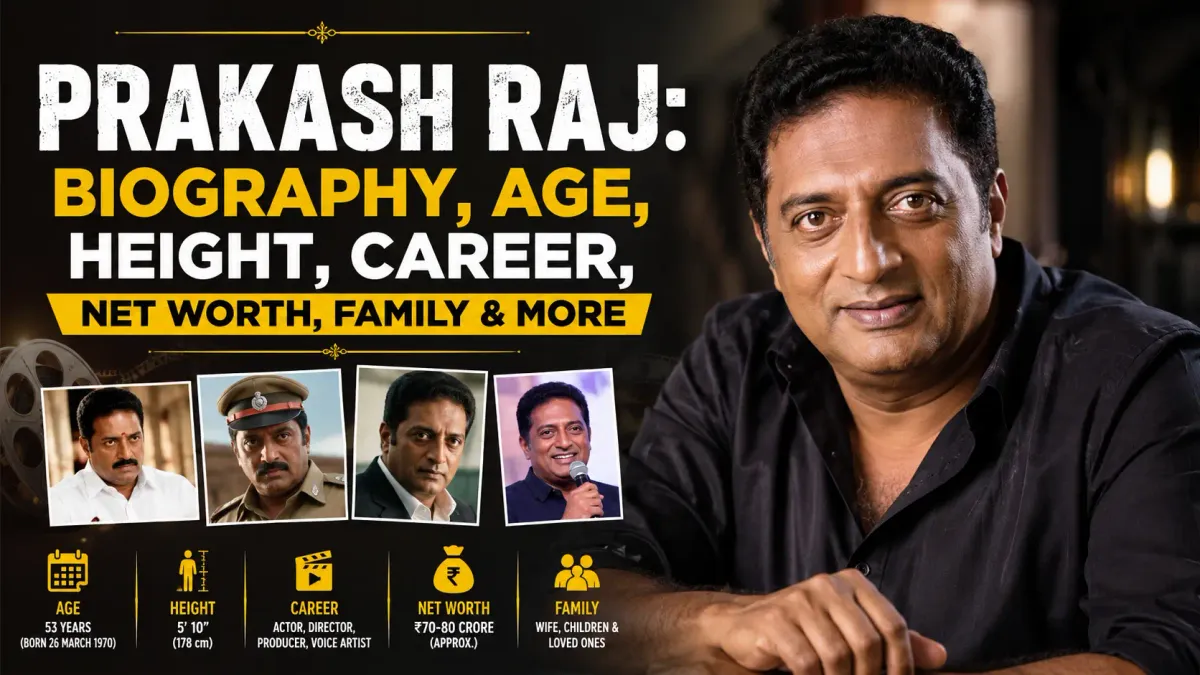
There are actors who play roles. And then there are actors who become the role so completely that audiences forget there's a camera present. Prakash Raj belongs firmly to that rare second category. Born Prakash Rai in Bangalore in 1965, he has spent four decades building one of the most extraordinary careers in the history of Indian cinema — not by playing heroes, but by making every character he inhabits unforgettably real.
From performing 2,000 street theatre shows for ₹300 a month at Kalakshetra in Bengaluru, to winning five National Film Awards across acting and production, Prakash Raj has earned a reputation that transcends language, industry, and genre. He has acted in over 400 films in Tamil, Telugu, Kannada, Hindi, Malayalam, and English — a polyglot performer who can shift seamlessly between snarling villainy, gentle fatherhood, and sharp political satire without missing a beat.
Most Indian moviegoers know him as the villain audiences love to hate — whether as Ghani Bhai in Wanted, the menacing Jaikant Shikre in Singham, or the manipulative antagonist across dozens of Telugu blockbusters. But the full Prakash Raj story is richer, stranger, and far more inspiring than any single role. It is the story of a self-made artist who climbed from obscure television serials to the National Film Award stage — and then stepped beyond cinema entirely to become one of India's most outspoken public voices.
Quick Biography Info
| Field | Information |
|---|---|
| Full Name | Prakash Rai |
| Stage Name | Prakash Raj |
| Profession | Actor, Film Producer, Director, Television Presenter, Activist, Politician |
| Famous For | Villain roles in Singham, Wanted, Okkadu; National Film Award-winning performances in Iruvar and Kanchivaram |
| Date of Birth | 26 March 1965 |
| Age | 61 years (as of 2026) |
| Birthplace | Bangalore, Mysore State (now Karnataka), India |
| Nationality | Indian |
| Religion | Non-believer (atheist; father was Hindu, mother was Roman Catholic) |
| Zodiac Sign | Aries |
| Height | 5 ft 9 in (175 cm) |
| Weight | Approximately 80 kg (176 lbs) |
| Eye Color | Dark Brown |
| Hair Color | Black (salt & pepper in recent years) |
| Education | Graduate in Commerce |
| School | St. Joseph's Indian High School, Bangalore |
| College/University | St. Joseph's College of Commerce, Brigade Road, Bangalore |
| Marital Status | Married (second marriage) |
| First Spouse | Lalitha Kumari (m. 1994 – div. 2009) |
| Current Spouse | Pony Verma (m. 24 August 2010) |
| Children | 4 — Meghana (daughter), Pooja (daughter), Sidhu (son, deceased 2004), Vedhanth (son, b. 2016) |
| Father | Manjunath Rai (Tulu community) |
| Mother | Swarnalatha (Kannada community) |
| Siblings | Not widely publicised |
| Net Worth | Approximately ₹150 crore (est. ~$18 million USD) |
| Monthly Income | Approx. ₹1–3 crore per film (varies by project) |
| Mother Tongue | Tulu |
| Languages Known | Kannada, Tulu, Tamil, Telugu, Hindi, Malayalam, English, Marathi |
| Hobbies | Theatre, painting, social activism, farming |
| Current Residence | Chennai, Tamil Nadu (primary); Bangalore, Karnataka |
| Production Company | Duet Movies |
| Official Website | N/A (active on social media) |
| Social Media | Facebook: PrakashRajOfficial; Twitter/X: @prakashraaj |
Early Life and Background
A Bangalore Boy with Tulu Roots
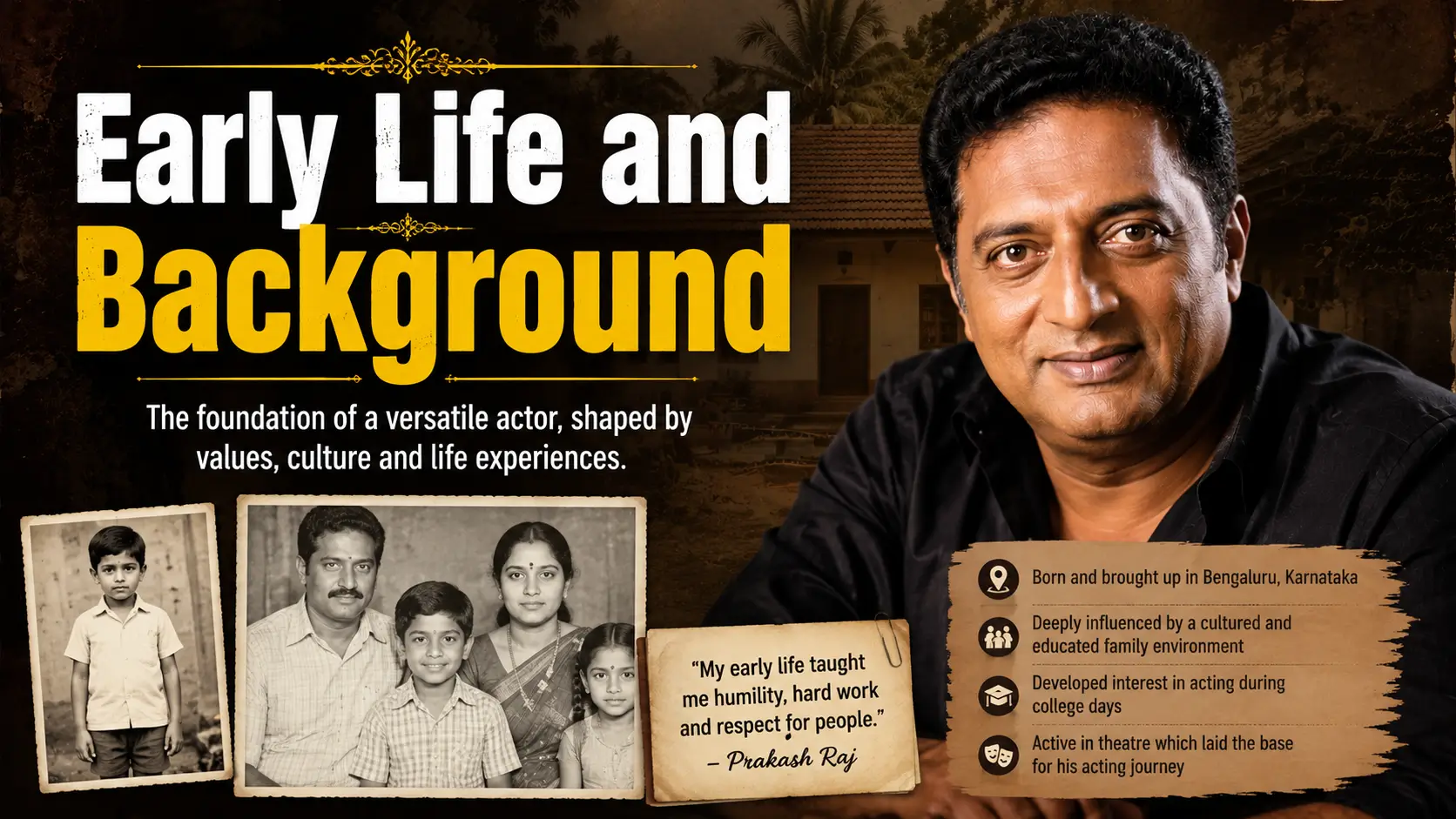
Prakash Raj was born on 26 March 1965 in Bangalore — a city that was already becoming a melting pot of South Indian cultures, languages, and ambitions. His birth name was Prakash Rai, a name rooted in his Tulu heritage. His father, Manjunath Rai, hailed from the Tulu-speaking community of coastal Karnataka, while his mother, Swarnalatha, was Kannadiga. This bicultural household gave the young Prakash an early fluency in multiple languages and, perhaps more importantly, an instinctive comfort with crossing cultural boundaries.
Growing up in Bangalore during the late 1960s and 1970s, Prakash was exposed to a city where Kannada culture flourished alongside diverse regional influences. His mother was Roman Catholic, his father Hindu — a detail that may partly explain why Prakash would later identify openly as a non-believer, comfortable questioning inherited certainties rather than defaulting to convention.
A Childhood Charged with Curiosity and Leadership
From a young age, Prakash showed a personality that combined natural leadership with intellectual restlessness. He was not a child who sat still. At school, he was known for his oratorical skills, his instinct for performance, and his active participation in every extra-curricular activity his teachers put before him. Friends and teachers alike recalled him as someone with a magnetic presence — the kind of kid who drew attention without particularly seeking it.
He won the President's Scout Award in 1982, a distinction that spoke to his discipline and community orientation even as a teenager. This balance — of structured achievement and creative expression — would define his approach to his craft throughout his adult career.
There were no actors in the family, no Bollywood connections, no silver screen lineage. What the Rai household did have was a love of storytelling, a respect for education, and a son who was quietly, determinedly, building his own path.
Education
Prakash Rai completed his schooling at St. Joseph's Indian High School in Bangalore, one of the city's most respected institutions. It was here that his talent for performance first found a formal stage. He participated in debates, inter-school competitions, and theatrical productions — activities that sharpened both his voice and his instinct for holding an audience's attention.
He went on to pursue higher education at St. Joseph's College of Commerce, Brigade Road, Bangalore, where he earned a degree in commerce. The college had a vibrant cultural scene, and Prakash threw himself into it completely. He participated in numerous plays — most of which were in Kannada — and continued to distinguish himself in debates.
It was during his college years that the theatre bug bit hardest. He began spending more time backstage and on stage than in the classroom, and after graduating, the choice was never really in question. He joined Kalakshetra, Bengaluru — a prestigious cultural institution — and began performing in back-to-back stage productions.
The academic grounding in commerce would later prove useful when Prakash transitioned into film production, but the real education that shaped him happened in the packed, chaotic world of street theatre.
Career Journey
Theatre and Television Beginnings
The early career of Prakash Raj is one of the most genuinely gritty stories in Indian cinema. He joined Kalakshetra and performed over 2,000 street theatre shows, earning a meagre ₹300 per month for this work. These were not glamorous productions — they were grassroots performances in community spaces, often with improvised sets and audiences who could be unpredictable. But they were an extraordinary classroom.
Two thousand performances teach you things that drama school cannot. They teach you to command a space, to modulate energy across different crowds, to find the emotional truth of a line even when everything around you is chaos. By the time Prakash Rai entered television, he had already logged more hours of live performance than most professional actors would accumulate in a decade.
He made his transition to the screen through Kannada Doordarshan serials, appearing in productions like Bisilu Kudure and Guddada Bhootha (broadcast in both Kannada and Tulu). These television appearances gave him visibility within Karnataka, and he also worked behind the camera during this period — as an assistant director and editor — gaining a comprehensive understanding of how films are made rather than just how to perform in them.
His early Kannada film appearances were in supporting roles — Raamachari, Nishkarsha, and Lockup Death — but even in minor parts, his dialogue delivery and physical command attracted attention. The breakthrough came with Harakeya Kuri (1992), directed by K.S.L. Swamy and starring Vishnuvardhan and Geetha. His performance caught the eye of lead actress Geetha, who was so impressed that she personally introduced him to her mentor: the legendary Tamil director K. Balachander.
Breakthrough in Tamil Cinema
That introduction to K. Balachander changed everything. Balachander cast Prakash Rai in his Tamil romantic drama Duet (1994), but with one significant modification: he asked the actor to change his surname from Rai to Raj. From that moment, Prakash Raj was born.
Duet gave Prakash Raj his Tamil debut and a new professional identity. In remembrance of this film and the man who gave him this second chance, he later named his production company Duet Movies — a tribute that speaks volumes about his sense of loyalty and gratitude.
Tamil audiences embraced him quickly. His naturalistic acting style — rooted in those 2,000 theatre shows — stood out against the more stylized performances common in commercial South Indian cinema of the era. He followed Duet with more Tamil and Kannada projects before making his Telugu debut in 1995 with Sankalpam.
The year 1997 was pivotal on multiple fronts. He returned to Kannada films with the critically acclaimed Nagamandala, directed by T.S. Naghabarana. More significantly, he appeared in Mani Ratnam's Iruvar — a political epic exploring the legendary friendship and rivalry between M.G. Ramachandran and M. Karunanidhi. His performance as Tamizhselvan in that film earned him the National Film Award for Best Supporting Actor in 1998.
Simultaneously, he received a National Film Award Special Mention for his work in the Telugu film Antahpuram (1998), directed by Krishna Vamsi. Two National Film Award recognitions in a single year established beyond any doubt that Prakash Raj was not just a commercial actor — he was a serious artist.
Dominating Telugu Cinema
Telugu cinema became Prakash Raj's most consistent playground for villainy. Through the late 1990s and 2000s, he appeared in a remarkable succession of blockbusters, often playing antagonists who were as compelling — sometimes more compelling — than the heroes.
Okkadu (2003) with Mahesh Babu was a landmark. His portrayal of Obul Reddy, the obsessive and dangerous antagonist, is still remembered as one of Telugu cinema's finest villain performances. The same year, he appeared in Shiva (2003) and continued to stack up hits in Tollywood throughout this period.
He also appeared in Tamil blockbusters like Ghilli (2004) and Mozhi (2007), building his reputation as an actor who could elevate any film regardless of his role's size. The Tamil comedy-drama Mozhi in particular showed audiences a different, warmer dimension of his talent.
The pinnacle of his acting career arrived with Kanchivaram (2008), directed by Priyadarshan. He played a silk weaver in Tamil Nadu who sacrifices everything so his daughter can wear a silk saree at her own wedding — a performance of extraordinary emotional depth and restraint. For this role, Prakash Raj won the National Film Award for Best Actor in 2007 (awarded in 2009), becoming one of the very few actors in Indian cinema history to win National Film Awards in both supporting and lead categories.
Bollywood Villainy
With his National Film Award pedigree firmly established, Bollywood came calling — specifically for his ability to play menacing antagonists. His Hindi debut in a major commercial capacity came with Wanted (2009), directed by Prabhu Deva and starring Salman Khan. As Ghani Bhai, the crime lord pulling the strings, Prakash Raj delivered a performance that introduced him to pan-Indian mainstream audiences.
More iconic still was his role in Singham (2011) as Jaikant Shikre, the corrupt politician-criminal who terrorises the protagonist police officer played by Ajay Devgn. The film was a massive hit, and Prakash Raj's villain became one of the most quoted and meme-d characters in contemporary Hindi cinema. He won the Zee Cine Award for Best Actor in a Negative Role (2012) for this performance.
He followed this with Dabangg 2 (2012) opposite Salman Khan again, and Mumbai Mirror (2013), further cementing his status as Hindi cinema's go-to South Indian villain. What distinguished his Bollywood work from many predecessor "South Indian villain" archetypes was his refusal to play characters as one-dimensional monsters — he always found the internal logic, the wounded ego or political calculation, that made the villainy comprehensible.
Return to Character Roles and Direction
As the 2010s progressed, Prakash Raj consciously began transitioning toward more complex character roles. He appeared in Thoongaa Vanam (2015) alongside Kamal Haasan, and continued working across industries in supporting but significant parts.
He also expanded into direction. His directorial ventures include Naanu Nanna Kanasu (Kannada), Dhoni (Tamil/Telugu), and Tadka (Hindi) — films that typically explored family dynamics, societal responsibility, and human relationships. While these did not achieve the commercial scale of his acting blockbusters, they demonstrated his commitment to content-driven storytelling.
The 2020s brought further distinguished appearances: Jai Bhim (2021), T.J. Gnanavel's acclaimed legal drama starring Suriya about Dalit rights and police brutality; Sita Ramam (2022), the Telugu romantic period drama; and Ponniyin Selvan: Part I (2022), Mani Ratnam's magnum opus adaptation of Kalki's classic Tamil novel. These choices reflect an actor who selects projects with purpose rather than purely for commercial return.
Production House: Duet Movies
Prakash Raj established Duet Movies as his production banner, reflecting his belief that significant cinema needs to be made, not just acted in. His most celebrated producing achievement was Puttakkana Highway (2012), directed by his longtime theatre friend B. Suresh, which won the National Film Award for Best Feature Film in Kannada — giving him his fifth National Film Award, this time as a producer. This feat is virtually without parallel: winning National Film Awards as a supporting actor, lead actor, and producer across three different film industries.
Filmography Highlights
Selected Major Films
| Year | Film | Language | Role/Category |
|---|---|---|---|
| 1994 | Duet | Tamil | Lead (debut) |
| 1997 | Iruvar | Tamil | Supporting — National Award |
| 1997 | Nagamandala | Kannada | Lead |
| 1998 | Antahpuram | Telugu | Special Mention — National Award |
| 2001 | Takkari Donga | Telugu | Antagonist |
| 2003 | Okkadu | Telugu | Antagonist (iconic) |
| 2004 | Ghilli | Tamil | Antagonist |
| 2007 | Mozhi | Tamil | Supporting |
| 2008 | Kanchivaram | Tamil | Lead — National Award (Best Actor) |
| 2009 | Wanted | Hindi | Antagonist |
| 2011 | Singham | Hindi | Antagonist (iconic) |
| 2012 | Dabangg 2 | Hindi | Antagonist |
| 2012 | Puttakkana Highway | Kannada | Producer — National Award |
| 2015 | Thoongaa Vanam | Tamil | Supporting |
| 2021 | Jai Bhim | Tamil | Character role |
| 2022 | Sita Ramam | Telugu | Character role |
| 2022 | Ponniyin Selvan: Part I | Tamil | Character role |
As Director
| Year | Film | Language |
|---|---|---|
| 2013 | Naanu Nanna Kanasu | Kannada |
| 2015 | Dhoni | Tamil/Telugu |
| 2017 | Tadka | Hindi |
Social Media Presence

Prakash Raj is one of the most outspoken Indian film personalities on social media — using his platforms not for promotional content but as a genuine arena for political commentary, social observation, and dialogue with citizens. His Twitter/X account in particular became a consistent source of commentary on democracy, free speech, and governance throughout the late 2010s and 2020s.
His Facebook page maintains a large and engaged following, with posts mixing film announcements with his activism — his "Just Asking" campaign, for instance, was prominently amplified through social media after the murder of journalist Gauri Lankesh in 2017.
| Platform | Handle | Approximate Followers |
|---|---|---|
| PrakashRajOfficial | 4.5 million+ | |
| Twitter / X | @prakashraaj | 1.5 million+ |
| @prakashraaj | 1 million+ | |
| YouTube | Duet Movies (production channel) | Moderate following |
He does not use social media as a celebrity branding tool — a deliberate and refreshing choice. His posts are characteristically direct and often provocative, reflecting the same fearless quality that defines his screen performances.
Physical Appearance
Standing at 5 feet 9 inches (175 cm) and weighing approximately 80 kg, Prakash Raj has a commanding physical presence that serves him extraordinarily well in antagonist roles. His dark, expressive eyes communicate menace or warmth with equal ease — a rare physical asset for a character actor.
In his younger years he maintained a lean, athletic build; in recent decades he has adopted a more distinguished, full-figured appearance that ironically makes him even more effective in roles requiring authority and gravitas. He keeps himself reasonably fit given the demands of his roles.
His fashion sense off-screen tends toward the understated — casual Indianwear or simple western clothes. There are no tattoos, no flamboyant public persona. What he projects physically is exactly what he is: a person entirely comfortable in his own skin, with nothing to prove aesthetically.
His voice is one of his most distinctive physical attributes — a rich, resonant instrument that he has refined through decades of stage and screen work. Even in quieter scenes, it carries weight. In confrontational scenes, it can fill a theatre without effort.
Net Worth & Financial Profile
Prakash Raj's financial profile reflects a career built over four decades in multiple film industries, as well as his work as a producer, director, and television host.
Estimated Net Worth: ₹150 Crore (~$18 Million USD)
| Income Source | Estimated Contribution |
|---|---|
| Film Acting (per film fee) | ₹2–3 crore per major film |
| Film Production (Duet Movies) | Significant catalogue revenue |
| Television Hosting (Neengalum Vellalam Oru Kodi) | Substantial per-episode fee |
| Brand Endorsements | Selective; not a high-volume endorser |
| Real Estate (Movable + Immovable assets) | Immovable: ₹26.59 crore; Movable: ₹4.93 crore |
| Fixed Deposits / Investments | ₹29.4 lakh+ declared |
Key Assets
- Vehicles: Black Mercedes-Benz ML250, Black BMW Q7 (combined estimated value ₹1.88 crore)
- Real Estate: Properties in Chennai and Bangalore
- Spouse Pony Verma's declared assets: Real estate ₹35 lakh, personal goods ₹20.46 lakh, jewellery ₹18 lakh
He is not known for an ostentatious lifestyle. Unlike many of his contemporaries, Prakash Raj does not display wealth for its own sake — his investments in social causes and theatre are as significant to him as his financial portfolio. He was reportedly paid approximately ₹2.4 crore (around $400,000) in 2017 for his film work, which gives a sense of his per-year earning scale at peak commercial activity.
Family and Relationships
Parents
Prakash Raj's father Manjunath Rai was from the Tulu-speaking community of coastal Karnataka. His mother Swarnalatha was Kannadiga. The family's mixed religious background — his mother Roman Catholic, his father Hindu — created a household that was culturally rich but ideologically open, which likely contributed to Prakash's later identification as a rationalist non-believer.
First Marriage: Lalitha Kumari (1994–2009)
In 1994 — the same year as his Tamil debut in Duet — Prakash Raj married Lalitha Kumari, a fellow actress from Karnataka. The marriage lasted fifteen years and produced three children:
- Meghana (daughter)
- Pooja (daughter)
- Sidhu (son) — born in 1999 and tragically passed away in 2004 at the age of just five years old, a loss that deeply affected Prakash Raj both personally and in his subsequent advocacy for children's wellbeing
The couple divorced in 2009. The split was handled with relative privacy, with neither party making public statements that sensationalised the separation.
Second Marriage: Pony Verma (2010–present)
Prakash Raj married renowned dance choreographer Pony Verma (born Rashmi Verma, 15 September 1977) on 24 August 2010. Pony Verma had built a distinguished career in Hindi film choreography, working on productions across multiple languages. Together they have a son:
- Vedhanth (born February 2016)
The couple are considered one of South India's most admired marriages — two professionals who have consistently supported each other's careers and causes. Pony Verma has accompanied her husband at numerous public events, including his political campaign in 2019.
Political Career
In 2019, Prakash Raj took the significant step of contesting the Lok Sabha elections as an independent candidate from the Bengaluru Central constituency. His campaign was built around civic accountability, freedom of expression, and opposition to what he described as the silencing of dissent in India. He did not emerge victorious from the election, but the campaign drew national attention and considerable public support — particularly from younger urban voters who appreciated his willingness to stand where he spoke.
He has consistently declined to formally align with any political party, maintaining his identity as an independent voice. He hosted a campaign called "Just Asking" — a series of public engagements and social media interactions focused on holding elected representatives accountable for silence on key national issues. The campaign grew significantly in the aftermath of the 2017 murder of journalist and activist Gauri Lankesh, a close friend of Prakash Raj's.
Controversies and Public Debates
Prakash Raj is among the most outspoken figures in Indian entertainment, and his public positions have made him a figure of significant controversy in certain political quarters. It is important to note that these controversies arise from his activism and public commentary, not from personal conduct scandals.
Gauri Lankesh Murder (2017) and National Award Threat
When journalist and activist Gauri Lankesh was shot dead outside her Bangalore home in September 2017, Prakash Raj was one of the first and most vocal public figures to demand accountability. He criticised the Prime Minister's silence on the murder and publicly stated he would not hesitate to return his National Film Award if the government did not act. His comment that the Prime Minister "follows those celebrating her murder on social media" triggered sharp responses from BJP leaders, who accused him of making baseless accusations. He remained firm on his position and continued to amplify the case.
"Just Asking" Campaign and Political Criticism
His "Just Asking" campaign — launched to assure citizens that they were not alone in asking difficult questions of those in power — made him a frequent target of online abuse and political criticism. BJP representatives called some of his statements inflammatory, and there were demands for legal action in certain instances. Prakash Raj responded consistently that holding power accountable through questions was not sedition but democratic duty.
2025–2026: Hyderabad Speech Controversy
A speech made at a public event in Hyderabad in late 2025 went viral in early 2026, in which Prakash Raj made strong statements about what he characterised as systematic targeting of minority communities. The speech triggered intense reactions — admiration from civil society activists, sharp condemnation from BJP leaders who called it seditious and based on false narratives. The debate sparked widespread discussion about free speech, political dissent, and the limits of public commentary in contemporary India.
Throughout all these controversies, Prakash Raj has maintained his positions consistently and without legal consequence, reflecting his care in framing criticism as questions of democratic accountability rather than personal attack.
Achievements & Awards
National Film Awards (5 Total)
| Year | Award | Film |
|---|---|---|
| 1998 | Best Supporting Actor | Iruvar (Tamil) |
| 1998 | Special Mention (Feature Film) | Antahpuram (Telugu) |
| 2007 | Best Actor | Kanchivaram (Tamil) |
| 2011 | Best Feature Film in Kannada (as Producer) | Puttakkana Highway |
Filmfare Awards South
| Year | Award | Film |
|---|---|---|
| 2009 | Best Actor (Tamil) | Kanchivaram |
| Multiple | Best Villain / Best Supporting Actor | Various |
Other Major Awards
| Award | Count |
|---|---|
| Nandi Awards (Telugu) | 8 |
| Tamil Nadu State Film Awards | 8 |
| Filmfare Awards South | 6 |
| SIIMA Awards | 4 |
| CineMAA Awards | 3 |
| Vijay Awards | 3 |
| Zee Cine Award for Best Actor in Negative Role | 1 (Singham, 2012) |
Total major awards won: 32+ (as of 2021 documentation)
He is one of the very few Indian actors to have won National Film Awards as a supporting actor, lead actor, AND producer — across three different regional language industries.
Interesting Facts About Prakash Raj
- He has over 2,000 street theatre performances to his credit, earning just ₹300 a month — a detail he mentions with pride rather than embarrassment.
- His production company Duet Movies is named in honour of the 1994 K. Balachander film that gave him his Tamil debut.
- He is a genuine polyglot — not just functionally but expressively fluent in Tamil, Telugu, Kannada, Hindi, Malayalam, Tulu, English, and Marathi. He has voiced his own characters in Malayalam films.
- He worked as an assistant director and editor before becoming an actor, giving him an unusually comprehensive understanding of filmmaking.
- He won the President's Scout Award in 1982 as a teenager — a fact that foreshadowed his lifelong commitment to community and leadership.
- He identifies as a non-believer (atheist/rationalist) in a film industry where public religious display is common and commercially expected.
- He launched an independent political campaign in 2019 without party affiliation — refusing the support of established political machines even when it would have improved his electoral chances.
- His son Sidhu passed away in 2004 at age five, a grief that Prakash Raj has spoken about rarely but when he does, with striking emotional depth.
- He is an active farmer and has spoken publicly about the importance of agriculture and rural India in interviews and social media.
- He hosted Neengalum Vellalam Oru Kodi (the Tamil version of Kaun Banega Crorepati) in its second season, proving himself equally effective as a television personality.
- He was persuaded to change his surname from Rai to Raj by K. Balachander — the director telling him the name would travel better across South Indian cinema.
Career and Life Timeline
| Year | Event |
|---|---|
| 1965 | Born Prakash Rai in Bangalore, Karnataka |
| 1982 | Wins President's Scout Award |
| Mid-1980s | Joins Kalakshetra, Bengaluru; begins 2,000+ street theatre performances |
| 1986 | Makes television debut with Kannada Doordarshan serials |
| 1990 | Film debut in Mithileya Seetheyaru (supporting role) |
| 1992 | Performance in Harakeya Kuri attracts attention of actress Geetha |
| 1994 | Tamil debut in K. Balachander's Duet; rechristened "Prakash Raj"; marries Lalitha Kumari |
| 1995 | Telugu debut in Sankalpam |
| 1997 | Appears in Mani Ratnam's Iruvar; returns to Kannada with Nagamandala |
| 1998 | Wins National Film Award for Best Supporting Actor (Iruvar) and Special Mention (Antahpuram) |
| 2003 | Okkadu becomes landmark Telugu blockbuster; iconic villain role |
| 2004 | Son Sidhu passes away at age five |
| 2008 | Leads Kanchivaram directed by Priyadarshan |
| 2009 | Wins National Film Award for Best Actor (Kanchivaram); Hindi breakthrough in Wanted |
| 2009 | Divorces Lalitha Kumari |
| 2010 | Marries choreographer Pony Verma |
| 2011 | Singham makes him pan-India villain star |
| 2012 | Produces Puttakkana Highway (National Film Award for Best Kannada Film) |
| 2016 | Son Vedhanth born |
| 2017 | Speaks out after Gauri Lankesh murder; launches "Just Asking" campaign |
| 2019 | Contests Lok Sabha elections as independent from Bengaluru Central |
| 2021 | Appears in acclaimed Jai Bhim |
| 2022 | Major roles in Sita Ramam and Ponniyin Selvan: Part I |
| 2025–2026 | Continues social activism; speech in Hyderabad sparks national debate |
Popular Quotes
"I question a lot. That's what I do. I'm not a great speaker, but I question."
"If they can lie to us a thousand times, we must speak the truth two thousand times."
"Not reacting to dirty things is dirty too. Men must take responsibility."
"Gauri's killers have not been caught yet. But what is more disappointing is people celebrating her murder over social media spreading hatred."
"My street theatre days were the best education I ever received. Two thousand shows taught me things no film set ever could."
Public Image & Legacy
Prakash Raj occupies a genuinely unusual position in Indian popular culture. He is simultaneously one of the most beloved screen villains in the country — a figure audiences cheer to boo — and one of the most principled public intellectuals working in entertainment. These two identities do not conflict in him; they coexist and reinforce each other.
His legacy as a screen villain has been transformative for how South Indian cinema conceives of antagonism. Before Prakash Raj, villains in commercial Telugu and Tamil films were largely cartoonish — defined by their physical menace and occasional comedy. He brought psychological depth, internal logic, and genuine menace to these roles, inspiring a generation of character actors to take the antagonist's perspective seriously.
His legacy as a public figure is still being written. The "Just Asking" campaign and his 2019 Lok Sabha run signalled an actor who refused to retreat behind the comfortable wall of celebrity neutrality. In an era when many entertainers are pressured to remain silent on political issues for commercial safety, Prakash Raj has been consistently, deliberately vocal — accepting the professional costs this may carry.
His theatre background makes him one of the few mainstream film stars who genuinely understands the performing arts as a public good rather than a personal brand. His production choices under Duet Movies reflect this — he has backed films that might not yield huge box office returns but that matter as cultural documents.
Fan communities across Tamil Nadu, Andhra Pradesh/Telangana, and Karnataka maintain active tributes to his work. His internet legacy includes some of Indian cinema's most meme-able villain moments — the irony being that these viral moments of comedic villainy coexist with serious documentary footage of his activism.
Latest News & Current Status
As of 2025–2026, Prakash Raj remains one of the most active senior character actors in Indian cinema. He has continued to appear in significant productions across South Indian languages, choosing projects based on the quality of the script and the integrity of the filmmakers rather than simply the size of the paycheck.
His public activism has continued without pause. In November 2025, he appeared at the Manorama Hortus literary event in Kerala, where he delivered a characteristically fiery session touching on free speech, the legacy of Gauri Lankesh, and the responsibility of citizens in a democracy. A speech in Hyderabad in late 2025 generated national controversy in early 2026, reigniting debates about the boundaries of political commentary by public figures.
He continues to maintain an active social media presence, particularly on Twitter/X and Facebook, where his posts on civic and political matters routinely generate significant engagement and debate.
There are no confirmed upcoming film releases announced as of mid-2026, though given his prolific output, new projects are likely in various stages of production across multiple industries.
Frequently Asked Questions (FAQs)
1. Who is Prakash Raj?
Prakash Raj (born Prakash Rai, 26 March 1965, Bangalore) is an Indian actor, film director, producer, television presenter, and social activist. He has acted in over 400 films across Tamil, Telugu, Kannada, Hindi, Malayalam, and English, and has won five National Film Awards.
2. How old is Prakash Raj?
Prakash Raj is 61 years old as of 2026 (born 26 March 1965).
3. What is Prakash Raj's real name?
His real name is Prakash Rai. He was renamed Prakash Raj by legendary Tamil director K. Balachander for his Tamil debut in Duet (1994).
4. What is Prakash Raj's net worth?
Prakash Raj's net worth is estimated at approximately ₹150 crore (around $18 million USD), earned across acting, production, television hosting, and endorsements.
5. Is Prakash Raj married?
Yes. He is currently married to choreographer Pony Verma (since 24 August 2010). He was previously married to actress Lalitha Kumari (1994–2009).
6. How many children does Prakash Raj have?
He has four children: daughters Meghana and Pooja (from his first marriage), son Sidhu (from his first marriage, who passed away in 2004 at age five), and son Vedhanth (born 2016, with Pony Verma).
7. What is Prakash Raj famous for?
He is famous for his iconic villain roles in Okkadu, Singham, and Wanted, for his National Film Award-winning performances in Iruvar and Kanchivaram, and for his outspoken social and political activism.
8. How many National Film Awards has Prakash Raj won?
He has won five National Film Awards — for Best Supporting Actor (Iruvar, 1998), Special Mention (Antahpuram, 1998), Best Actor (Kanchivaram, 2007), and Best Feature Film in Kannada as producer (Puttakkana Highway, 2011).
9. Where was Prakash Raj born?
He was born in Bangalore, Karnataka, India (then Mysore State).
10. What is Prakash Raj's height?
He is 5 feet 9 inches (175 cm) tall.
11. What languages does Prakash Raj speak?
He speaks Tamil, Telugu, Kannada, Hindi, Malayalam, Tulu, English, and Marathi — making him one of the most genuinely multilingual actors in Indian cinema.
12. What is Duet Movies?
Duet Movies is Prakash Raj's production company, named in honour of the 1994 K. Balachander film Duet that gave him his Tamil debut. Under this banner, he produced Puttakkana Highway, which won the National Film Award for Best Kannada Film.
13. Did Prakash Raj contest in elections?
Yes. In 2019, he contested the Lok Sabha elections as an independent candidate from the Bengaluru Central constituency. He did not win but the campaign drew widespread national attention.
14. What is Prakash Raj's religion?
Prakash Raj identifies as a non-believer (rationalist/atheist). His father was Hindu and his mother was Roman Catholic.
15. Who is Pony Verma?
Pony Verma (born Rashmi Verma, 15 September 1977) is a prominent Indian dance choreographer and Prakash Raj's wife since 2010. She has worked as a choreographer on numerous Hindi films and television productions.
16. What is the "Just Asking" campaign?
"Just Asking" is a social activism campaign launched by Prakash Raj following the murder of journalist Gauri Lankesh in 2017. The campaign was designed to reassure citizens that asking questions of those in power is a democratic right, and that those who do are not alone.
17. Which is Prakash Raj's most famous villain role?
While he has many iconic antagonist performances, his roles as Obul Reddy in Okkadu (Telugu, 2003) and Jaikant Shikre in Singham (Hindi, 2011) are considered his most culturally iconic.
18. How many films has Prakash Raj acted in?
He has acted in over 400 films across multiple Indian languages.
19. Did Prakash Raj work in Bollywood?
Yes. He has appeared in multiple Hindi films including Wanted (2009), Singham (2011), Dabangg 2 (2012), and Mumbai Mirror (2013).
20. What TV shows has Prakash Raj hosted?
He hosted Neengalum Vellalam Oru Kodi — the Tamil-language adaptation of Kaun Banega Crorepati — during its second season.
21. What is Prakash Raj's mother tongue?
His mother tongue is Tulu, the language of the coastal Karnataka community from which his father comes.
22. Has Prakash Raj directed any films?
Yes. He has directed Naanu Nanna Kanasu (Kannada), Dhoni (Tamil/Telugu), and Tadka (Hindi).
23. What is Prakash Raj's most critically acclaimed film?
Kanchivaram (2008), directed by Priyadarshan, in which he plays a silk weaver, is widely considered his greatest acting achievement and earned him the National Film Award for Best Actor.
24. Is Prakash Raj active on social media?
Yes — particularly on Twitter/X (@prakashraaj) and Facebook (PrakashRajOfficial), where he regularly posts on social and political issues.
25. What is the connection between Prakash Raj and Gauri Lankesh?
Gauri Lankesh was a Kannada journalist and activist and a close personal friend of Prakash Raj. Her murder in 2017 galvanised him into one of the most vocal public campaigns of his life, leading to the "Just Asking" movement and his eventual 2019 political run.