Sonam Wangchuk: Biography, Age, Height, Career, Net Worth, Family & More


There are very few people in the world who manage to become a legend in their own lifetime — not through fame or fortune, but through sheer force of purpose. Sonam Wangchuk is one of them. Born in a tiny village in the trans-Himalayan region of Ladakh, India, he grew up without a formal school, learned from his mother and the mountains, and went on to redefine what education, innovation, and environmental activism could look like in the 21st century.
He invented artificial glaciers called Ice Stupas to solve Ladakh's water crisis. He founded SECMOL — an education movement that transformed how children in one of the world's harshest terrains learn and grow. He launched the Himalayan Institute of Alternatives, Ladakh (HIAL) to build a future-ready, context-based university. And he inspired one of Bollywood's biggest ever blockbusters — 3 Idiots — through the sheer audacity of his thinking.
Today, Sonam Wangchuk is not just an engineer or an educator. He is a symbol: of what one person from the margins can do when driven by love for their land and its people. Nicknamed the "Snow Warrior" by many admirers, he has collected some of the world's most prestigious awards while living a remarkably grounded life in Leh.
His story is not without complexity. His activism for Ladakh's political rights brought him into direct conflict with the Indian state, leading to a dramatic NSA detention in 2025 that drew international attention. But even that chapter — raw and unresolved — only deepens the portrait of a man who refuses to be silent.
Quick Biography — Sonam Wangchuk at a Glance
| Field | Information |
|---|---|
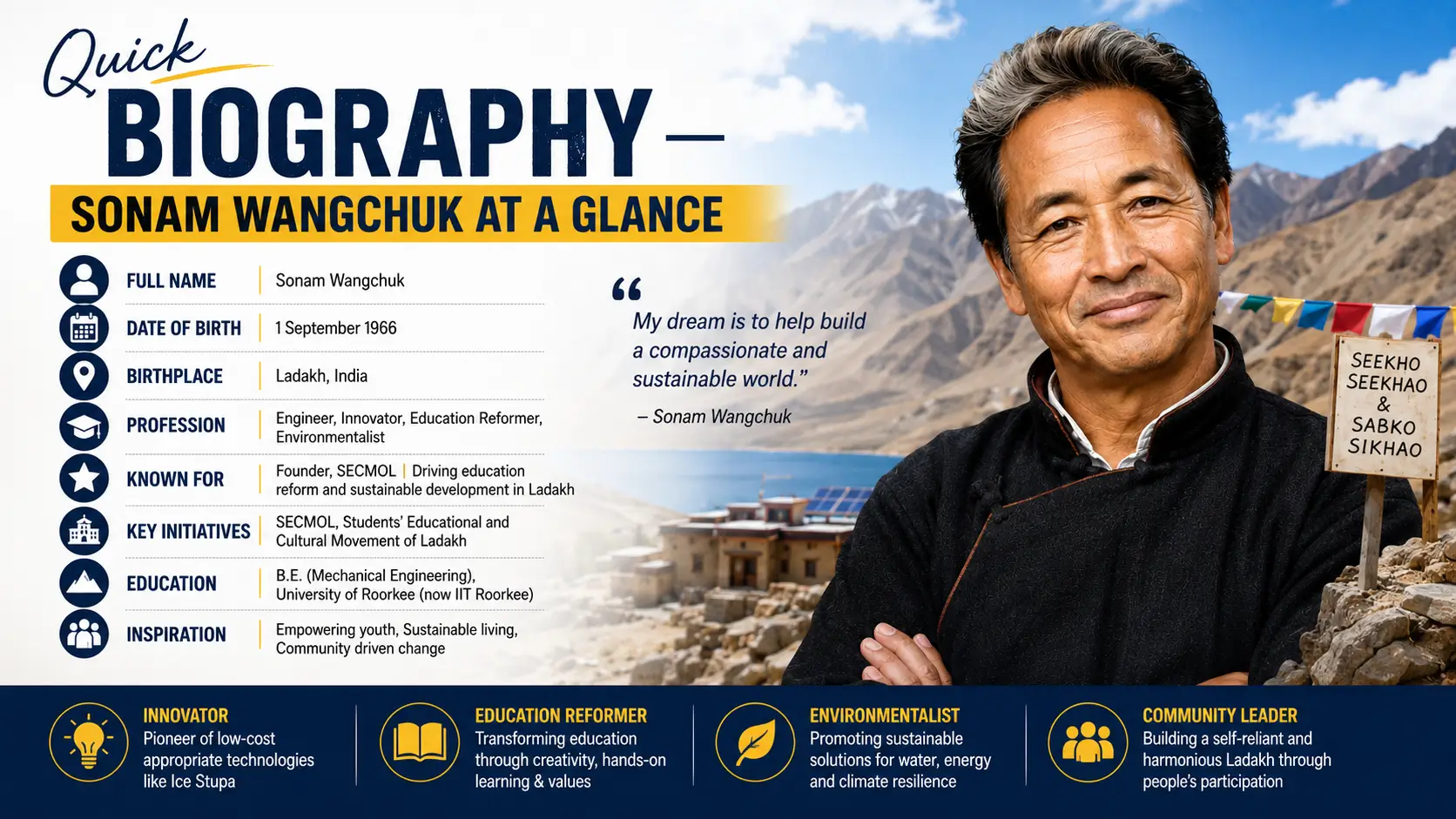
| Full Name | Sonam Wangchuk |
| Nickname | Snow Warrior, Real-Life Phunsukh Wangdu, Iceman of Ladakh |
| Profession | Engineer, Innovator, Education Reformer, Environmentalist, Activist |
| Famous For | Ice Stupa invention, SECMOL, HIAL, inspiration behind 3 Idiots character Phunsukh Wangdu |
| Date of Birth | 1 September 1966 |
| Age | 59 years (as of 2025) |
| Birthplace | Uleytokpo village, near Alchi, Leh district, Ladakh (then Jammu & Kashmir), India |
| Nationality | Indian |
| Religion | Buddhism |
| Zodiac Sign | Virgo |
| Height | 5 feet 8 inches (173 cm) |
| Weight | Approximately 72 kg |
| Eye Color | Dark Brown |
| Hair Color | Black (salt-and-pepper in recent years) |
| Education | B.Tech. in Mechanical Engineering (NIT Srinagar); Diploma/studies in Earthen Architecture (CRAterre / École de Architecture de Grenoble, France) |
| School | Vishesh Kendriya Vidyalaya, Delhi (after initial schooling in Srinagar) |
| College/University | National Institute of Technology (NIT), Srinagar |
| Marital Status | Married |
| Spouse | Gitanjali J. Angmo (social entrepreneur, co-founder of HIAL) |
| Children | Not publicly confirmed |
| Parents | Father: Sonam Wangyal (politician, former J&K minister); Mother: Tsering Wangmo |
| Siblings | P. Wangyal (brother; Deputy Chairman, Ladakh Autonomous Hill Development Council) |
| Net Worth | Estimated ₹80 Crore (~$12 million USD) |
| Monthly Income | Not publicly disclosed |
| Hobbies | Innovation, architecture, climate research, cycling, community building |
| Current Residence | Leh, Ladakh, India |
| Languages Known | Ladakhi, Hindi, English, French (working knowledge) |
| Official Website | N/A (primarily active on social media) |
| Social Media Profiles | YouTube: @SonamWangchuk66 · Instagram: @sonamwangchuk · X (Twitter): @Wangchuk66 |
Early Life and Background
Born in the Mountains, Shaped by the Land
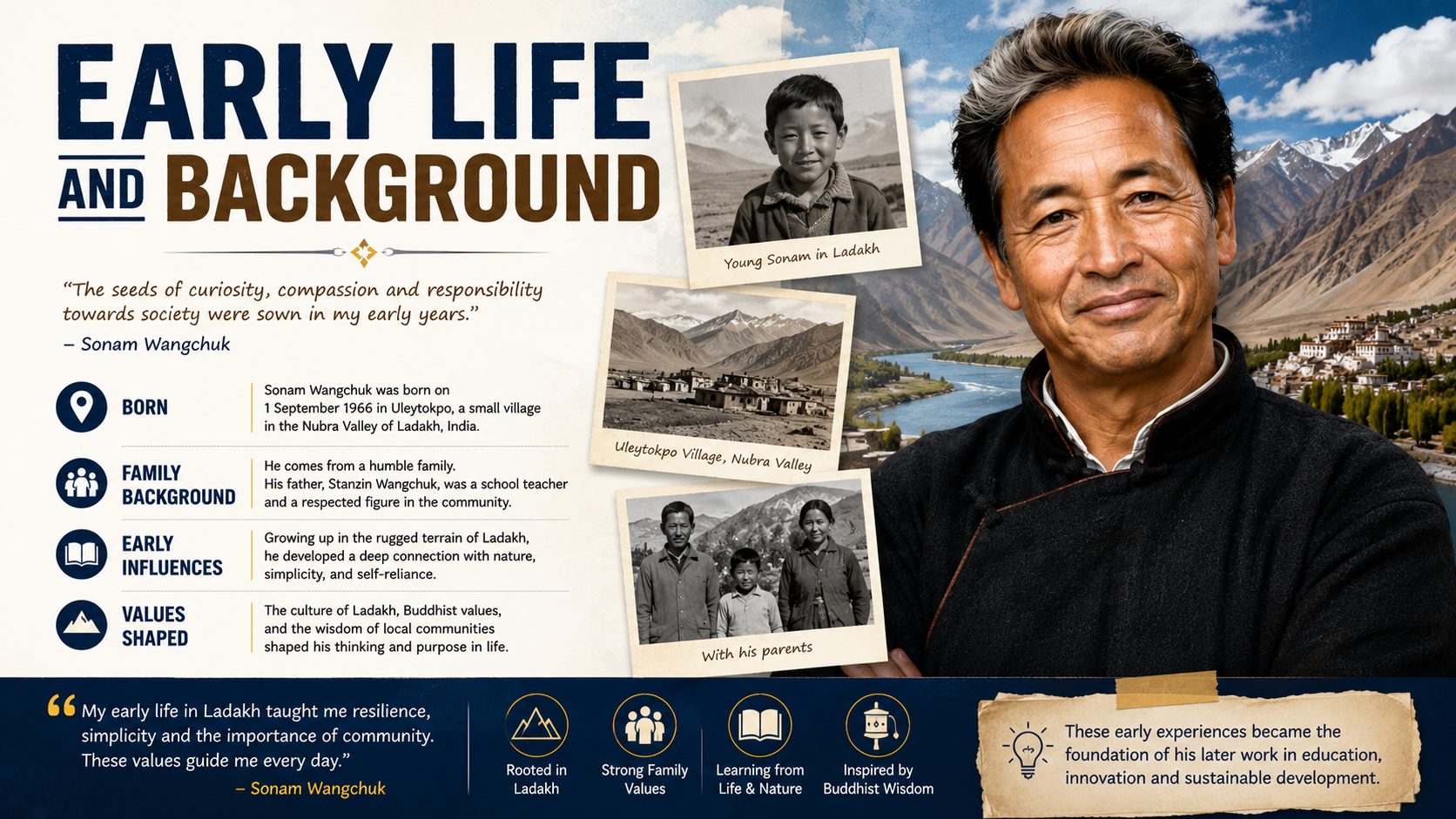
Sonam Wangchuk was born on 1 September 1966 in Uleytokpo, a small village near Alchi in the Leh district of Ladakh — a remote, high-altitude desert wedged between the mighty Himalayas and the Karakoram range. At the time of his birth, Ladakh was part of the state of Jammu & Kashmir (it became a Union Territory in 2019). Life in Uleytokpo was simple, seasonal, and profoundly shaped by nature.
There were no formal schools in Uleytokpo. Wangchuk grew up learning from his mother, Tsering Wangmo, and from the landscape around him — a childhood that, looking back, prepared him uniquely for a life of unconventional thinking. His father, Sonam Wangyal, was a politician who would later become a minister in the Jammu & Kashmir state government, and who also served as a security officer to the 14th Dalai Lama.
Until the age of nine, Sonam received informal education in his mother tongue, Ladakhi. He considers himself fortunate, in a way, to have been spared early exposure to the alien educational systems that were being imposed on Ladakhi children — a system that would later become the central problem he dedicated his career to solving.
A Painful Awakening in Srinagar
In 1975, when his father became a minister and the family relocated to Srinagar, nine-year-old Sonam was enrolled in a mainstream school for the first time. It was a culture shock of the most bruising kind.
At school in Srinagar, he was surrounded by children who looked different from him and spoke a language he did not yet understand. Teachers addressed him in a language foreign to his ears. His silence and bewilderment were mistaken for intellectual deficiency. Classmates and teachers, he would later recall, treated him as if he were slow or stupid.
He describes that period as "the darkest part of his life."
Refusing to accept that assessment, in 1977 — at just eleven years old — he made a bold, almost unthinkable decision: he left Srinagar alone and traveled to Delhi, where he walked into a school called Vishesh Kendriya Vidyalaya and literally pleaded his own case to the principal. It was a raw, instinctive act of self-advocacy. The principal listened, and Sonam was admitted.
That experience of being branded a failure by a system built for someone else would become the intellectual foundation of everything Wangchuk would build in his adult life.
Early Personality and Character
From a young age, Wangchuk was known for a restless, problem-solving mind. He was observant, deeply connected to his community, and inclined toward practical solutions over theoretical ideas. Growing up in a harsh mountain environment, where survival demanded ingenuity, shaped an instinct for engineering that no classroom could fully replicate. He was also, by all accounts, fiercely independent — the kind of child who didn't accept a "no" when a "how" was still possible.
Education
School Life
After his remarkable self-advocacy in Delhi, Wangchuk studied at Vishesh Kendriya Vidyalaya. His early experience of being labeled unintelligent in Srinagar gave him both empathy for struggling students and a burning drive to prove the label wrong — not for ego, but to demonstrate that the problem lay in the system, not in the student.
Engineering at NIT Srinagar
Wangchuk went on to complete his Bachelor of Technology (B.Tech.) in Mechanical Engineering from the National Institute of Technology (NIT), Srinagar — then known as the Regional Engineering College (REC) Srinagar. This was a rigorous technical degree, and graduating from it gave him the scientific vocabulary to later design and build systems that would genuinely change lives.
He was not, by his own admission, the typical topper. He was the kind of student who cared more about why things worked than about memorising what the textbook said.
Studies in Earthen Architecture — France
Driven by his vision for sustainable, affordable buildings suited to Ladakh's extreme climate, Wangchuk later pursued studies in earthen architecture at CRAterre (International Centre for Earth Construction), associated with the École d'Architecture de Grenoble in France. This training profoundly influenced the design of the SECMOL campus and would eventually earn international architectural recognition.
He was one of the few Indian educators of his era to blend hard engineering with vernacular architecture and environmental science — a multidisciplinary approach that was well ahead of its time.
Career Journey
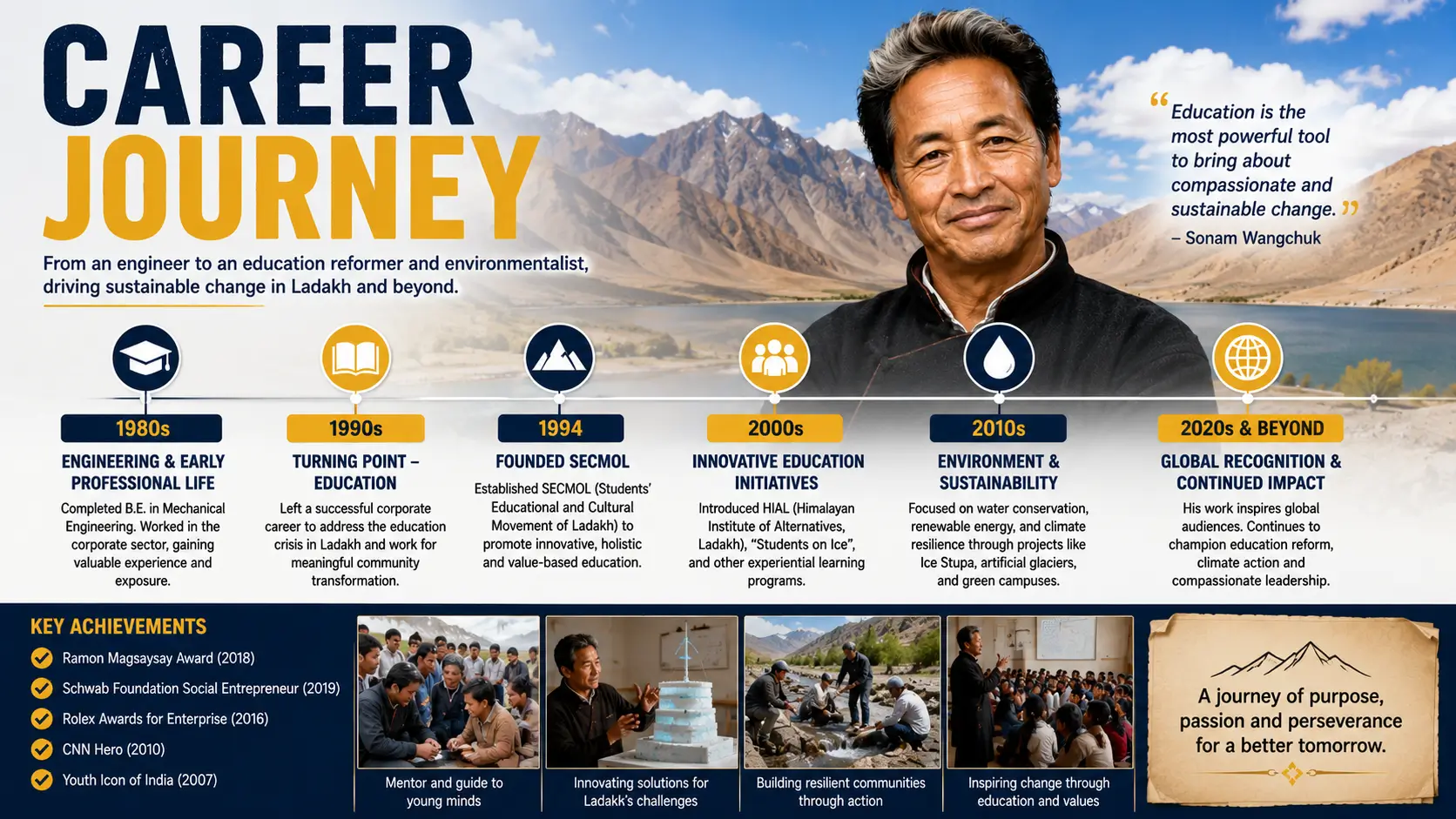
The SECMOL Foundation (1988)
Fresh out of engineering college in 1988, Sonam Wangchuk didn't head for a corporate job or a government posting. Instead, he co-founded the Students' Educational and Cultural Movement of Ladakh (SECMOL) — a grassroots organisation with a deceptively simple mission: fix an education system that was failing Ladakhi children.
SECMOL was born out of the recognition that the mainstream Indian school curriculum was designed for the plains, taught in languages alien to Ladakhi students, and was entirely disconnected from the realities of mountain life. Children who failed exams were not failures — they were victims of a mismatch between their world and the system's assumptions.
SECMOL's alternative school campus near Leh eventually became internationally famous. Its admission policy was radical: students who had failed their board exams were actively encouraged to apply. Here, education became experiential, hands-on, and rooted in Ladakhi culture. Students learned by doing — building solar structures, managing water, farming, and running the campus itself.
The campus became a marvel of sustainable design. Situated in the cold Ladakhi desert where winters can plunge to -30°C, the buildings are heated entirely through passive solar architecture. There is no fossil fuel used for cooking, lighting, or heating. The campus generates its own electricity through solar panels and operates as a self-sufficient community — a living, breathing demonstration of what sustainable mountain living can look like.
In 2016, the SECMOL campus won the International Terra Award for Earth Architecture, recognising it as one of the finest examples of sustainable construction in the world.
Operation New Hope (1994)
In 1994, Wangchuk took his education reform efforts beyond SECMOL and helped launch Operation New Hope — a triangular collaboration between the government, village communities, and civil society to reform the state-run school system in Ladakh.
The program trained teachers, introduced practical and culturally relevant curricula, and shifted assessment methods away from rote memorisation. Its impact was measurable: pass rates in government schools in Ladakh climbed dramatically over the following years, from a dismal 5% to over 75% at the peak of the program's influence.
Operation New Hope became one of the most cited examples of successful community-driven educational reform in India — proof that large-scale change was possible without waiting for top-down government initiative.
Ladags Melong — The Voice of Ladakh
Between 1993 and 2005, Wangchuk also served as editor of Ladags Melong, Ladakh's only print magazine. The publication, written in Ladakhi, was a crucial tool for community communication, cultural preservation, and civic engagement in a region that often went unheard in national media. His work with the magazine also influenced Ladakh's Vision 2025 development strategy — a regional planning document that drew on local voices rather than bureaucratic templates.
The Ice Stupa Innovation (2014)
Of all Wangchuk's inventions, the Ice Stupa is perhaps his most globally recognised contribution to climate adaptation.
Ladakh faces a paradoxical water problem: the region receives snowfall and glacial meltwater in abundance during winter and early spring, but by April and May — exactly when crops need water most — the streams run dry while the glaciers haven't yet begun melting. Farmers were going without water precisely when they needed it most.
Inspired by the earlier experimental work of fellow Ladakhi engineer Chewang Norphel, Wangchuk developed a more practical and visually distinctive system. He discovered that if a pipe could carry stream water uphill during winter and spray it into the freezing air, it would freeze and accumulate into a conical ice formation — shaped, deliberately, like a Buddhist stupa. The cone shape minimised surface area relative to volume, slowing the melt. The result was an artificial glacier that stored water through winter and released it steadily in spring.
The first prototype Ice Stupa, built in 2013–14, stood 30 metres tall and stored an estimated 5,000 cubic metres of water. It survived until mid-May — providing water for fields that had previously gone dry.
The technology required no electricity, no heavy machinery, and cost a fraction of conventional water storage systems. It worked. It spread. Today, Ice Stupas have been built in multiple Himalayan villages, and the concept has attracted attention from climate scientists, water engineers, and policy makers worldwide.
In 2016, the Ice Stupa project won the prestigious Rolex Awards for Enterprise, given in Los Angeles to those who have "reshaped the world with innovative thinking." He also received the Fred M. Packard International Parks Merit Award and the Global Award for Sustainable Architecture in 2017.
HIAL — Himalayan Institute of Alternatives, Ladakh (2017)
SECMOL addressed school-level education. But Wangchuk had a larger ambition: to build a university-level institution that would train a generation of problem-solvers who understood mountain ecosystems, sustainable technology, and community leadership.
In 2017, he and his wife Gitanjali J. Angmo co-founded the Himalayan Institute of Alternatives, Ladakh (HIAL). Envisioned as an alternative university, HIAL operates on five pillars: Contextual Learning, Experiential Learning, Transdisciplinary Approach, Community Engagement, and Holistic Development.
The institute faced significant headwinds from bureaucratic and political resistance over land allocation and funding — challenges that became tied to Wangchuk's later activism and would escalate dramatically by 2025.
Social Media Presence
Sonam Wangchuk uses social media not for personal branding in the conventional sense, but as a platform for education, climate advocacy, and civic mobilisation. His YouTube channel and Instagram have become powerful tools for reaching audiences across India and the world with messages about sustainable living, Ladakh's challenges, and the philosophy of unconventional education.
His videos — often shot in Ladakh's dramatic landscapes with raw, unfiltered production values — go viral regularly. A climate fast he undertook at high altitude, for instance, attracted hundreds of thousands of viewers and generated significant national media coverage.
| Platform | Username | Approx. Followers |
|---|---|---|
| YouTube | @SonamWangchuk66 | ~1.8 million+ subscribers |
| @sonamwangchuk | ~1.5 million+ followers | |
| X (Twitter) | @Wangchuk66 | ~900K+ followers |
| Sonam Wangchuk (public page) | ~500K+ followers |
He does not engage in commercial sponsorships or brand promotions — his platforms remain entirely mission-driven, which has earned him a particularly loyal and engaged audience.
Physical Appearance
Sonam Wangchuk stands at approximately 5 feet 8 inches (173 cm) and carries himself with the weathered, grounded energy of someone who has spent decades working outdoors in extreme conditions. His build is lean but strong — befitting someone who regularly fasts, treks, and lives in high-altitude terrain.
His most distinctive physical feature, especially in recent years, is a full beard that has taken on shades of silver — giving him an unmistakably sage-like appearance that suits the wise, quiet authority he commands. Dark, expressive brown eyes and high Ladakhi cheekbones complete a face that has become widely recognizable across India.
His personal style is refreshingly minimal: he is most often seen in traditional Ladakhi clothing — the goncha (a heavy robe-like coat) — or in practical, outdoorsy layers suited to the high-altitude cold. He owns none of the designer brands or luxury accessories that come to mind when one thinks of India's public intellectuals. His wardrobe is as practical as his architecture.
Wangchuk maintains his health through an active lifestyle. He has undertaken multiple hunger strikes and cold-weather fasts — including one at -20°C at Khardung La — as forms of non-violent protest, demonstrating a level of physical and mental discipline that draws comparisons to Mahatma Gandhi's methods.
Net Worth & Financial Profile
Estimated Net Worth
Sonam Wangchuk's estimated net worth is approximately ₹80 Crore (around $12 million USD). It is important to contextualise this figure carefully. Wangchuk has never pursued wealth as a personal goal, and his lifestyle reflects this. His income comes primarily from awards, speaking engagements, grants to his institutions, and whatever support flows to SECMOL and HIAL.
He does not live lavishly. He resides in Leh, one of India's most remote urban centres, in a modest setting consistent with his values of sustainability and simplicity.
Net Worth Breakdown
| Income / Asset Source | Estimated Contribution |
|---|---|
| Awards and Prize Money (Rolex, Magsaysay, etc.) | ₹5–8 Crore |
| International Speaking Engagements | ₹2–4 Crore |
| SECMOL & HIAL Institutional Grants | Institutional (not personal) |
| YouTube Channel Revenue | Modest / reinvested |
| Land and Property in Ladakh | ₹10–15 Crore (estimated) |
| Endorsements / Brand Deals | None (publicly committed to none) |
| Residual / Investments | Estimated ₹50+ Crore |
Note: Most financial estimates for Wangchuk are speculative. He is known to reinvest his earnings and prize money into his institutions rather than personal accumulation.
Family and Relationships

His Father: Sonam Wangyal
Sonam Wangchuk's father, Sonam Wangyal, was a significant figure in Ladakhi political life. He served as a minister in the Jammu & Kashmir state government and was also the security officer of the 14th Dalai Lama — a role of great cultural and spiritual significance within the Tibetan Buddhist community. This background gave young Sonam exposure to both governance and the philosophical traditions of Tibetan Buddhism.
His Mother: Tsering Wangmo
Tsering Wangmo was, by Wangchuk's account, his first and most important teacher. In the early years of his life in Uleytokpo, before any formal schooling, she was the primary source of his education — teaching him in Ladakhi and instilling a love for his cultural roots.
His Brother: P. Wangyal
Sonam's brother, P. Wangyal, has followed their father into politics and serves as the Deputy Chairman of the Ladakh Autonomous Hill Development Council in Leh. The Wangchuk-Wangyal family has, across generations, been deeply embedded in Ladakhi civic life.
His Wife: Gitanjali J. Angmo
Sonam Wangchuk is married to Gitanjali J. Angmo, a remarkable person in her own right. Born in Balasore, Odisha, into a Punjabi Jain family, Gitanjali holds an MBA from the Xavier Institute of Management, Bhubaneswar, and has a background in education leadership — having headed a Cambridge-affiliated school in Chennai and served as an advisor to the Maharashtra International Education Board.
She co-founded HIAL with Sonam in 2017 and serves as its Founder, CEO, and Dean. Her cross-cultural background — a Punjabi Jain woman building an institution in the Buddhist mountains of Ladakh — is a beautiful embodiment of India's multicultural potential. In 2022, she received the Women Transforming India Award from the Government of India.
When Sonam was detained under the NSA in September 2025, Gitanjali became one of the most vocal and visible advocates for his release, filing a habeas corpus petition in the Supreme Court and speaking publicly about what she described as the politically motivated nature of the detention.
Their partnership is both personal and professional — a shared life built entirely around a shared mission.
Controversies
The Ladakh Constitutional Movement and 2025 Protests
Sonam Wangchuk's most significant and defining controversy emerged from his decades-long activism for Ladakh's political rights — specifically his demand for Sixth Schedule status under the Indian Constitution (which provides tribal constitutional protections for land, culture, and governance) and full statehood for Ladakh.
When the Indian government revoked Article 370 in August 2019 and bifurcated Jammu & Kashmir into two Union Territories — leaving Ladakh without a legislature — Wangchuk initially welcomed the move, hoping it would bring greater local governance. But as months passed and it became clear that Ladakh had been left more powerless than before, his position shifted toward open advocacy.
Through 2021–2024, he undertook multiple hunger strikes and peaceful demonstrations, including a 21-day climate fast in March 2024 and a famous "Delhi Chalo" march in which thousands of Ladakhis marched toward the capital demanding political protections.
NSA Detention (September 2025 – March 2026)
On September 24, 2025, large-scale protests in Leh turned violent, leaving four people dead and nearly 100 injured. Two days later, on September 26, 2025, Sonam Wangchuk was detained under the National Security Act (NSA) — a law that allows preventive detention for up to 12 months without formal charges.
He was transferred to Jodhpur Central Jail in Rajasthan — thousands of kilometres from Ladakh. The Ladakh administration alleged that he had made "provocative speeches" and engaged in "activities prejudicial to the security of the state." The Ladakh police also controversially claimed links between Wangchuk and Pakistani intelligence — a charge his wife and supporters vehemently denied, arguing he had attended a UN climate conference and an event by Pakistani media outlet Dawn, which were peaceful international engagements.
Wangchuk maintained that his protests were strictly non-violent and in the Gandhian tradition. His wife challenged the detention in the Supreme Court.
The detention drew widespread international condemnation, coverage from Al Jazeera, BBC, and major global outlets, and significant domestic outrage from civil society groups, intellectuals, and opposition politicians.
HIAL Land Lease Cancellation and SECMOL FCRA Issue
Separately, the Ladakh administration cancelled HIAL's 40-year land lease in what Gitanjali alleged was a politically motivated move. A senior minister reportedly warned her that the lease freeze would continue unless Wangchuk gave up his activism for Sixth Schedule status. Officials denied this, citing procedural delays as the reason.
SECMOL also had its FCRA (Foreign Contribution Regulation Act) licence cancelled, which restricted its international funding — a move Gitanjali said set the institution back by two years.
Release and Resolution (March 2026)
On March 14, 2026, the Government of India revoked Wangchuk's NSA detention "with immediate effect." The Home Ministry stated that it remained committed to "peace, stability, and mutual trust in Ladakh" and expressed hope for "constructive engagement and dialogue." Wangchuk was released from Jodhpur jail at 1:30 PM that day, with Gitanjali present for the formalities.
Following his release, Gitanjali announced they would return to Ladakh and resume their work on HIAL and SECMOL, glacier preservation, and Ladakh's empowerment — continuing the mission that had defined their lives.
Awards and Achievements
Sonam Wangchuk is among the most decorated social innovators in Asia. His recognition spans education, environmental science, architecture, and civic leadership.
| Year | Award / Recognition | Awarding Body |
|---|---|---|
| 2002 | Ashoka Fellowship for Social Entrepreneurship | Ashoka Foundation |
| 2008 | Real Heroes Award | CNN-IBN / Network18 |
| 2016 | Rolex Awards for Enterprise | Rolex Foundation, Los Angeles |
| 2016 | Fred M. Packard International Parks Merit Award | IUCN / Fred M. Packard Foundation |
| 2016 | International Terra Award for Earth Architecture | CRAterre (SECMOL campus) |
| 2017 | Global Award for Sustainable Architecture | Paris |
| 2018 | Ramon Magsaysay Award | Ramon Magsaysay Foundation, Philippines |
| 2022 | Women Transforming India Award (Gitanjali Angmo) | Govt. of India / NITI Aayog |
The Ramon Magsaysay Award
The Ramon Magsaysay Award, received in 2018, is arguably the most prestigious of Wangchuk's accolades. Often called the "Nobel Prize of Asia", it is awarded by the Manila-based Ramon Magsaysay Foundation to individuals and organisations in Asia who have demonstrated integrity in public service, transformative leadership, and profound impact on their communities. The award citation noted his work in education reform and sustainable innovation in Ladakh.
Interesting Facts About Sonam Wangchuk
- He inspired Aamir Khan's character Phunsukh Wangdu in 3 Idiots (2009) — the fictional inventor-teacher who disappears into the mountains to teach unconventionally. The parallels are unmistakable. However, Wangchuk himself has been careful to say that he is not Phunsukh Wangdu, and that the character is a fictional creation, not a biopic.
- His very first Ice Stupa stood 30 metres tall and stored roughly 5,000 cubic metres of water — a feat achieved with virtually no external infrastructure.
- He has undertaken multiple hunger strikes in sub-zero temperatures, including one at Khardung La pass at approximately -20°C, as a form of non-violent protest for Ladakh's rights.
- He never used fossil fuels in his SECMOL campus — the entire building runs on solar energy for heating, cooking, and lighting. Visitors have described arriving at the campus in January and finding it warm inside without a single heater running.
- He received the Ashoka Fellowship in 2002 — making him one of India's earliest recognised social entrepreneurs.
- He edited Ladakh's only print magazine for over a decade, using it as a civic tool when social media didn't yet exist.
- His wife is from Odisha — their cross-cultural union is a source of quiet inspiration in itself, embodying the India they both work to build.
- He has undergone fasting as a political tool on at least four major occasions, each time drawing enormous public attention to Ladakh's issues.
- The 3 Idiots connection brought him fame he never sought. He has said the film's success surprised him and the attention was somewhat overwhelming, though he appreciated the philosophy it spread about rethinking education.
- He was detained 6,000 km from Ladakh — the Jodhpur jail in Rajasthan is one of the most geographically remote prisons from Leh in India, a fact many observers found symbolically harsh.
Career & Life Timeline
| Year | Event |
|---|---|
| 1966 | Born on 1 September in Uleytokpo village, Ladakh |
| 1975 | Family moves to Srinagar; enrolls in mainstream school, experiences cultural shock |
| 1977 | Escapes alone to Delhi; secures admission at Vishesh Kendriya Vidyalaya |
| 1988 | Completes B.Tech. in Mechanical Engineering from NIT Srinagar; co-founds SECMOL |
| 1993 | Becomes editor of Ladags Melong, Ladakh's only print magazine |
| 1994 | Launches Operation New Hope, a landmark education reform initiative |
| 1998 | SECMOL Alternative Campus established near Leh |
| 2002 | Receives Ashoka Fellowship for Social Entrepreneurship |
| 2008 | Wins CNN-IBN Real Heroes Award |
| 2009 | 3 Idiots released; character Phunsukh Wangdu widely linked to Wangchuk |
| 2013–14 | Builds first Ice Stupa prototype (30 metres tall) |
| 2016 | Wins Rolex Awards for Enterprise (Ice Stupa project); SECMOL campus wins International Terra Award |
| 2017 | Co-founds HIAL with wife Gitanjali J. Angmo |
| 2017 | Wins Global Award for Sustainable Architecture, Paris |
| 2018 | Receives Ramon Magsaysay Award ("Nobel Prize of Asia") |
| 2019 | Welcomes Article 370 revocation; later shifts to advocacy for Sixth Schedule protections |
| 2021–2023 | Multiple hunger strikes and protests for Ladakh's constitutional rights |
| 2024 | Undertakes 21-day climate fast; leads "Delhi Chalo" march for Ladakh |
| Sept 2025 | Protests in Leh turn violent; detained under NSA and transferred to Jodhpur jail |
| March 2026 | Released from NSA detention after Centre revokes order |
Popular Quotes
"Become capable. Success will then come chasing you."
— Philosophy attributed to Wangchuk, echoed in 3 Idiots
"The biggest waste of education is when it makes students feel like failures."
"We don't need big dams or big technology. We need appropriate technology — solutions designed for the people who will use them, in the place where they live."
"Imprisoning me will only awaken more people."
— Statement before his NSA detention, September 2025
"Ladakh needs safeguards for its land, its people, its culture — not just roads and internet."
Major Projects and Initiatives
SECMOL (Students' Educational and Cultural Movement of Ladakh)
Founded in 1988. Operates an alternative school campus in Phyang, near Leh. The campus is solar-powered and uses passive heating architecture. Produced hundreds of graduates who became teachers, engineers, and community leaders.
Operation New Hope (1994)
A collaborative education reform initiative that raised Ladakh government school pass rates from under 5% to over 75% at its peak.
Ladags Melong Magazine (1993–2005)
Ladakh's only print publication, edited by Wangchuk. Preserved language, culture, and civic voice for over a decade.
Ice Stupa Project (2013–present)
Artificial glacier technology for high-altitude water storage. Has been replicated in multiple Himalayan communities and studied by climate researchers worldwide.
HIAL — Himalayan Institute of Alternatives, Ladakh (2017–present)
An alternative university project with a five-pillar framework focused on mountain communities, sustainability, and contextual learning. Co-founded with Gitanjali J. Angmo.
Solar Tents for Indian Army
Wangchuk designed solar-heated military tents for Indian soldiers posted in extreme Himalayan cold — a contribution to both innovation and national security.
Climate Activism and Fasting Campaigns (2019–2025)
Multiple hunger strikes and protest marches demanding constitutional protections, Sixth Schedule status, and statehood for Ladakh.
Public Image and Legacy
The Real-Life Phunsukh Wangdu
In 2009, 3 Idiots made Wangchuk a household name across India and beyond — even though most people didn't know it was him they were celebrating. The film's Phunsukh Wangdu — an eccentric genius who refuses to follow conventional paths and retreats to the mountains to transform education — was unmistakably inspired by Wangchuk's life and philosophy.
The film became one of Bollywood's highest-grossing films ever and was a massive hit in China, where it sparked national conversations about rote learning and the purpose of education. Wangchuk's philosophy travelled through cinema to hundreds of millions of people who never knew his name.
A Model for Grassroots Innovation
In the global development community, Wangchuk is held up as a rare example of bottom-up innovation done right — solutions designed for and by the communities that need them, rather than imposed from outside. The Ice Stupa is studied in environmental engineering courses. SECMOL is cited in education policy research. HIAL is being watched as a potential model for alternative higher education in challenging geographies.
Cultural and Environmental Icon
For Ladakh, Wangchuk is more than an innovator — he is a symbol of the region's distinctiveness and its right to self-determination. In a land increasingly facing tourism pressure, climate disruption, and political marginalisation, he represents a way of being modern without abandoning what is essential.
Internationally, organisations like the United Nations have recognised his climate adaptation work as a model for how mountain communities can respond to accelerating glacial loss.
The Political Dimension
His NSA detention in 2025 and the global outcry that followed elevated him to a new stature — as a political conscience. Whether one agrees with all his positions or not, his willingness to fast, march, face arrest, and speak truth to power in the manner of India's great Gandhian tradition is widely respected.
Latest News & Current Status (2025–2026)
NSA Detention and Release
After being detained on September 26, 2025 under the National Security Act in the wake of violent protests in Leh, Sonam Wangchuk spent nearly six months in Jodhpur Central Jail. The Centre revoked his detention on March 14, 2026, citing a commitment to dialogue and peace in Ladakh.
His wife Gitanjali, who fought tirelessly for his release through the Supreme Court and the media, confirmed following his release that they planned to return to Ladakh and resume their work on HIAL, glacier preservation, and Ladakh's constitutional rights.
HIAL and SECMOL Recovery
Both institutions suffered operational setbacks during the period of political pressure — HIAL's land lease was cancelled, and SECMOL's FCRA licence was suspended. The road to recovery for both institutions will be one of the defining challenges of the coming years for Wangchuk and Angmo.
Ongoing Advocacy
As of mid-2026, Wangchuk remains committed to his core demands: Sixth Schedule constitutional protections for Ladakh, statehood, and safeguards for the region's land, culture, and fragile ecosystem. His detention has, if anything, amplified his moral authority and his international platform.
Frequently Asked Questions (FAQs)
Q1: Who is Sonam Wangchuk?
Sonam Wangchuk is an Indian engineer, innovator, educator, and activist from Ladakh. He is best known for founding SECMOL, inventing Ice Stupas, co-founding HIAL, and inspiring the Bollywood character Phunsukh Wangdu in 3 Idiots.
Q2: How old is Sonam Wangchuk?
Sonam Wangchuk was born on 1 September 1966. As of 2025, he is 59 years old.
Q3: What is Sonam Wangchuk's net worth?
His estimated net worth is approximately ₹80 Crore (~$12 million USD), though he is known to reinvest earnings into his educational institutions rather than personal accumulation.
Q4: Is Sonam Wangchuk married?
Yes. He is married to Gitanjali J. Angmo, a social entrepreneur and educator who co-founded HIAL with him. She is also the CEO and Dean of HIAL.
Q5: What is Sonam Wangchuk famous for?
He is famous for inventing the Ice Stupa (an artificial glacier for water storage), founding SECMOL (a pioneering education reform organisation), co-founding HIAL, and inspiring the character Phunsukh Wangdu in the 2009 Bollywood film 3 Idiots.
Q6: Where was Sonam Wangchuk born?
He was born in Uleytokpo village, near Alchi in the Leh district of Ladakh (then part of Jammu & Kashmir), India.
Q7: What is Sonam Wangchuk's height?
He is approximately 5 feet 8 inches (173 cm) tall.
Q8: What is the Ice Stupa?
The Ice Stupa is an artificial glacier invented by Wangchuk. It stores winter stream water as a conical ice formation, which melts slowly in spring to provide irrigation water to Himalayan farms during the dry early growing season.
Q9: Did Sonam Wangchuk inspire the movie 3 Idiots?
Partially, yes. The character Phunsukh Wangdu, played by Aamir Khan in 3 Idiots (2009), was broadly inspired by Wangchuk's philosophy and work. It is not a biopic, and Wangchuk has consistently noted that he is not Phunsukh Wangdu, though the creative parallels are clear.
Q10: What is SECMOL?
SECMOL stands for Students' Educational and Cultural Movement of Ladakh. It is an organisation Wangchuk co-founded in 1988 to reform education in Ladakh. It operates an alternative school campus near Leh that uses solar energy and experiential learning.
Q11: What award is Sonam Wangchuk most famous for?
The Ramon Magsaysay Award (2018) is arguably his most prestigious, often called the "Nobel Prize of Asia." He also won the Rolex Awards for Enterprise (2016) for the Ice Stupa project.
Q12: What is HIAL?
HIAL stands for Himalayan Institute of Alternatives, Ladakh. It is an alternative higher education institution co-founded by Wangchuk and his wife Gitanjali in 2017, focused on contextual, experiential, and community-oriented learning.
Q13: Why was Sonam Wangchuk arrested?
Wangchuk was detained in September 2025 under India's National Security Act, following violent protests in Leh demanding statehood and Sixth Schedule constitutional protections for Ladakh. The government alleged he made provocative speeches; he and his supporters maintained his activism was entirely non-violent.
Q14: When was Sonam Wangchuk released from jail?
He was released on March 14, 2026 after the Indian government revoked his NSA detention "with immediate effect."
Q15: What religion does Sonam Wangchuk follow?
He is a practising Buddhist, which is the predominant religion of Ladakh.
Q16: What is Sonam Wangchuk's educational background?
He holds a B.Tech. in Mechanical Engineering from NIT Srinagar and later pursued studies in Earthen Architecture at CRAterre / École d'Architecture de Grenoble in France.
Q17: What language does Sonam Wangchuk speak?
He speaks Ladakhi, Hindi, English, and has a working knowledge of French from his time studying architecture in France.
Q18: What is Operation New Hope?
Operation New Hope was an education reform initiative launched in 1994 by Wangchuk, which involved a collaboration between government, village communities, and civil society to improve Ladakh's government school system. It significantly raised student pass rates.
Q19: What does Sonam Wangchuk think about Article 370?
He initially welcomed the revocation of Article 370 in 2019, hoping it would bring democratic benefits to Ladakh. However, he later became one of its strongest critics when it became clear that Ladakh had been left without a legislature or constitutional protections under the new arrangement.
Q20: Who is Sonam Wangchuk's wife?
His wife is Gitanjali J. Angmo, born in Balasore, Odisha, into a Punjabi Jain family. She holds an MBA from Xavier Institute of Management, Bhubaneswar, and is the CEO and Dean of HIAL. She received the Women Transforming India Award from the Government of India in 2022.
Q21: Does Sonam Wangchuk use social media?
Yes. He is active on YouTube (@SonamWangchuk66), Instagram (@sonamwangchuk), and X (Twitter) (@Wangchuk66). He uses social media for activism, climate awareness, and educational content, not for commercial purposes.
Q22: What is Sonam Wangchuk's zodiac sign?
He was born on 1 September, making him a Virgo.
Q23: What are Sonam Wangchuk's main demands for Ladakh?
His four core demands have been: Sixth Schedule constitutional status for Ladakh, full statehood (with a legislature), safeguards for Ladakhi land and environment, and job reservations for locals.
Q24: Has Sonam Wangchuk received any government recognition from India?
He has received recognition from various government bodies — including meeting Ladakh's Lt. Governor to discuss sustainable development — and his wife received the Women Transforming India Award from the Government of India. However, his relationship with the Central Government became strained over his political activism.
Q25: What is Sonam Wangchuk's current status in 2026?
As of 2026, Wangchuk has been released from NSA detention and is planning to return to Ladakh to resume work on HIAL, SECMOL, glacier conservation, and Ladakh's political rights movement.
Article last updated: June 2026. All facts have been verified against published sources including Wikipedia, Al Jazeera, The Wire, The Tribune, and official award body documentation.