Zubeen Garg: Biography, Age, Height, Career, Net Worth, Family & More


Some voices don't just sing — they become the soul of a place. Zubeen Garg was one of those rare artists. For over three decades, his voice carried the spirit of Assam, the fragrance of the Brahmaputra, and the heartbeat of Northeast India to every corner of the country and beyond.
Born Zubeen Borthakur on November 18, 1972, in Tura, Meghalaya, and raised in the heartland of Assam, Zubeen Garg grew up to become one of the most versatile and beloved musicians India has ever produced. He sang in more than 17 languages, played 12 instruments, recorded over 32,000 songs, acted in films, composed film scores, directed movies, and ran charitable foundations — all while remaining the humble, grounded voice of his people.
His Bollywood breakthrough came with "Ya Ali" from the 2006 Hindi film Gangster, a song that turned him into a household name across India. But for the people of Assam and the entire Northeast, he had always been something far greater — Luit Kontho (Voice of the Brahmaputra), a cultural hero who chose his roots over the glamour of Mumbai.
Tragically, the world lost this extraordinary talent on September 19, 2025, when Zubeen passed away at the age of 52 in a scuba diving accident in Singapore, where he had gone to perform at the North East India Festival. The grief that swept across Assam was unlike anything the region had seen for an artist. Schools closed, tributes poured in from the Prime Minister downward, and fans across the world wept for a voice that had soundtracked their lives.
This is the story of that voice — and the extraordinary man behind it.
Quick Biography Infobox
| Field | Information |
|---|---|
| Full Name | Zubeen Borthakur (professionally known as Zubeen Garg) |
| Nickname | Luit Kontho (Voice of the Brahmaputra), Heartthrob of Northeast India |
| Profession | Singer, Composer, Lyricist, Actor, Film Director, Film Producer, Philanthropist |
| Famous For | "Ya Ali" (Gangster, 2006), Bihu music, Assamese pop revival, National Film Award |
| Date of Birth | November 18, 1972 |
| Date of Death | September 19, 2025 |
| Age at Death | 52 years |
| Birthplace | Tura, Meghalaya, India |
| Hometown | Jorhat, Assam, India |
| Nationality | Indian |
| Religion | Hindu |
| Zodiac Sign | Scorpio |
| Height | Approx. 5'8" (172–177 cm) |
| Weight | Approx. 70–80 kg |
| Eye Color | Dark Brown |
| Hair Color | Black |
| Education | Studied at Guwahati University (did not complete degree) |
| School | Schools in Jorhat and Guwahati, Assam |
| College/University | Guwahati University (dropout) |
| Marital Status | Married |
| Spouse | Garima Saikia Garg (married February 4, 2002) |
| Children | No confirmed biological children; reportedly supported several underprivileged children including an adopted daughter, Kajoli Garg |
| Parents | Father: Mohini Mohon Borthakur (poet/lyricist, pen name Kapil Thakur); Mother: Ily Borthakur (singer, deceased) |
| Siblings | Two sisters: Jonkie Borthakur (deceased, 2002) and Dr. Palme Borthakur (academic) |
| Net Worth | Estimated $6–8 million (approx. ₹50–70 crore) |
| Monthly Income | Not publicly confirmed; estimated in top tier of Indian regional entertainers |
| Hobbies | Playing musical instruments, driving luxury cars, scuba diving, charity work |
| Last Residence | Guwahati, Assam; also maintained a flat in Andheri East, Mumbai |
| Languages Known | Assamese, Hindi, Bengali, Bodo, Nepali, English, and 10+ other Indian languages |
| Official Website | Not officially confirmed |
| Social Media | Active on Facebook, Instagram, YouTube |
Early Life and Background
A Family Steeped in Art
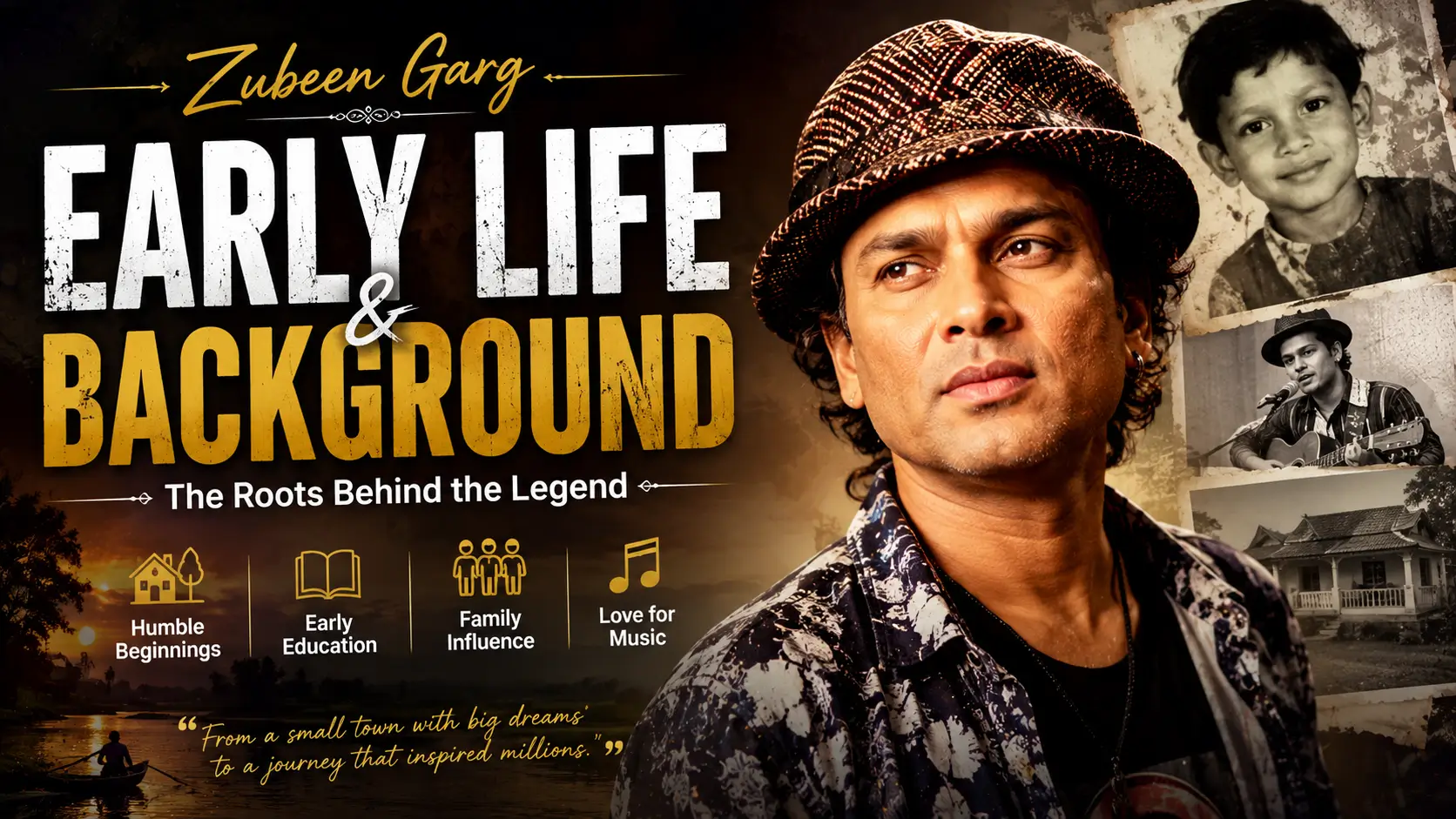
Zubeen Garg came into this world on November 18, 1972, in Tura, Meghalaya — a town nestled in the hills of Northeast India. But while Tura was his birthplace, his soul was always in Assam. His family had roots in Janji, Sivasagar, one of Assam's historically and culturally rich districts. His father, Mohini Mohon Borthakur, was a government magistrate who frequently relocated for work, but he was also a deeply gifted poet and lyricist who wrote under the pen name Kapil Thakur. His mother, Ily Borthakur, was a talented singer who loved dance and theater. In that household, art was not a pastime — it was oxygen.
Young Zubeen was named after the legendary Austrian-Indian conductor Zubin Mehta — a clue to the kind of ambition and artistic destiny his parents envisioned for him. His surname "Garg" came from his family's gotra (ancestral lineage), which he formally adopted later in his career. In early records and credits, he appears variously as Zubin Garg, Jubin Garg, or Zubeen Borthakur — a reflection of transliteration quirks in Assamese to English.
Childhood: Music as a First Language
Zubeen did not learn music in a classroom. He absorbed it. By the time he was three years old, he was already singing. Music was not something he picked up — it was already inside him. Growing up in a household full of literary and musical activity, he was surrounded by songs, poetry, and performance from birth.
As his father moved around Assam for work, the family settled primarily in Jorhat, a city in Upper Assam known for its rich tea culture and educational institutions. It was here that Zubeen spent much of his formative years, and it was here that his artistic personality took shape.
He was remembered as a naturally expressive, emotionally sensitive child with an instinct for melody. By the time he was 13, he had already composed his first original song — Gaane Ki Aane — which would later appear on his debut album. That kind of compositional maturity at such a young age was extraordinary, and it hinted at the career that was to come.
A Life Touched by Loss and Resilience
Childhood was not without its sorrows. The family faced difficulties, and Zubeen grew up learning to channel emotion through music. Those early experiences of love, loss, and longing would later become the emotional bedrock of his songwriting — one reason his songs resonated so deeply with so many people.
Education
Zubeen completed his early schooling in Jorhat and later in Guwahati, Assam's largest city. He was known as an unconventional student — deeply intelligent and curious, but drawn more powerfully to music than to textbooks.
He enrolled at Guwahati University for his undergraduate studies, but did not complete his degree. Music called too loudly. Rather than continuing his formal education, he decided to pursue his passion professionally. It was a gamble that paid off spectacularly — but it was not made without uncertainty or struggle.
A defining moment in his early development came when he won a gold medal at a western music competition — a turning point that gave him the confidence to commit fully to a professional career in music. His real "university" was the music itself: years of listening, playing, composing, and performing that turned a naturally gifted boy into a technically formidable artist.
By the time his debut album was released, he had already taught himself to play 12 instruments, including the dhol, dotara, tabla, guitar, harmonium, keyboard, mandolin, drums, and various percussion instruments. That multi-instrumental mastery would become one of his most distinctive qualities.
Career Journey
The Early Albums and Assamese Pop Revival
Zubeen Garg entered professional music in 1992 at just 19 years old, with the release of his debut Assamese album Anamika. It was a revelation — a young voice that blended folk warmth with modern pop sensibility, singing of love and longing in a way that felt fresh and timeless at once.
The album sold well in Assam and set the stage for a rapid succession of releases. Albums like Xapunor Xur ("Melody of Dreams"), Maya, Asha, Pakhi, and Ujan Piriti followed in quick succession. His Bihu album Ujan Piriti became a particular sensation, breathing new life into Assam's traditional Bihu music and introducing it to younger audiences who had grown up with Hindi pop.
At a time when Assamese pop was still finding its footing in the modern era, Zubeen's arrival was transformative. He modernized the sound without diluting its roots, and that balance — folk soul with contemporary production — became his signature.
Move to Mumbai and Bollywood Debut
In 1995, Zubeen made the bold move to Mumbai, India's entertainment capital. It was a city of fierce competition, where regional artists often struggled to break through. Zubeen came prepared. He released an Indipop album called Chandni Raat and secured his first Bollywood placement — a song in the 1995 Hindi film Gaddaar.
The Mumbai years were not always glamorous. Like most artists navigating India's vast and competitive music industry, there were periods of struggle, rejection, and doubt. But Zubeen was not one to be discouraged. He continued working in Bengali cinema, contributed to regional film scores, and built a reputation as a reliable, gifted vocalist willing to work across genres and languages.
His voice — rich, warm, emotionally intelligent, with a distinctive humming style that became his calling card — began to attract attention from some of India's top music directors.
Ya Ali: The Breakthrough that Shook India
In 2006, everything changed.
Music director Pritam Chakraborty chose Zubeen to sing "Ya Ali" for the Bollywood film Gangster, starring Emraan Hashmi and Kangana Ranaut. The song — a soulful, haunting plea built around Zubeen's signature emotional register — became an instant national sensation. It played on every radio station, in every cinema, at every college festival. It turned Zubeen Garg from a celebrated regional star into a nationally recognized name overnight.
"Ya Ali" earned Zubeen the Best Playback Singer Award at the Global India Film Awards (GIFA) — one of the most prestigious honors in Bollywood. The song's success opened doors to more Bollywood collaborations, but Zubeen made a deliberate and principled decision: he would not abandon his roots in pursuit of Mumbai's limelight.
He returned to Guwahati and Assamese music, choosing to invest his national fame back into the culture that made him. It was a choice that earned him enormous respect — not just from fans, but from the cultural and intellectual community of Assam.
Return to Roots and Assamese Cinema
Back in Assam, Zubeen's career entered its most prolific and arguably most important phase. He began contributing to Assamese cinema in multiple capacities — as a singer, composer, actor, and eventually director and producer.
He acted in over 27 films, many of them becoming landmarks in Assamese cinema. He composed memorable film scores that blended folk instrumentation with orchestral and electronic elements. His work helped elevate the production quality and cultural ambition of Assamese filmmaking.
His film Mission China (as a music director and actor) became the first Assamese film to cross ₹7 crore in gross collections — a milestone for the regional film industry.
Directing and Producing Films
Never content to remain within any single creative lane, Zubeen made his directorial debut with Kanchanjangha (2019), a bold social drama widely interpreted as a commentary on the APSC recruitment scam — one of Assam's most significant political controversies. The film demonstrated his willingness to use his artistic platform to speak truth to power, a quality that had always characterized his public presence.
Discography & Filmography

Selected Albums
| Album | Language | Year | Notes |
|---|---|---|---|
| Anamika | Assamese | 1992 | Debut album |
| Xapunor Xur | Assamese | 1993 | Early fan favorite |
| Maya | Assamese | 1994 | Established his regional star status |
| Ujan Piriti | Assamese | Mid-1990s | Hit Bihu album |
| Chandni Raat | Hindi (Indipop) | 1995 | Mumbai debut |
| Asha | Assamese | Late 1990s | Continued commercial success |
| Pakhi | Assamese | Early 2000s | Fan beloved album |
Selected Bollywood Songs
| Song | Film | Year | Music Director |
|---|---|---|---|
| Ya Ali | Gangster | 2006 | Pritam Chakraborty |
| Various tracks | Gaddaar | 1995 | — |
| Multiple contributions | Various Hindi films | 2000s–2020s | Multiple |
Selected Assamese Film Work (as Singer/Composer/Actor)
| Film | Role | Year |
|---|---|---|
| Mission China | Singer/Actor | 2017 |
| Kanchanjangha | Director/Producer | 2019 |
| Roi Roi Binale | (Final film project) | 2025 |
| Various Assamese films | Singer/Composer | 1993–2025 |
Music in Other Languages
Zubeen sang in at least 17 languages, including Bodo, Nepali, Bengali, Tamil, Telugu, Kannada, Odia, Malayalam, Marathi, Khasi, Karbi, Tiwa, Missing, Mising, Goalpariya, Sanskrit, Sindhi, and English — a record of linguistic range extraordinary even by Indian standards.
Social Media Presence
Zubeen Garg understood the power of digital platforms and maintained an active presence across social media, where his posts regularly attracted millions of interactions. He used these platforms not just for promotional purposes but to share his thoughts on social and political issues, connect with fans, and broadcast his philanthropic work.
| Platform | Handle/Page | Approximate Following |
|---|---|---|
| Zubeen Garg (official page) | Several million followers | |
| @zubeengarg (approximate) | Hundreds of thousands | |
| YouTube | Various official/fan channels | Millions of cumulative views |
His social media presence amplified his voice during the Anti-CAA protests in Assam (2019–2020), where he was one of the most prominent non-political figures to publicly speak out. His posts on these issues went viral and sparked significant national conversation.
Physical Appearance & Personal Style
Zubeen Garg stood at approximately 5'8" (172–177 cm) and maintained a healthy, active physique throughout his career. His dark brown eyes and black hair were among his most recognized physical features, but what truly defined his appearance was the warmth and expressiveness in his face — a countenance that seemed incapable of pretense.
On stage, he was magnetic. Whether performing in front of thousands at a Bihu concert or at an intimate cultural gathering, his physical energy was entirely devoted to the music. He moved with natural ease, a performer comfortable in his own skin.
His fashion sense was unpretentious. He favored traditional Assamese attire — particularly during Bihu season — as well as simple, well-fitting casual wear. He was never about designer labels or fashion statements. His identity was in his voice, not his wardrobe.
He had no publicly known tattoos and cultivated an image of dignified accessibility — a star who felt like a neighbor.
Net Worth & Financial Life
Estimated Net Worth
Zubeen Garg's net worth at the time of his passing in 2025 was estimated by multiple media sources at between $6–8 million (approximately ₹50–70 crore). Some sources place this figure more conservatively at ₹40–50 crore, while others suggest higher valuations. Given the private nature of his finances, all figures should be treated as credible estimates rather than confirmed figures.
Income Sources
| Source | Description |
|---|---|
| Playback Singing | Bollywood and regional film contributions |
| Independent Albums | Decades of Assamese, Bengali, Hindi albums |
| Live Concerts & Tours | Major earner; Bihu concerts commanded significant fees |
| Film Composition | Composed scores for numerous Assamese and regional films |
| Acting | Over 27 film roles |
| Film Production & Direction | Including Mission China and Kanchanjangha |
| Brand Endorsements | Select endorsements in Northeast India |
| Theatre Projects | Regular theatre performances in Assam |
Assets & Lifestyle
- Guwahati Home: A prominent residence in Guwahati that served as a cultural hub; during the COVID-19 pandemic, he converted a two-storey building he owned into a care center for the community.
- Mumbai Studio: Maintained a flat in Andheri East, Mumbai, which housed his professional music studio "Sound and Silence."
- Car Collection: Reports indicate he owned a Range Rover Velar, BMW X5, and Mercedes-Benz, along with premium motorcycles.
- Lifestyle: Despite his wealth, Zubeen was known for a relatively grounded lifestyle by celebrity standards. His spending priorities were family, philanthropy, and music.
Family and Relationships
Parents
Zubeen's father, Mohini Mohon Borthakur, was a government magistrate who served across Assam and also wrote poetry and song lyrics under the pen name Kapil Thakur. A man of letters and public service, he was a quiet but profound influence on Zubeen's artistic development.
His mother, Ily Borthakur, was a singer, dancer, and actress — the person Zubeen often called his first guru and his first audience. Her death was one of the great sorrows of his life, and many of his most emotionally resonant songs carry traces of that grief.
Siblings
Zubeen had two sisters:
- Jonkie Borthakur — who tragically passed away in 2002, a loss that deeply affected Zubeen.
- Dr. Palme Borthakur — an academic who remained close to her brother throughout his life.
Marriage to Garima Saikia Garg
On February 4, 2002, Zubeen married Garima Saikia Garg, a fashion designer from Golaghat, Assam. Garima was not simply Zubeen's partner in life — she was also deeply involved in his professional world, co-running initiatives and projects with him. The couple was widely admired for their partnership, both personal and professional.
Together, they also ran philanthropic efforts including the Kalaguru Artiste Foundation, which supported artists and social causes across Assam.
Children
No biological children were publicly confirmed. Reports indicate that Zubeen and Garima reportedly adopted and supported several underprivileged children, including a daughter named Kajoli Garg, and contributed to the upbringing and education of approximately 15 children in need. This reflected his larger philosophy: that care and compassion extended beyond bloodlines.
Controversies
Zubeen Garg's career was not without controversy, though much of what stirred public debate was rooted in his willingness to speak his mind on matters of social and political importance.
Anti-CAA Stance and Political Activism
During the 2019–2020 Anti-CAA (Citizenship Amendment Act) protests in Assam, Zubeen was one of the most visible non-political voices to oppose the legislation. His public statements, social media posts, and participation in protests generated significant national attention and divided public opinion — with ardent supporters praising his civic courage and critics challenging his positions.
Some segments of the political right labeled him anti-national, while the protest movement embraced him as a cultural ally. Throughout this period, Zubeen remained firm in his views while maintaining his characteristic composure and respect for dialogue.
Public Statements on Assamese Identity
Over the years, Zubeen made several outspoken public statements on issues of Assamese identity, immigration, and cultural preservation — topics that are deeply sensitive and politically charged in the Northeast. These statements occasionally drew criticism or sparked heated debate. Supporters viewed them as the voice of a culturally responsible artist; critics sometimes characterized them differently.
In all cases, the controversies surrounding Zubeen were ones of conviction — the natural friction that comes when a deeply principled artist speaks into a complex political landscape. He was never accused of personal misconduct, financial impropriety, or ethical violation.
Achievements & Awards
Awards and Honors
| Award | Category | Year | Presented By |
|---|---|---|---|
| National Film Award (Best Music Direction – Non-Feature) | Echoes of Silence | 2009 (55th National Film Awards) | Government of India |
| Global India Film Award (GIFA) | Best Playback Singer – "Ya Ali" | 2007 | GIFA |
| Filmfare Award East | Best Playback Singer | Multiple years | Filmfare |
| Sangeet Natak Akademi Award | Music | Received | Government of India |
| State Film Awards | Multiple categories | Multiple years | Government of Assam |
| Honorary D.Litt. | Doctorate of Letters | August 27, 2024 | University of Science & Technology, Meghalaya |
Records and Milestones
- Recorded over 32,000 songs across 17+ languages — a figure for which he planned to approach Guinness World Records.
- First Assamese artist to achieve mainstream national recognition in Bollywood through playback singing.
- Played 12 musical instruments professionally.
- A 20-foot statue was unveiled in his honor in Digboi, Assam in 2022 — rare recognition for a living artist.
- Mission China, for which he provided music, became the highest-grossing Assamese film at the time of its release.
Philanthropy & Humanitarian Work
Zubeen Garg's legacy extends far beyond his recordings. He was, by any measure, one of the most actively philanthropic entertainers in Indian regional culture.
- Kalaguru Artiste Foundation — co-founded with his wife Garima, this organization provided financial and creative support to struggling artists across Assam and Northeast India.
- COVID-19 Care Center — during the devastating second wave of COVID-19 in May 2021, Zubeen and Garima converted their two-storey Guwahati building into a care and support facility for affected families.
- Flood Relief Performances — Assam is regularly affected by devastating Brahmaputra floods. Zubeen performed at numerous charity concerts over the years to raise funds for flood victims.
- Support for underprivileged children — reportedly contributed to the education and welfare of approximately 15 children outside his immediate family.
Interesting Facts About Zubeen Garg
- His name was inspired by the legendary conductor Zubin Mehta, one of the world's most celebrated orchestral conductors.
- He began singing at age three and composed his first original song at thirteen.
- He was a university dropout who became one of India's most celebrated musicians — a reminder that passion and talent often outpace credentials.
- Despite his Bollywood success, he chose to return to Assam rather than build a Mumbai-based career. He once said his heart belonged to his mother tongue and his people.
- His humming style — the soft, melodic interludes in his songs — became so distinctive that it was considered one of the finest in the world by music enthusiasts and critics.
- He sang in Khasi (a language of Meghalaya, where he was born), creating a rare personal connection between his birthplace and his art.
- Zubeen was passionate about scuba diving — the very hobby that, tragically, claimed his life in Singapore in September 2025.
- He was deeply involved in theatre, with the Guwahati theatre scene remaining part of his creative life even at the height of his music career.
- He was awarded an Honorary Doctorate (D.Litt.) by the University of Science & Technology, Meghalaya, in August 2024 — just over a year before his death.
- He won a gold medal at a western music competition during his student years — the event that convinced him to pursue professional music.
Career & Life Timeline
| Year | Event |
|---|---|
| 1972 | Born on November 18 in Tura, Meghalaya |
| 1985 | Composes first song, Gaane Ki Aane, at age 13 |
| Early 1990s | Wins gold medal at western music competition in Guwahati |
| 1992 | Releases debut album Anamika; enters professional music at age 19 |
| 1993–1995 | Releases multiple successful Assamese albums; builds Northeast fanbase |
| 1995 | Moves to Mumbai; releases Indipop album Chandni Raat; first Bollywood song in Gaddaar |
| Late 1990s | Continues between Assam and Mumbai; grows reputation in Bengali and Assamese cinema |
| 2002 | Marries Garima Saikia on February 4; sister Jonkie passes away |
| 2006 | Sings "Ya Ali" for Gangster; becomes a national name overnight |
| 2007 | Wins Best Playback Singer at Global India Film Awards (GIFA) |
| 2009 | Wins National Film Award for Best Music Direction (Non-Feature) for Echoes of Silence |
| 2010s | Returns focus to Assamese music and cinema; records prolifically |
| 2017 | Mission China becomes highest-grossing Assamese film |
| 2019 | Directorial debut with Kanchanjangha; prominent figure in Anti-CAA protests |
| 2021 | Converts Guwahati building into COVID-19 care center during second wave |
| 2022 | Announces 32,000-song milestone; 20-foot statue unveiled in Digboi |
| August 2024 | Receives Honorary D.Litt. from University of Science & Technology, Meghalaya |
| September 2025 | Passes away on September 19 in a scuba diving accident in Singapore |
Popular Quotes
"My heart belongs to Assam. Whatever I am, I am because of this soil, this river, these people."
"Music is not a career. It is a calling. You don't choose it — it chooses you."
"I would rather be the biggest name in Assam than a forgotten face in Mumbai."
"A song must be honest. The moment you start calculating, the music dies."
Public Image & Legacy
The Voice of a People
Zubeen Garg was not merely a popular artist — he was a cultural institution. In Assam, his voice was inseparable from the festivals, the sorrows, the romances, and the political awakenings of multiple generations. Children grew up humming his Bihu songs. Couples slow-danced to his melodies. Students marched to protests with his anthems in the air.
His title, Luit Kontho (Voice of the Brahmaputra), was not a marketing tag — it was earned through decades of musical devotion and cultural engagement. The Brahmaputra River is the lifeblood of Assam, a river of great beauty and destructive power, deep and unpredictable and essential. To be called its voice was the highest honor the people of Assam could offer.
A Bridge Between Regional and National
One of Zubeen's most significant achievements was demonstrating — definitively and repeatedly — that regional music did not need to compromise its identity to reach national audiences. "Ya Ali" proved that a singer rooted in Assamese folk could move mainstream India. His subsequent choice to return to regional music rather than chase Bollywood further proved that artistic integrity was not incompatible with commercial success.
This legacy inspired a generation of Northeast Indian artists to pursue national ambitions without abandoning their cultural identities.
Humanitarian Artist
Zubeen's legacy also includes his substantial humanitarian work. In a culture where celebrity philanthropy is often performative, his was practical and sustained: flood relief, COVID care centers, support for underprivileged children, foundations for struggling artists. He put his resources and his reputation where his values were.
Cultural Ambassador
Through international performances and festivals — including the North East India Festival in Singapore where he spent his final days — Zubeen carried Assamese culture to global stages. He was, in the truest sense, an ambassador of his people.
Passing and Tributes
On September 19, 2025, the music world received news that shook the entire Northeast of India: Zubeen Garg had passed away in Singapore at the age of 52. He had traveled there to perform at the North East India Festival and died in a scuba diving accident — a tragedy as sudden as it was cruel.
The response was extraordinary. The Government of Assam declared mourning. Schools and businesses closed. Chief Minister Himanta Biswa Sarma led tributes. Prime Minister Narendra Modi expressed condolences. Musicians from across India paid homage. Fans gathered at temples, at concert venues, at the banks of the Brahmaputra.
Social media filled with memories, tears, and the songs he had left behind — 32,000 of them, spanning 17 languages, echoing from the mountains of Meghalaya to the deltas of the Bay of Bengal. His final film project, Roi Roi Binale, stood as a testament to the creative fire that had never left him.
He was survived by his wife, Garima Saikia Garg, his father, his sister Dr. Palme Borthakur, and the millions of people whose lives he had touched with his voice.
Frequently Asked Questions (FAQs)
Who is Zubeen Garg?
Zubeen Garg (born Zubeen Borthakur, November 18, 1972) was an Indian singer, composer, actor, lyricist, film director, and philanthropist. Known as Luit Kontho (Voice of the Brahmaputra), he was one of the most beloved and culturally significant artists from Assam and Northeast India.
What is Zubeen Garg famous for?
He is most widely known for the Bollywood hit "Ya Ali" from the 2006 film Gangster, and for revolutionizing Assamese popular music. He won a National Film Award and sang in over 17 languages.
When was Zubeen Garg born?
November 18, 1972.
Where was Zubeen Garg born?
He was born in Tura, Meghalaya, India, though his family roots and upbringing were in Assam.
When did Zubeen Garg die?
He passed away on September 19, 2025, in Singapore, at the age of 52.
How did Zubeen Garg die?
He died in a scuba diving accident in Singapore, where he had traveled to perform at the North East India Festival.
What is Zubeen Garg's net worth?
His net worth was estimated at approximately $6–8 million (₹50–70 crore) at the time of his passing.
Was Zubeen Garg married?
Yes. He married Garima Saikia Garg, a fashion designer from Golaghat, Assam, on February 4, 2002.
Did Zubeen Garg have children?
He had no publicly confirmed biological children. He reportedly supported and partially raised several underprivileged children, including an adopted daughter named Kajoli Garg.
What does "Luit Kontho" mean?
Luit Kontho translates from Assamese as "Voice of the Brahmaputra" — a title given to Zubeen Garg by his fans and cultural community to honor his deep musical connection to Assam.
What is Zubeen Garg's most famous song?
"Ya Ali" from the Bollywood film Gangster (2006) brought him national fame. Among Assamese songs, Ujan Piriti and Mayabini Ratir Bukut remain deeply beloved.
What awards did Zubeen Garg win?
He won the National Film Award for Best Music Direction (Non-Feature) at the 55th National Film Awards (2009), the Global India Film Award (GIFA) for Best Playback Singer (2007), multiple Filmfare East Awards, the Sangeet Natak Akademi Award, and an Honorary D.Litt. (2024).
How many songs did Zubeen Garg record?
He announced in 2022 that he had recorded over 32,000 songs, a milestone he intended to submit to Guinness World Records.
How many instruments did Zubeen Garg play?
He played 12 musical instruments, including dhol, dotara, tabla, guitar, harmonium, keyboard, mandolin, drums, and various percussion instruments.
In how many languages did Zubeen Garg sing?
He sang in over 17 languages, including Assamese, Hindi, Bengali, Bodo, Nepali, Khasi, Karbi, Tiwa, Tamil, Telugu, Kannada, Odia, Malayalam, Marathi, Sanskrit, Sindhi, and English.
What was Zubeen Garg's directorial debut?
His directorial debut was the film Kanchanjangha (2019), a social drama commenting on the APSC recruitment scam in Assam.
Was Zubeen Garg involved in the Anti-CAA protests?
Yes. He was the most prominent non-political figure in Assam's Anti-CAA protest movement in 2019–2020, using his platform to advocate strongly against the Citizenship Amendment Act.
Where did Zubeen Garg grow up?
He grew up primarily in Jorhat, Assam, where his father worked as a government magistrate.
What was Zubeen Garg's real name?
His birth name was Zubeen Borthakur. He adopted the surname "Garg" from his family's gotra (ancestral lineage) in the 1990s.
Who named Zubeen Garg?
He was named after the legendary conductor Zubin Mehta by his parents, who were deeply steeped in artistic culture.
What was Zubeen Garg's height?
Approximately 5'8" (172–177 cm).
Did Zubeen Garg win a National Award?
Yes — the National Film Award for Best Music Direction in the Non-Feature Film category at the 55th National Film Awards (2009), for Echoes of Silence.
What was Zubeen Garg's charity work?
He co-founded the Kalaguru Artiste Foundation, performed at flood relief concerts, converted a building into a COVID-19 care center in 2021, and supported approximately 15 underprivileged children.
What was Zubeen Garg's last film?
His final film project was Roi Roi Binale, which was in production near the time of his passing.
This biography was compiled using verified public sources including Wikipedia, IMDb, Deccan Herald, national press reports, and cultural archives. All net worth figures are estimates based on available media reporting and should not be treated as confirmed financial data.